
Monumento a Júlio de Castilhos
Monumento a Júlio de Castilhos is a monument located in the center of Praça Marechal Deodoro in the historic center of Porto Alegre, Brazil. It was inaugurated on January 25, 1913. The monument honors Júlio de Castilhos, who served as president of Rio Grande do Sul and is considered the “Patriarch of Rio Grande do Sul.”
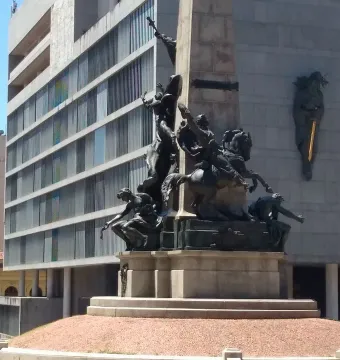
January 2018 © Ajmcbarreto · CC BY-SA 4.0
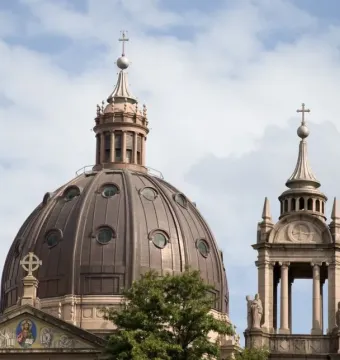
March 2008 © Eneas De Troya · CC BY 2.0
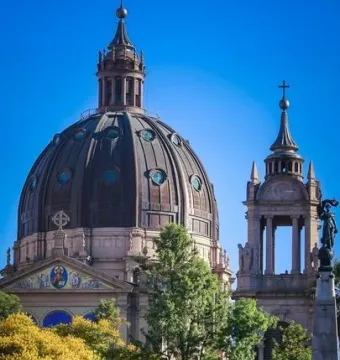
November 2018 © Joel Vargas / PMPA · Attribution
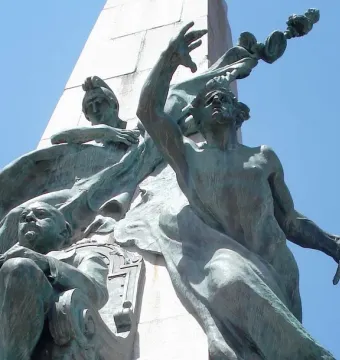
2008 © Tetraktys · CC BY-SA 3.0
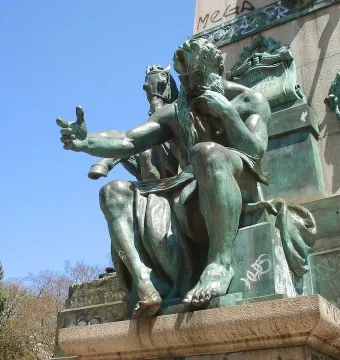
2007 © User:Tetraktys · CC BY-SA 3.0
Identification | |
| Title | Monumento a Júlio de Castilhos |
| Type | Monument; sculpture |
Historical context | |
| Honoree's role | President of Rio Grande do Sul |
| Purpose | Commemorates Júlio de Castilhos |
| Commissioned after | The death of Júlio de Castilhos on 24 October 1903 |
| Inauguration date | 25 January 1913 |
Creator | |
| Original project author | Décio Villares (painter and sculptor) |
Discovery and provenance | |
| Construction start date | 27 July 1910 |
| Construction supervision | Affonso Hebert supervised the work |
| Stonework execution | Jacob Aloys Friedrichs was responsible for the stonework |
History and restoration | |
| Construction work | Ground leveling and laying of the foundations |
| Construction difficulties | The works suffered several delays and alterations; at one point the scaffolding collapsed, destroying what had already been built and forcing the work to restart |
Iconography and meaning | |
| East face subject | Júlio de Castilhos in his final phase, after leaving power |
| Prudence symbol | A dragon crawling along the ground of the homeland |
| Dragon symbolism | The dragon also recalls the threat of a return of the old monarchical order and symbolizes the House of Braganza, to which Emperor Dom Pedro II belonged |
| Constancy figure | An athletic warrior in armor, in an upright and unwavering attitude |
| Constancy attributes | A lion skin draped over his back |
| Constancy classical reference | An allusion to Hercules and to spiritual mastery over crude and disordered passions |
| Constancy object held | Three keys of unclear meaning, possibly representing the executive, legislative, and judiciary powers |
| Civism figure | An airy figure embracing the Brazilian national flag |
| Named figures referenced in inscriptions | Tiradentes and José Bonifácio |
| East face depiction | Shown as an old man with a long beard but still physically vigorous, in the rhetorical attitude of a classical sage |
| East face interpretation | Intended to show that age did not break the vigor of his spirit or dissipate the wisdom gained through experience |
| South face subject | A young gaucho on horseback |
| South face symbolism | Represents the youthful energy of the people of Rio Grande do Sul, hope for the future, and the indispensable support of the popular masses for successful reform, progress, and improvement |
| Historical references in inscriptions | The proclamation of the Republic and the French Revolution are inscribed in the monument |
| Courage figure | An inspired figure with laurel wreaths of victory in one hand and the other free to urge action; its eyes are partially blindfolded |
| Inscription associated with Tiradentes | "Libertas quae sera tamen" |
| Inscription associated with José Bonifácio | "A sã política é filha da moral e da razão" ("Sound politics is the daughter of morality and reason") |
| Political values emphasized | Freedom, peace, and fraternity |
| Prudence figure | A figure that restrains Courage and points out the dangers and difficulties of applying the abstract idea in practice |
| North face depiction | He is enthroned in a high chair, apparently meditating after reading a book but ready to act |
| Auxiliary virtue figures | His qualities are personified in auxiliary figures |
| Figure at the top | The Republic |
| Subject | Júlio de Castilhos |
| Overall theme | An idealized, positivist allegory of Júlio de Castilhos's political career and principles |
| Stylistic approach | Idealized; idealistic, even mystical |
| Characterization of Castilhos | Wise, virtuous, energetic, and an enlightened organizer |
| Symbolic phases represented | The propaganda phase of republicanism; the phase of organizing the positivist government in the state; and the phase after his withdrawal from government |
| Conceptual character | Described as a public altar and a "positivist handbook" in sculptural form |
| Attributes of the Republic figure | A flame of the new social order in one hand and the codex of the new law in the other |
| Sphere decoration | Stars representing the Brazilian states and the motto "Order and Progress" |
| West face subject | Republican Propaganda |
| West face figure | A young man leaning forward and offering copies of the newspaper A Federação |
| North face subject | Júlio de Castilhos as an exemplary statesman |
| Motto | "Know in order to provide" ("Saber para prover") |
| Associated philosophy | Auguste Comte's philosophy |
Significance | |
| Historical significance | The proclamation of the Republic is presented as a fundamental factor in the political emancipation of Rio Grande do Sul; the French Revolution is described as inspiring a global civilizing impulse |
| Honoree's significance | Considered the "Patriarch of Rio Grande do Sul" |
| Public support theme | Enthusiastic popular support for the republican cause is treated as an essential element of the monument's message |
Physical characteristics | |
| Central element | A central obelisk topped by the figure of the Republic standing on a sphere |
| Structure | Groups of statues arranged around a pyramidal core |
| Height | 22.5 meters |
Location and ownership | |
| Location | Center of Plaza Mariscal Deodoro, in the historic center of Porto Alegre, Brazil |