
Three Standing Figures
Three Standing Figures is a large stone sculpture by Henry Moore, created between 1947 and 1948. It was first exhibited at the London County Council’s inaugural open-air sculpture exhibition in Battersea Park in 1948, where Moore’s work also featured in the event’s publicity. The sculpture was originally intended for a commission from the Museum of Modern Art in New York, but the MoMA chose another Moore work instead. Purchased by the Contemporary Art Society and then given to the London County Council, it was permanently installed in Battersea Park in 1950. The sculpture was carved from Darley Dale sandstone and became a Grade II listed building in 1988.
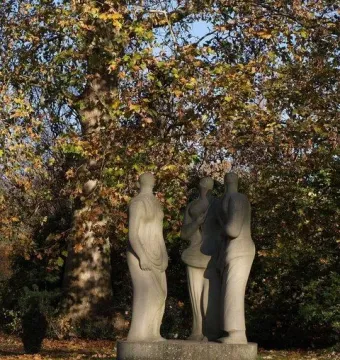
November 2007 © Derek Harper · CC BY-SA 2.0
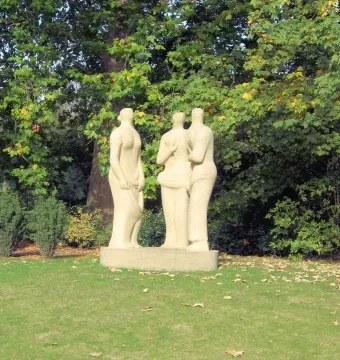
October 2009 © Jim Linwood · CC BY 2.0
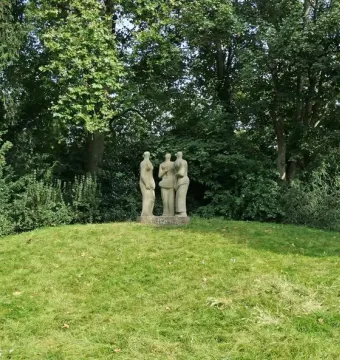
September 2021 © amandabhslater · CC BY-SA 2.0
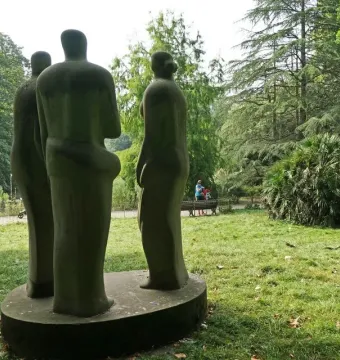
September 2021 © amandabhslater · CC BY-SA 2.0
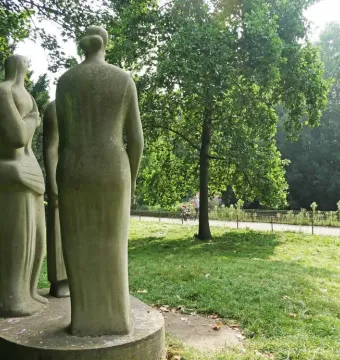
September 2021 © amandabhslater · CC BY-SA 2.0
Identification | |
| Title | Three Standing Figures |
| Original title | Trois Figures Debout |
| Catalogue number | LH 268 |
| Type | Stone sculpture |
Historical context | |
| Date made | 1947–1948 |
| Original commission | Originally intended to fulfill a commission from the Museum of Modern Art, New York |
| Inspiration | Drawings inspired by Moore's observations of people in underground bomb shelters during the Second World War |
Creator | |
| Artist | Henry Moore |
Discovery and provenance | |
| Model | Terracotta model made c. 1945; current location unknown |
| Plaster copies | Two known copies: one at the Henry Moore Foundation and one on long-term loan to Tate Gallery |
| Bronze edition | Cast in bronze in an edition of four plus one artist's copy, 1948–1949 |
| Later artist's copy | A new personal copy was made in 1985 |
| Other examples | Examples are held at the Smith College Museum of Art in Massachusetts and in the Peggy Guggenheim Collection in Venice |
Materials | |
| Material | Darley Dale sandstone |
| Material | Terracotta |
Physical characteristics | |
| Composition | Two figures stand closer together and are observed by the third |
| Pose | Standing |
| Subject | Three standing women |
| Number of figures | 3 |
Appearance | |
| Clothing | Flowing, draped garments |
| Facial features | Rudimentary facial features, including eye holes |
Iconography and meaning | |
| Interpretation | David Sylvester interpreted the sculpture in The Burlington Magazine in 1948 as a family group: a protective mother, a stern father, and a child standing beside them; Sylvester noted this was an unusual interpretation |
| Artist comment | In 1968, Moore said it is as though the three women are standing there, expecting something to happen from the sky |
Location and ownership | |
| Ownership history | Lent for the 1948 exhibition, then bought by the Contemporary Art Society and donated to the London County Council |
| Date installed | 1950 |
| Current location | Permanently sited in Battersea Park, Battersea, London |
| Exhibition display | Placed prominently at the top of a slight rise in the ground, with trees behind it |
| Publicity use | Used on the exhibition's advertising poster |
| Exhibition role | Moore was a member of the selection committee for the outdoor exhibition |
| Exhibited at | London County Council's first Open-Air Sculpture Exhibition at Battersea Park in 1948 |
History and restoration | |
| Listed status | Grade II listed monument |
| Date listed | 1988 |
Significance | |
| Notable status | One of the last sculptures Moore made from English stone |
| Recognition | Moore's reputation grew dramatically from 1948, when he was selected as Britain's greatest living artist for the 24th Venice Biennale and won the sculpture prize |
Other | |
| Popular culture appearance | Appears in the Mr. Bean episode 'Mr. Bean Goes to Town'; Bean tries to take a photo with the sculpture in the background, asks a passerby to take his picture, and the passerby steals his camera |