
William the Silent
William the Silent is a 1928 monument at Rutgers University in New Brunswick, New Jersey. Installed in the Voorhees Mall section of the College Avenue campus along Seminary Place, it stands near several academic buildings, including the School of Graduate Studies in Education, Van Dyke Hall, and Milledoler Hall. The statue depicts William of Orange, one of the early leaders of the Dutch revolt against Habsburg Spain, which led to Dutch independence in 1648. It was donated by Fenton B. Turck to commemorate Rutgers’ Dutch heritage, with the anonymous gift arranged through the New York Dutch Society by Turck and Leonor F. Loree. The sculpture has also been part of student life and has been restored after vandalism.
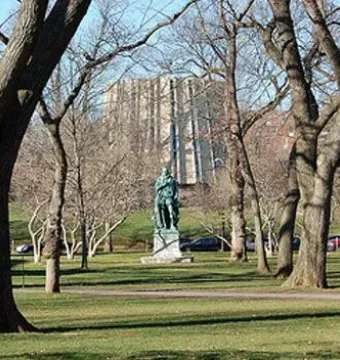
© ColonelHenry · CC BY-SA 3.0
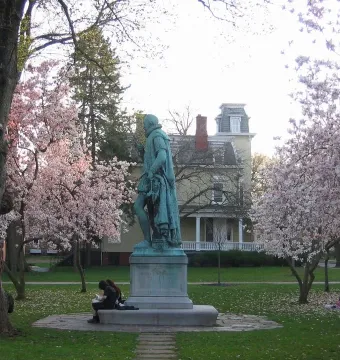
© Rickyrab · CC BY-SA 3.0
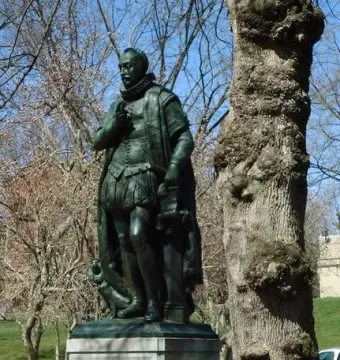
April 2013 © Tomwsulcer · CC0
Identification | |
| Title | William the Silent |
| Alternate names | Willie the Silent; Still Bill; William of Orange; Father of the Fatherland of the Netherlands |
| Type | bronze statue; monument |
| Subject | William I, Prince of Orange (1533–1584), also known as William the Silent |
Iconography and meaning | |
| Student legend | According to campus tradition, the statue is expected to whistle if a virgin passes by |
| Depicted figure | William the Silent, leader of the Dutch Revolt against Habsburg Spain and national hero of the Netherlands |
| Historical significance | Associated with the Dutch Revolt against Habsburg Spain, which led to the Netherlands' independence in 1648 |
Location and ownership | |
| Specific site | Along Seminary Place, between Rutgers University and the New Brunswick Theological Seminary, near the Graduate School of Education, Van Dyke Hall, and Milledoler Hall |
| Institution | Rutgers University |
| Current location | Western end of Voorhees Mall, College Avenue Campus, Rutgers University, New Brunswick, New Jersey, United States |
Historical context | |
| Early campaign | The Holland Society of New York began seeking a prominent monument to celebrate New York's Dutch heritage in 1887 and selected William the Silent in 1892 |
| Year installed | 1928 |
| Donation purpose | To commemorate Rutgers University's Dutch heritage |
| Donation arrangement | An anonymous donation arranged through the Holland Society of New York |
| Advocate for Rutgers donation | Leonor Fresnel Loree, a Rutgers trustee and friend of Fenton B. Turck |
| Site selection for Rutgers | Rutgers College was suggested as a more appropriate site because of the university's Dutch legacy and founding by Dutch Reformed clergymen |
| Delay | World War I delayed the society's plans |
| 1913 investigation | Tunis Bergen visited the Netherlands, asked whether a copy of Royer's Hague statue could be made, and took measurements and photographs |
| Proposed sites | Central Park, New York City; Albany, New York; and other locations along the Hudson Valley |
Creator | |
| Copy made by | Toon Dupuis |
| Replica based on | A similar monument created in 1848 by Dutch sculptor Lodewyk Royer |
Discovery and provenance | |
| Related family connection | Turck was a direct descendant of Dr. Paschasius Turck, who treated William the Silent after the 1581 assassination attempt |
| Storage | Kept in the basement of Turck's laboratory at 428 Lafayette Street, Lower Manhattan, New York City, from 1920 to 1928 |
| Purchase context | Bought during a trip through Europe after World War I |
| Foundry | Fonderie Nationale des Bronzes, Brussels |
| Transfer to Rutgers | With Loree's help, the Holland Society transferred the statue to Rutgers University |
| Purchased by | Dr. Fenton Benedict Turck |
Physical characteristics | |
| Base shape | Square |
| Height | Approximately 15 feet (4.5 m) |
| Base height | Approximately 6 feet (1.8 m) |
| Weight | 2,000 pounds (907 kg) |
Materials | |
| Signature inscription | ROYER - STATUAIRE |
| Base material | Stone |
| Foundry mark language | French |
| Foundry inscription | FONDERIE NATLE DES BRONZES |
| Sculpture material | Bronze |
| Base inscriptions | Incised letters on each of the four sides of the square base |
Technique | |
| Mounting | Mounted on a square base |
Appearance | |
| Clothing and features | 16th-century civilian magistrate's clothing, including a ruffled collar, open ankle-length coat, buttoned vest, and breeches; moustache and beard |
| Additional figure | A small dog sitting at his feet on his right side |
| Left hand | Holding an open scroll |
| Pose | Standing with his right hand raised to his chest and pointing with the index finger |
History and restoration | |
| 2006 vandalism | Vandals allegedly from Princeton painted a large penis and the word 'Princeton' several times on the statue |
| Restoration scope | Restoration of the statue and the four historic gates on Rutgers University's historic Queens Campus |
| Restoration funding | About $150,000 in alumni donations from the Class of 1956 |
| Restoration year | 2006 |
| Dedication date | June 9, 1928 |
| 1947 vandalism | On October 11, 1947, Princeton students painted the statue |
| Vandalism | It has occasionally been vandalized in the Rutgers-Princeton rivalry, often by Princeton students spray-painting it orange before athletic events |
| Student nicknames | Willie the Silent; Still Bill |
| Notable event | Senator Ted Kennedy held a campaign rally in front of the statue on October 11, 1976, attended by about 1,000 students |
| Campus role | Part of student and community life; used for graduation ceremonies until 2007, pep rallies, Dutch-American festivals, protests, anti-war protests, and strike rallies in the 1970s |
| Restoration treatment | Cleaned to remove graffiti and transparent tape residue; conservation work restored the bronze casting and granite base |