
Monument of Leopold II in Ostend
The monument of Leopold II in Ostend is an equestrian statue erected in Belgium in memory of King Leopold II, the second King of the Belgians. It stands on the Royal Galleries by the beach and was inaugurated on 19 July 1931. The king was commemorated here as a benefactor of Ostend and the Belgian Congo. The monument has long been controversial because of Leopold II’s colonial rule over the Congo Free State, under which millions of Congolese people died. It was vandalised in 2004 and again in 2020, reflecting ongoing debate over how Leopold II should be remembered in public space.
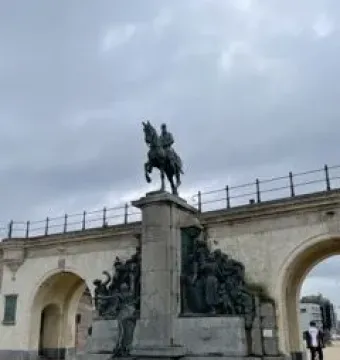
April 2022 © SarahHDI2.2022 · CC BY-SA 4.0
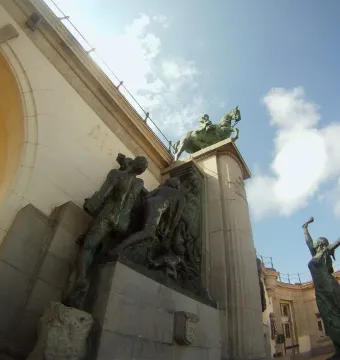
© Roysfoto · CC BY-SA 3.0
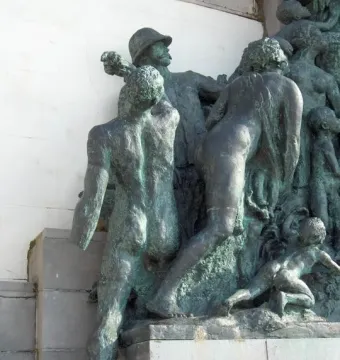
April 2005 © Georges Jansoone · CC BY-SA 3.0
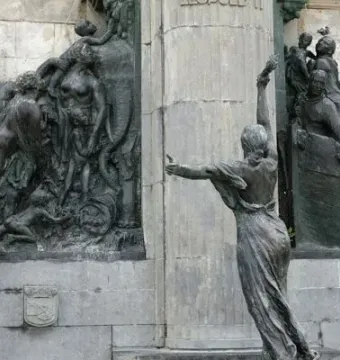
July 2021 © PMRMaeyaert · CC BY-SA 4.0
March 2021 © JoJan · CC BY 4.0
Identification | |
| Title | Monument of Leopold II in Ostend |
| Local name | De Drie Gapers ("The Three Gaps") |
| Type | Equestrian statue monument |
| Subject | Leopold II, second King of the Belgians |
| Original Dutch name | Ruiterstandbeeld van Koning Leopold II |
Historical context | |
| Commemorative purpose | Erected to honour Leopold II as a benefactor of Ostend and the Belgian Congo |
| Colonial context | Associated with Leopold II’s colonial rule over the Congo Free State and the exploitation of Congolese people |
| Controversy | Subject of ongoing controversy because of Leopold II’s role in the Congo Free State and Belgium’s colonial past |
| Commissioning context | Planned after Leopold II’s death in 1909; the city government resumed work on the monument after the First World War, on the proposal of an alderman who wanted to preserve the memory of his benefactor |
Creator | |
| Associated artist | Thomas Vinçotte |
| Sculptor | Alfred Courtens |
| Architect | Antoine Courtens |
Discovery and provenance | |
| Location | Ostend, Belgium |
| Specific location | Promenade du Roi Baudouin, on the seawall facing the North Sea, by the Royal Galleries |
| Inauguration date | 19 July 1931 |
| Unveiling | Unveiled by King Albert I after speeches by the mayor of Ostend and the king |
| Attending dignitaries | Members of the royal family, members of the government, the President of the Chamber, the President of the Court of Cassation, the President of the Court of Appeal, foreign ambassadors, and consuls general |
| Public reception | An enormous crowd was present to acclaim the king |
Physical characteristics | |
| Inscriptions | "Ostende à son génial protecteur LÉOPOLD II" |
| Orientation | Designed so the king can be admired from the dyke; from the opposite side only the rider is visible |
| Material | Bronze |
| Main figure | Leopold II on horseback, wearing a military uniform and looking over the North Sea |
| Structure | A monument divided into four large parts, centered on a vertical column with two horizontal bases |
Appearance | |
| Monogram form | The monument is shaped like a double L monogram, referring to Leopold II’s monogram of two reversed Ls |
Iconography and meaning | |
| Left-side group | The Congolese people thanking Leopold II for having liberated them from Arab slavery; includes a helmeted colonizer, a man seen from behind, two women with broken chains, children picking cocoa, and an elephant trunk alluding to the ivory trade |
| Right-side group | The population of Ostend, especially the fishermen of the region, paying tribute to their king; includes two men, three women, and four children in a fishing boat |
| Front figure | Belgium paying homage to its king, represented by an allegorical figure |
| Meaning | The monument presents Leopold II as a benefactor and recipient of gratitude from Congo, Ostend fishermen, and Belgium |
| Associated group name | Gratitude of the Congolese |
| Alternative section name | The Colonial Work |
History and restoration | |
| Protection status | Declared a protected monument on 22 September 1981 |
| Vandalism | Vandalised several times, including in 2004 and 2020; one later attack covered the equestrian statue in red paint |
| 2004 vandalism | Activists from De Stoete Ostendenoare symbolically cut off a bronze hand from one of the kneeling Congolese figures to denounce abuses under Leopold II’s colonial regime |
| 2020 vandalism | Vandalised again in 2020 during Black Lives Matter protests after the murder of George Floyd |
| Petitions | Petitions were created to remove statues of Leopold II, including this monument |
| Municipal response | On 9 June 2020, Mayor Bart Tommelein said the city council takes the fight against racism seriously but that replacing or removing statues would not happen |
Significance | |
| Public debate | Part of the broader debate over whether Leopold II statues should be removed or kept, in the context of decolonizing public space |