
Children and Frog
Children and Frog is a sculptural fountain group located in Odesa on Theatre Square, near the English Club building. It is one of several replicas of a French sculpture composition by a French sculptor. The Odesa version is also known as Narcissus, while related versions are titled Youth in Dijon and Fairy-Tale Fountain in Germany and Switzerland. The original composition was shown in a Paris art salon in 1904 and quickly became popular. The Odesa replica appeared in 1905–1907 and likely decorated the garden of jeweler Akiym Biska’s villa on French Boulevard. In 1925, it was moved to Theatre Square, where it later stood near the wall of the English Club, then used by the Museum of the Maritime Fleet.
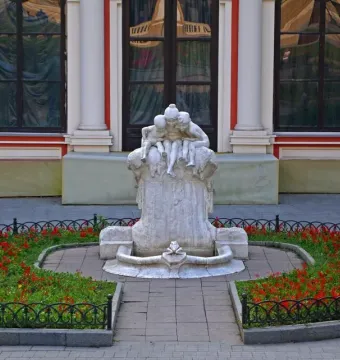
July 2016 © Posterrr · CC BY-SA 4.0
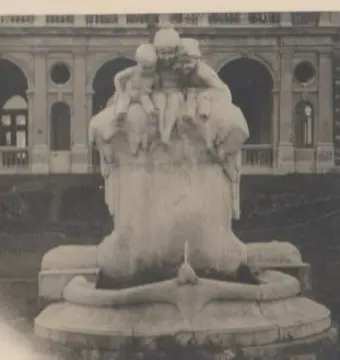
© Unknown authorUnknown author · Public domain
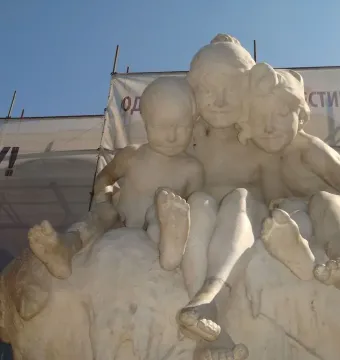
September 2012 © HOBOPOCC · CC BY-SA 3.0
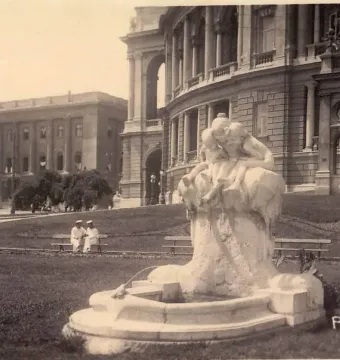
1942 © Unknown authorUnknown author · Public domain
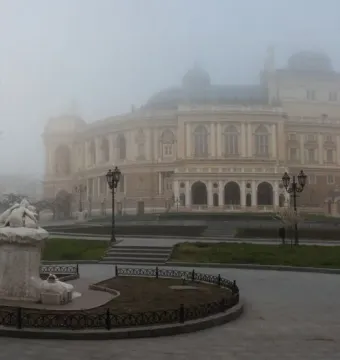
April 2015 © Krasnickaja Katya · CC BY-SA 4.0
Identification | |
| Title | Children and Frog |
| Original title | Youth |
| Other names | Narcissus; Fountain of Youth; Fairy Tale Fountain; "Children and Frog" in Ukrainian: Діти і жабеня; in Russian: Дети и лягушки |
Historical context | |
| Date first presented | 1904 |
| First presented at | Paris Art Salon |
| Replicas made | Several replicas were made to order |
Creator | |
| Artist | Max Blondat |
| Original composition author | A French sculptor not named in the source fragment |
Discovery and provenance | |
| Reception | The work was successful and immediately popular, attracting buyers from several European countries |
| Acquired by | An affluent resident of Odessa |
| Ukrainian version date | Approximately 1905–1907 |
| Possible original location in Odessa | The garden of jeweler Akim Bisk's villa on French Boulevard, 26, Odessa |
| Provenance hypothesis | Odessa local historians Elena Krasnova and Anatoly Drozdovsky suggested this was the sculpture's original location |
| Akim Bisk | Well-known jeweler in Southern Russia and father of poet and translator Alexander Bisk |
| Later fate of estate site | Buildings of Odessa University were later erected there |
| Post-nationalization context | After Soviet power was established, immovable property was nationalized, and Bisk's dacha suffered this fate |
| Production context | The sculptor agreed to produce modified sculptural groups for different buyers, with changes possibly made to suit individual commissions |
Physical characteristics | |
| Subject | Three sitting children and a frog |
| Variation between versions | Versions differ in the number of frogs and in details of the stone carving, while the three seated children are identical in all cases |
| Type | Marble sculptural composition-fountain |
| Composition | A sculptural group of three seated children on a stone base, with frogs added in different installations |
Appearance | |
| Classical version arrangement | Three frogs sit opposite the children at the other end of the fountain and emit three water jets |
| Possible original appearance in Odessa | It is possible that the Odessa fountain originally also had three frogs, which may later have been replaced by a single frog |
Location and ownership | |
| Related installations | Replicas are located in Dijon, Düsseldorf, Zurich, and Denver |
| Current location | Theater Square, Odesa, Ukraine, near the English Club building at 6 Langeronivska Street |
| Location in 1925 | Teatralna Square, Odesa |
| Year installed | 1925 |
| Original placement on the square | In the center of a flowerbed between the City Theatre and the English Club building, closer to the Opera Theater wall |
| Later relocation | In the 1970s, moved closer to the English Club building |
| Soviet-period use of English Club building | It housed the Odessa Museum of the Navy / Museum of the Sea Fleet |
| Denver location | No specific location given in the source fragment |
| Düsseldorf location | An old palace park, described as the first public park in Germany |
| Dijon location | Darcys Square in the city center, surrounded by picturesque flowerbeds |
History and restoration | |
| Vandalism history | Repeatedly vandalized on Theatrical Square |
| Düsseldorf later action | Before the fountain's 80th anniversary, the city moved the marble sculptures to a museum and installed bronze copies in the park |
| Düsseldorf conservation history | Despite a protective fence, vandals repeatedly caused significant damage to the marble figures |
| Repairs after vandalism | City services repeatedly repaired the damage |
| Damage caused by vandals | Children's figures had limbs broken off; the frog was smashed or stolen |
Significance | |
| Reception in Düsseldorf | The fountain has often been drawn by artists and appears in many photographs and postcards from different periods |
Other | |
| Related uses of motif by artist | Max Blondat also used the motif for household objects such as a porcelain inkstand, gilt-bronze ashtray, and wooden figurine |