
Mae West
Mae West is a public artwork on Effnerplatz in Munich-Bogenhausen, named after the actress Mae West. Designed by artist Rita McBride, the 52-meter-tall sculpture is a framework of pipes forming a rotational hyperboloid. The pipes are mostly made of carbon-fiber-reinforced plastic. The work was created as part of the 2006 redevelopment and tunneling of Effnerplatz, in connection with the requirement that public buildings allocate a share of their budget to art. Its form, size, and cost were debated in the city council and among the public. Planned since 2002, construction began in October 2010 and was completed in January 2011. Since December 2011, Munich’s tram has passed through the sculpture.
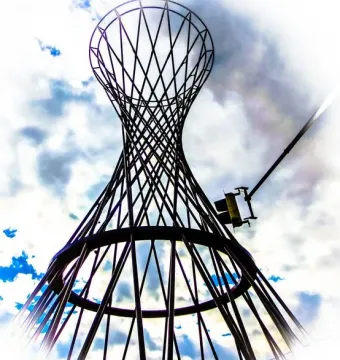
March 2013 © Mummelgrummel · CC BY-SA 3.0
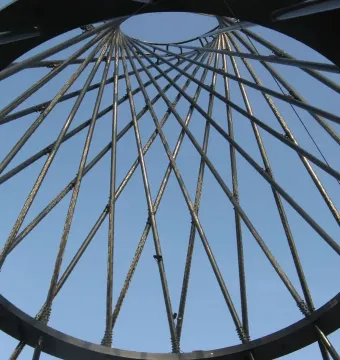
March 2014 © SuPperLot · CC BY-SA 3.0 de
November 2019 © Amrei-Marie · CC BY-SA 4.0
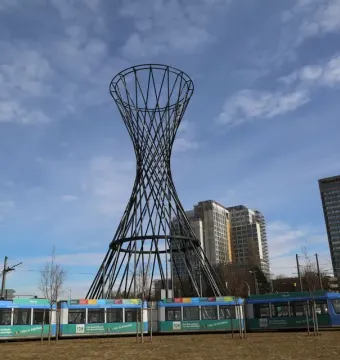
February 2017 © Wikiolo · CC BY-SA 3.0
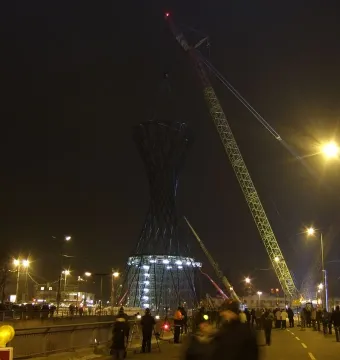
January 2011 © Coupon4 · CC BY 3.0
Identification | |
| Title | Mae West |
| Type | sculpture |
Creator | |
| Artist | Rita McBride |
Historical context | |
| Approval history | local district committee approved the project in June 2004; the development plan became legally binding in March 2008 |
| Planned title | Tower |
| Criticism | Christian Ude compared it to an egg cup and a flower stand; Bernhard Schilling called it a possible plagiarism of the Port Tower in Kobe and the Centre Point Tower in Sydney |
| Controversy | highly controversial in city council and among the public, especially over size and cost |
| City council vote | 40–35 in favor of building the sculpture |
| Support | supporters emphasized the corrosion-resistant material's low maintenance and the role of culture in Munich's economy |
| Competition | 8 artists were invited to develop ideas; McBride's proposal prevailed over designs by Thomas Schütte and Dennis Oppenheim |
| Selected site | Effnerplatz in connection with the Mittlerer Ring East tunnel project |
| Planning date | 2002 |
| Named after | actress Mae West |
| Art context | Kunst am Bau |
| Reason for site selection | planning of the Effnertunnel made the square available for a new art project |
Discovery and provenance | |
| Commissioning and design process | selected in 2002 by the commission for art in architecture and public space for the Effnerplatz site; revised proposal approved in January 2003 and redesigned in July 2003 with the engineering office of Werner Sobek |
Physical characteristics | |
| Parts | lower part about 15 meters high; upper part about 36 meters high |
| Pipe dimensions | 32 pipes, each 40 meters long, 225 to 275 millimeters in outer diameter, and about 15 millimeters thick; each weighs about 550 kilograms |
| Weight | approximately 200 tons |
| Shape | hyperboloid of one sheet |
| Dimensions | lower diameter 32 meters; upper diameter 19.5 meters; waist diameter 7.5 meters |
| Overall form | tower-like plastic sculpture with a slim waist |
| Structure | open framework of straight beams forming a double-curved hyperboloid of revolution |
| Height | 52 meters; originally planned at 60 meters |
Materials | |
| Intermediate ring material | steel |
| Raw materials | carbon fibers and resin |
| Main material | carbon-fiber-reinforced plastic |
| Connecting elements | steel rings and steel connection elements |
| Lower part material | 32 identical carbon-fiber-reinforced plastic pipes with steel tube cores for impact protection |
| Upper part material | 32 identical slightly conical carbon-fiber-reinforced plastic pipes |
Technique | |
| Manufacturing process | pipes were wound from resin-soaked carbon-fiber bundles, cross-wound, cured in an oven, and sealed against UV-related embrittlement |
| Surface treatment | coated with an anti-corrosion agent |
| Heating system | electric heating system to prevent icicles |
Appearance | |
| Visual reference | alludes to Mae West's curvy body shape; the title was also used as a distraction while technical issues were discussed |
Location and ownership | |
| Location | Effnerplatz, Bogenhausen, Munich, Bavaria, Germany |
| Site | middle island of Effnerplatz above the Effnertunnel |
| Nearby transport | Munich tram and city buses stop near the sculpture; the tram line runs through it to St. Emmeram |
| Surroundings | at the junction of the Mittlerer Ring between Isarring and Richard-Strauss-Straße, with Bülowstraße and Effnerstraße on different levels; Arabellapark and its high-rises are nearby |
History and restoration | |
| Assembly responsibility | CGB Carbon Großbauteile GmbH handled manufacturing, construction management, and assembly at Effnerplatz |
| Tram interaction | tracks for the tram line to St. Emmeram were laid through the sculpture in April 2011, and tram service through it began in December 2011 |
| Project leadership | Johann Wittmann |
| Construction period | 21 October 2010 to the night of 30-31 January 2011 |
| Installation method | the upper part was lifted by a 600-ton crane onto the lower part and the two parts were joined by screwing together the steel rings |
| Delayed completion | delayed by temporary frosty temperatures |
| Planned completion | December 2010 |
Significance | |
| Reception | mocked by many Munich residents; often described by the boulevard press as a sex symbol |
| Interpretation | a striking contemporary urban sign and a work whose form stimulates multiple associations |
| Urban function | marks the traffic junction of Effnerplatz as a city landmark |
| Recognition | considered by the Abendzeitung in 2014 to be probably the best-known and most conspicuous example of Kunst am Bau in Munich |