
Senster
Senster is a work of robotic art by Edward Ihnatowicz, commissioned by Philips for display at the Evoluon in Eindhoven, the Netherlands. It was shown there from 1970 to 1974 before being dismantled. Built from welded steel tubing and powered by hydraulic rams, it measures about 8 feet high at the shoulder and 15 feet long, with a three-legged, animal-like form and a long neck. Four microphones and two Doppler radar sensors allowed a computer system to sense sound and movement, making the sculpture react to its surroundings. After years outdoors in Colijnsplaat, the frame was purchased by AGH University of Science and Technology in Krakow, restored in the late 2010s, and reactivated in 2017.
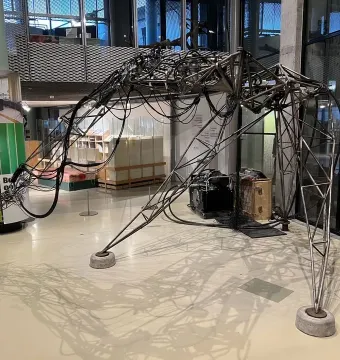
December 2023 © Sandra Fauconnier · CC BY 2.0
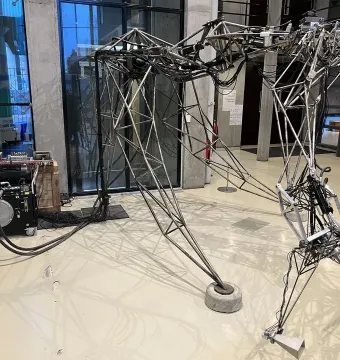
December 2023 © Sandra Fauconnier · CC BY 2.0
Identification | |
| Title | The Senster |
| Type | Robotic sculpture; robotic art |
Creator | |
| Artist | Edward Ihnatowicz |
| Artist activity | Active in Great Britain in the 1960s and 1970s |
| Artist nationality | Polish |
Historical context | |
| Art movement | Cybernetic art |
| Commissioned by | Philips |
| Commissioned for | Evoluon, Eindhoven, the Netherlands |
| Presentation period | 1970 to 1974 |
| Work period | Created over several years |
Discovery and provenance | |
| Post-decommission location | Displayed in the open air outside the firm that originally built it in Colijnsplaat, the Netherlands |
| Current collection | AGH University of Science and Technology |
| Previous owner | Delmeco Group, the Netherlands |
| Purchase date | April 2017 |
| Purchased by | AGH University of Science and Technology in Kraków |
| Fate after display | Dismantled after 1974 |
History and restoration | |
| Restoration | Restored in the late 2010s |
| Reactivation | Reactivated after lengthy restoration as part of the 100th inauguration of the Academic Year |
| Restoration status | The Faculty of Humanities of AGH University of Science and Technology was working on restoration |
Physical characteristics | |
| Form | Massive steel construction resembling an animal; stands on three legs with a long giraffe-like neck |
| Height | About 8 feet (2.5 m) at the shoulder |
| Length | About 15 feet (4 m) |
Materials | |
| Material | Welded steel tubing |
Technique | |
| Actuation | Hydraulic rams |
| Sensors | Four microphones and two Doppler radar sensors mounted on the head |
| Control system | Philips P9201 computer system, a clone of the more common Honeywell 416 |
| Programming language | Assembly language |
| Interaction control | A program loaded into the computer regulated the order of interaction |
Appearance | |
| Behavior | Reacted to sounds and movements of viewers; attracted to quiet sounds and slow movements, and repelled by loud sounds and abrupt or violent movements |
| Perceived effect | The acoustics of the Evoluon hall and the unpredictable behavior of visitors made its movements appear much more complex than its programming would suggest |
Iconography and meaning | |
| Sensor function | Sensed the sound and movement of nearby people |
Significance | |
| Historical significance | Considered the first robotic sculpture controlled by a digital computer |
| Artistic significance | First computer-controlled sculpture in the world |
| Cultural recognition | Listed in the Digital Canon of the Netherlands (1960-2000) |
| Description | One of the most valuable works of new media art |
| Critical assessment | Edward Ihnatowicz is placed among the leading artists whose work demonstrated the possibility of dialogue between traditional art and the sciences |
Location and ownership | |
| Original exhibition venue | Evoluon, Eindhoven, the Netherlands |
| Venue type | Exhibition space and science and technology museum |
| Recent exhibition | Shown during the 2023-2024 digital art retrospective exhibition REBOOT at Nieuwe Instituut in Rotterdam |