
Statue of Peace
The Statue of Peace was a bronze monument in Union Square in Berlin’s Moabit district, within Mitte. It was created to commemorate the “comfort women” — girls and women forced into prostitution in Japanese military brothels during World War II — and also serves as a broader symbol against sexual violence against girls and women. Initiated by the Action Group Comfort Women of the Korea Verband, the statue was unveiled on September 28, 2020. Designed by South Korean artist couple Kim Eun-sung and Kim Seo-kyung, it was the first statue of its kind installed in a public space in Germany. The monument was removed on October 17, 2025, pending a proposed relocation to Unionstrasse 8.
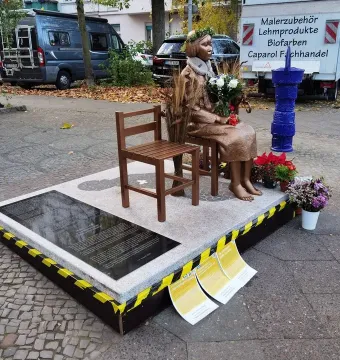
2020 · CC BY-SA 4.0
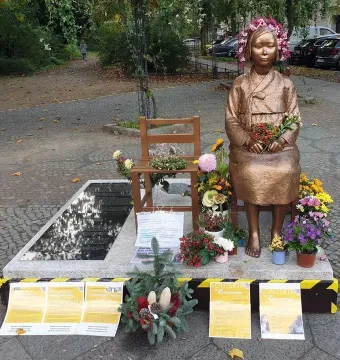
October 2020 © OTFW · CC BY-SA 3.0
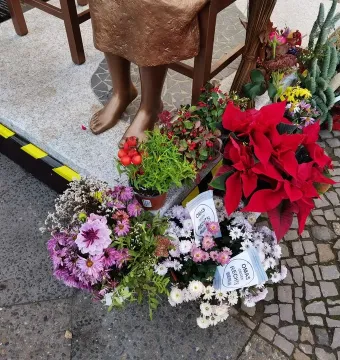
2020 · CC BY-SA 4.0
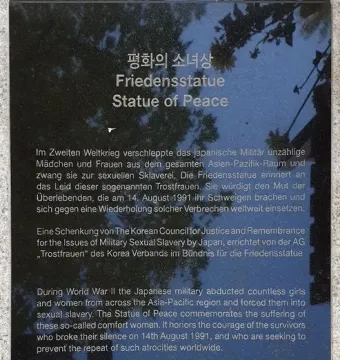
October 2020 © OTFW · CC BY-SA 3.0
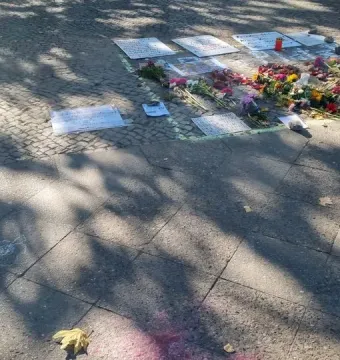
October 2025 © C.Suthorn · CC BY-SA 4.0
Identification | |
| Title | Statue of Peace |
| Subject | "Comfort women"—girls and women forced into prostitution by the Japanese military during World War II |
| Alternative name | Peace Statue; Friedensstatue |
| Type | Memorial statue; peace statue |
Historical context | |
| Associated date | 14 August 1991 |
| Officially registered victims in South Korea | 240 victims |
| Historical context | World War II and wartime sexual violence |
| Broader social context | After Kim Hak-sun's testimony, about 250 affected women from the Asia-Pacific region followed her example and campaigned for apologies and compensation |
| Associated event | Kim Hak-sun publicly testified about the human rights abuses suffered by former comfort women |
| Estimated number of victims | Disputed; estimates range from about 20,000 to 200,000 |
| Associated person | Kim Hak-sun |
| Compensation reference | In 2015, 34 of the then 47 living former comfort women accepted compensation payments from Japan |
Creator | |
| Artists' nationality | South Korean |
| Artists | Kim Eun-sung and Kim Seo-kyung |
Discovery and provenance | |
| Approved by | Mitte District Office |
| Initiated by | The Action Group Comfort Women of Korea Verband |
Physical characteristics | |
| Figure | Bronze figure of a young girl seated on a chair |
| Clothing | Traditional Korean attire (hanbok) |
| Additional object | A second, empty chair stands beside the girl |
| Base elements | Two black explanatory plaques are inset into the sides of the base |
| Mosaic | A floor mosaic shows the girl's shadow as the silhouette of an old woman with a white butterfly inside it |
Materials | |
| Material | Bronze |
Appearance | |
| Depicted age | Young girl |
| Pose | Seated on a chair |
| Attire | Hanbok |
Iconography and meaning | |
| Symbolic figure | A comfort woman figure |
| Purpose | To commemorate the suffering of former comfort women and denounce sexual violence against girls and women |
| Intended symbolism of clothing and age | They are meant to reflect the victims' situation at the time of their abduction |
| Symbolic meaning | A general symbol against sexual violence against girls and women |
Location and ownership | |
| Original location | Union Square (Unionplatz), Moabit, Mitte district, Berlin, Germany |
| Planned relocation site | Unionstrasse 8, about 100 metres from the former location |
| Temporary home | ZK/U in Berlin-Moabit |
History and restoration | |
| Permit history | The permit was revoked on 8 October 2020, the removal order was temporarily halted by the Berlin Administrative Court, the installation was extended several times, and further extensions were rejected in October 2025 |
| Temporary home date | 22 January 2026 |
| Removal deadline | 14 October 2020 |
| Temporary home duration | One year |
| Current status after removal | In storage |
| Removed by | The Mitte District Office via a contractor |
| Removed on | 17 October 2025 |
| Unveiled on | 28 September 2020 |
Significance | |
| Notable claim | First statue of its kind installed in a public space in Germany |
| Reception | It provoked debates on cultures of remembrance at local, state, and diplomatic levels |
| Related controversies | The German district office said the statue promotes hatred and is not compatible with reconciliation; critics described the memorial politics as symbolic, politically motivated, and one-sided |
| Political support | Alliance 90/The Greens Berlin-Mitte supported retaining the statue |
| District assembly position | In December 2020, the Berlin-Mitte district assembly voted for permanent retention |
| Japanese government response | Japanese officials, including Katsunobu Kato and Toshimitsu Motegi, intervened against the statue's installation |
| Comparable interventions elsewhere | Similar Japanese interventions had already occurred in Freiburg, San Francisco, and Nagoya |
| 2019 censorship event | A 2019 exhibition in Nagoya featuring a similar peace statue was abruptly closed |
| First similar statue | A similar statue was erected in front of the Japanese Embassy in Seoul in 2011 |
| Other related memorials | Similar memorials exist in Tateyama (Chiba), Japan; the United States; Canada; Australia; Hong Kong; the Philippines; Freiburg; Wiesent near Regensburg; Frankfurt; and the University of Kassel |
| University of Kassel installation | Another peace statue was installed in the campus garden of the University of Kassel from 8 July 2022 to March 2023 |