
Battle of Britain Monument
The Battle of Britain Monument is a sculpture on the Victoria Embankment in London, overlooking the River Thames. It commemorates the individuals who took part in the Battle of Britain during the Second World War. Unveiled on 18 September 2005, the 65th anniversary of the battle, it was presented by Prince Charles and Camilla, Duchess of Cornwall, in the presence of surviving airmen known as “The Few.” Designed by Paul Day, the monument combines a panelled granite structure with bronze relief sculpture and plaques listing 2,937 pilots and aircrew from 14 countries on the Allied side. The cast was made by Morris Singer.
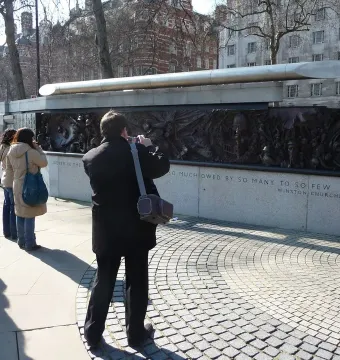
March 2010 © Lewis Clarke · CC BY-SA 2.0
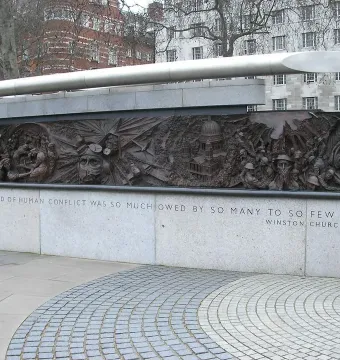
March 2011 © Gzen92 · CC BY-SA 4.0
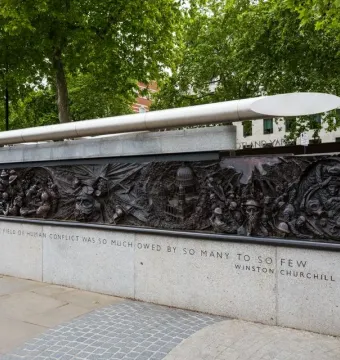
May 2026 © Martin Pettitt · CC BY 4.0
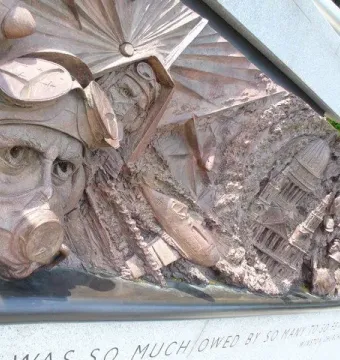
June 2007 © Colin Smith · CC BY-SA 2.0
© Rhys Park · CC BY-SA 3.0
Identification | |
| Title | Battle of Britain Monument |
| Original name | Monumento alla battaglia d'Inghilterra |
| Type | memorial sculpture / monument |
Historical context | |
| Battle of Britain dates | 10 July – 31 October 1940 |
| Purpose | Memorial to the people who took part in the Battle of Britain during World War II |
| Dedicated to | those known as 'The Few' and those who supported them |
Creator | |
| Conceived by | Bill Bond, founder of the Battle of Britain Historical Society |
| Architects | Donald Insall Associates |
| Sculptor | Paul Day |
Discovery and provenance | |
| Funding source | mostly private donations; financial support was also provided by the Czech government |
| Design process | Paul Day researched books, films, and veterans' interviews and spent three months immersed in the atmosphere of the battle and wartime |
| Committee patrons | Winston Churchill, Len Deighton, William Hague, Vera Lynn, and others not named in the fragment |
| Sponsors | University of Edinburgh, Daily Mail, Eurotunnel, Rolls-Royce, Vauxhall Motors, Jaguar, Imperial Tobacco, and others not named in the fragment |
| Budget | £1.74 million |
| Funds raised by public donations | £1,650,000 |
| Fundraising amount raised by appeal | over £250,000 |
| Fundraising chairman | Lord Tebbit |
| Fundraising committee | formed by Bill Bond to raise funds, select the sculptor, and coordinate the project |
| Site negotiated by | Bill Bond, who was solely responsible for negotiating with the City of Westminster to secure the site |
Physical characteristics | |
| Form | 25-metre-long granite panel structure split into two parts with a walkway between them |
| Dimensions | 25 metres long, 2 metres high, 2 metres wide |
| Walkway | a diagonal, slightly sloping walkway cuts across the center of the structure |
Materials | |
| Foundry note | described as the oldest art foundry in the world; it has cast many notable sculptures and statues in London and worldwide, including the lions and fountains of Trafalgar Square |
| Materials | granite cladding, bronze panels, bronze plaques, granite cobblestone paving |
| Foundry | Morris Singer |
Technique | |
| Relief technique | bronze high-relief panels |
Appearance | |
| Additional imagery | the emblem of the Royal Air Force |
| Date panel | 10 July – 31 October 1940 |
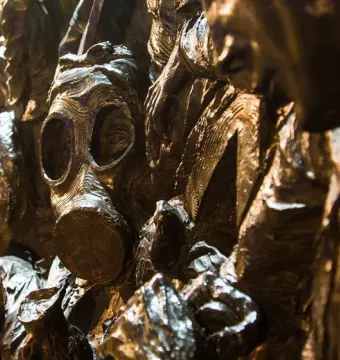
| Civilian frieze | Kent hop pickers watching the fight in the sky; anti-aircraft gunners passing shells; women working in a factory; a Royal Air Force pilot chasing a Luftwaffe pilot; St Paul's Cathedral in smoke after the Blitz; searches for survivors among ruins; and a family pouring tea in an Anderson shelter |
| Quotations | Churchill quotation commemorating the battle |
| Separate panel | brief description of the events of the Battle of Britain |
| Name panels | bronze plaques encircling the memorial with the names of 2,936 British and Allied airmen from 14 countries, grouped by place of origin and bearing squadron insignia and aircraft silhouettes |
| Military frieze | fighter pilots resting after combat; members watching an air battle; mechanics and riggers loading aircraft with ammunition; a pilot focused on the battle as his aircraft escapes pursuit; and young pilots with more experienced comrades telling their stories |
| Central donor plaque | a plaque in the center of the paved circle listing the four largest donors |
| Central sculptural group | life-sized figures of pilots running to their aircraft during the battle, projecting toward the viewer |
| Main decorative elements | bronze panels with raised reliefs on the inner-facing walls of the two parts of the monument, placed at eye level for passersby |
| Battle scenes | scenes from the Battle of Britain, including military and civilian episodes |
Iconography and meaning | |
| Depicted subject | the Battle of Britain, showing that it was fought in the air and on the ground and commemorating the spirit and sacrifices of The Few and those who supported them |
Location and ownership | |
| Location | Victoria Embankment, central London, England, overlooking the River Thames, near Westminster Bridge, Big Ben, and the Palace of Westminster |
| Site allocated by | Westminster |
| Listed in | The Imperial War Museum's register |
History and restoration | |
| Unveiled by | Charles, Prince of Wales, and Camilla, Duchess of Cornwall |
| Ceremonies before unveiling | a veterans' dinner with the Duke of Edinburgh, a memorial service, and wreath-laying at Westminster Abbey |
| Commemorative service history | first held in 1943 at St Paul's Cathedral and since then held at Westminster Abbey |
| Associated ceremony | Royal Air Force Battle of Britain Sunday thanksgiving and rededication service |
| Unveiling attendance | many surviving airmen known as 'The Few', plus UK Secretary of State for Defence John Reid and about 700 people in total including 70 surviving pilots |
| Bronze parts weight | about 2 tons |
| Unveiled for | the 65th anniversary of the Battle of Britain |
| Unveiled on | 18 September 2005 |
| Bronze parts installed | August 2005 |
| Preparation work | part of the original structure was dismantled and cut to the project design at a plant in Cornwall |
| Construction start | February 2005 |
| Original structure | a structure originally designed as a smoke outlet for steam-powered London Underground trains |
Significance | |
| Historical significance | the failure to conquer Britain ultimately cost Germany the war |
| Aircrew losses | of the 2,936 pilots and crew members in Fighter Command who took part in the Battle of Britain, 544 were killed and another 795 did not live to see final victory in 1945 |
| Foreign participants | one sixth came from outside the United Kingdom |