
Bernardo de Gálvez
Bernardo de Gálvez is a monument by sculptor Juan de Ávalos dedicated to Bernardo de Gálvez and installed in the center of Washington, D.C., the capital of the United States. The sculpture commemorates Gálvez’s key role in the American War of Independence. A member of an aristocratic Spanish family, he served in the military from the age of 16 and later became governor of Louisiana. During the war, he supported the American revolutionaries with supplies and military action against the British, helping to secure victories at Fort Bute, Baton Rouge, Natchez, and Pensacola. He was later made a count and posthumously honored as an honorary citizen of the United States.
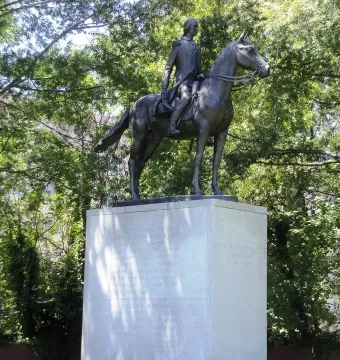
June 2013 © Farragutful · CC BY-SA 3.0
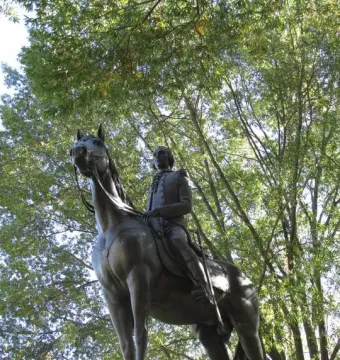
October 2014 © G0T0 · CC0
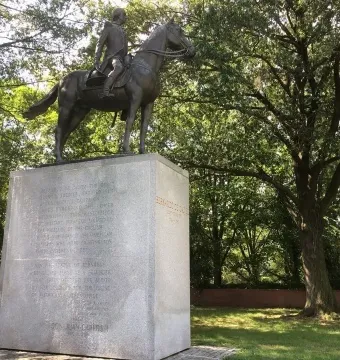
© NPS Photo · Public domain
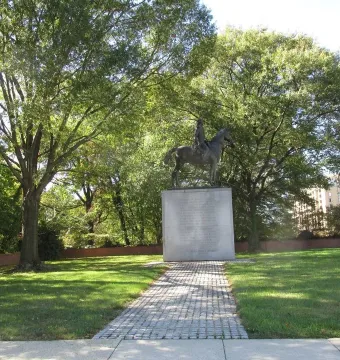
October 2014 © G0T0 · CC0
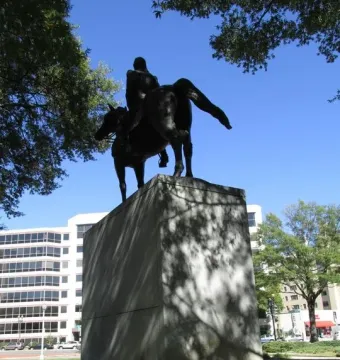
October 2014 © G0T0 · CC0
Identification | |
| Title | Monument to Bernardo de Gálvez |
| Alternative title | Bernardo de Gálvez |
| Type | Outdoor equestrian bronze statue monument |
| Series | Statues of the Liberators |
| Number in series | One of five statues |
Historical context | |
| Dedication date | June 3, 1976 |
| Gift occasion | The U.S. Bicentennial, the 200th anniversary of American independence |
| Historical context | Installed 200 years after the American Revolution and the American Revolutionary War (1776–1783) |
Creator | |
| Pedestal designer | Not named in the provided fragment |
| Sculptor location | Madrid, Spain |
| Sculptor | Juan de Ávalos |
Discovery and provenance | |
| Donor | King Juan Carlos I of Spain |
| Recipient | the people and government of the United States |
| Place cast | Spain |
| Original intended location | federal land in Washington, D.C. |
| U.S. approval | Approved by the U.S. Department of the Interior, the U.S. Commission of Fine Arts, the National Capital Planning Commission, and President Gerald Ford; Senate Resolution No. 94-287 was adopted on May 21, 1976, following Senate Memorandum No. 3031 introduced by Senator Joseph Montoya on February 25, 1976 |
| Arrival in the United States | Arrived with an oval pedestal |
Physical characteristics | |
| Dimensions | Statue: 12 by 13 by 6 feet; pedestal: 15 by 13 by 6 feet |
| Materials | Bronze statue on a gray granite pedestal |
| Form | Equestrian statue |
Appearance | |
| Clothing | Military uniform with a long jacket with epaulettes, a shirt with a lace collar, and knee-high boots |
| Objects held | Left hand holds the horse’s reins; right hand holds a tricorn hat |
| Sword location | Hung on the left side of the saddle |
| Hair | Hair tied in a bun |
| Inscriptions | Front inscription in Spanish: "BERNARDO DE GALVES (COUNT OF GALVES) 1746–1786"; right-side inscription in Spanish: excerpted speech by His Majesty Don Juan Carlos I, King of Spain, delivered at this place on June 3, 1976 |
| Inscription language | Spanish |
| Depicted pose | Gálvez is shown mounted on a calmly standing horse, with both rider and horse facing left |
Location and ownership | |
| Visibility | Considered one of the least known landmarks in Washington, D.C. |
| Current location | Center of Gálvez Park, Foggy Bottom, Washington, D.C., United States |
| Setting | Located among large trees and shrubs, reached by a cobblestone path from the sidewalk |
| Nearby landmarks | Near the headquarters of the Organization of American States; near the U.S. Department of State; east of the John F. Kennedy Center for the Performing Arts; near Farragut West station |
History and restoration | |
| Unveiling ceremony | Formal ceremony attended by the Spanish honor guard and American officials |
| Temporary base | Initially installed on railroad ties after the planned oval pedestal was rejected |
| Permanent pedestal | Later placed on a permanent pedestal designed by an architect and executed by Roubin and Janeiro and North Carolina Granite Corporation |
| Condition assessment | In 1993, Save Outdoor Sculpture! rated the monument's condition as good |
Significance | |
| Dedication remarks | At the dedication, Gerald Ford said Spain and America could proudly remember Bernardo de Gálvez and that Washington would soon receive the statue as a generous Bicentennial gift; Juan Carlos I described Gálvez as a great Spanish soldier who helped George Washington's army and said the statue should remind people of Spain's contribution to American independence |