
Apotheosis of Democracy
Apotheosis of Democracy is a public artwork by American sculptor Paul Wayland Bartlett that decorates the east portico pediment of the House of Representatives chamber at the U.S. Capitol in Washington. The original pediment was commissioned in 1857 but never completed because of a lack of funding. A new competition was held in 1908, and Bartlett won it. The figures were modeled in Paris and Washington between 1911 and 1914, then carved by the Piccirilli Brothers from 1914 to 1916. Installed on Georgia marble, the composition centers on an allegorical figure of peace, surrounded by symbols of agriculture, industry, and the oceans.
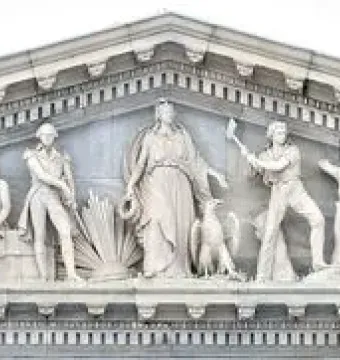
December 2011 © USCapitol · Public domain
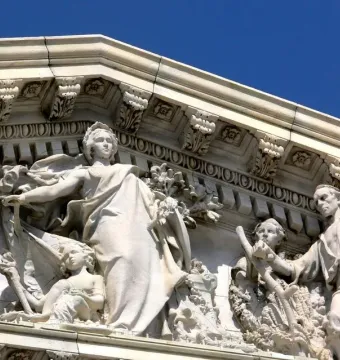
May 2007 © Photo: Andreas Praefcke · CC BY 3.0
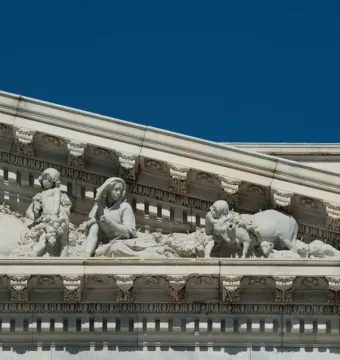
April 2014 © USCapitol · Public domain
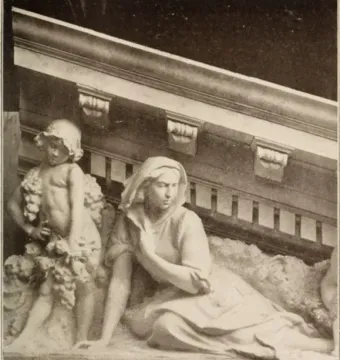
1912 © Internet Archive Book Images · No restrictions
Identification | |
| Title | Apotheosis of Democracy |
| Study type | Study |
| Type | Pediment sculpture |
| Study title | Apotheosis of Democracy |
Creator | |
| Artist nationality | American |
| Study artist | Bartlett |
| Artist | Paul Wayland Bartlett |
| Carvers | Piccirilli Brothers |
Historical context | |
| Original commission | Commissioned from Erastus Dow Palmer in 1857 for the east pediment of the House of Representatives portico at the U.S. Capitol |
| Competition for later work | Held in 1908; Bartlett won |
| Original commission status | Never completed because of lack of funding |
History and restoration | |
| Study condition in 1995 | Needed urgent treatment |
| Plaster maquettes donation | Donated to the U.S. Government in March 1963 by Bartlett's stepdaughter, Armistead Peter III |
| Condition in 1993 | Well maintained |
| Opening date | 2 August 1916 |
| Carving period | 1914–1916 |
| Modeling location | Paris and Washington, D.C. |
| Modeling period | 1911–1914 |
| Contract date | February 1909 |
Discovery and provenance | |
| Survey program | Smithsonian's Save Outdoor Sculpture! program |
| Study purchase year | 1959 |
| Survey date | 1993 |
Physical characteristics | |
| Material | Georgia marble |
| Study base | Wooden base |
| Study dimensions | 54 x 54.5 x 18 |
| Study material | Bronze |
Appearance | |
| Background element | Olive tree beside Peace |
| Corner decoration | Waves |
| Right-side figures | Industry, an engraver, an ironworker, a founder, a factory girl, and a fisherman |
| Left-side figures | Agriculture, a reaper with his assistant, a farmer with his bull, putti carrying grapes, and a mother with her child playing with a ram |
| Supporting figure | Genius, leaning against Peace and holding a torch |
| Central figure | Allegorical figure of Peace, armored |
Iconography and meaning | |
| Corner wave meaning | Represent the Atlantic and Pacific oceans |
| Study subjects | Peace and Genius |
| Torch symbol | Immortality |
Location and ownership | |
| Study collection in 1995 | Westmoreland Museum of American Art |
| Current display location of maquettes | Capitol underground hallway leading to the Rayburn House Office Building |
Other | |
| Related bibliography | Allen, William C., History of the United States Capitol: A Chronicle of Design, Construction, and Politics (Architect of the Capitol, 2001) |
| Related bibliography | Somma, Thomas P., Paul Wayland Bartlett and The Apotheosis of democracy, 1908–1916: the pediment for the House wing of the United States Capitol (University of Delaware Press, 1995) |
| Related bibliography | Wood, James M., Washington Sculpture (Johns Hopkins Press, 2008) |