
Marc Anton Group, Vienna
The Marc Anton Monument, also known as the Marc Anton Group, is a large bronze sculpture from 1899/1900 located on Friedrichstraße next to the Vienna Secession building in Vienna, Austria. It was created by Secession artist Arthur Strasser for the Paris World Exhibition of 1900 and later installed beside the Secession building. The work depicts the Roman general and politician Marcus Antonius in a triumphal chariot drawn by lions. In popular usage, it is sometimes called the “lion fiaker.”
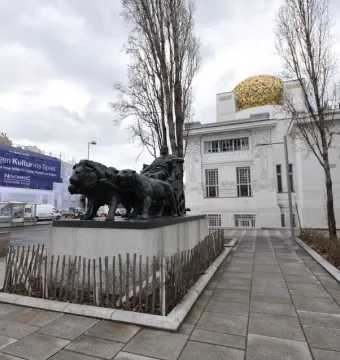
March 2009 © Jorge Láscar · CC BY 2.0
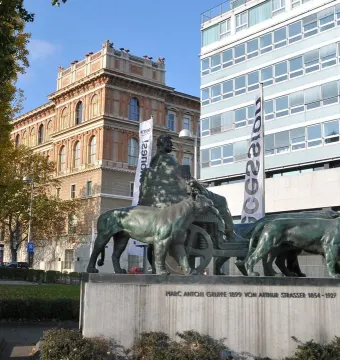
November 2012 © böhringer friedrich · CC BY-SA 3.0 at
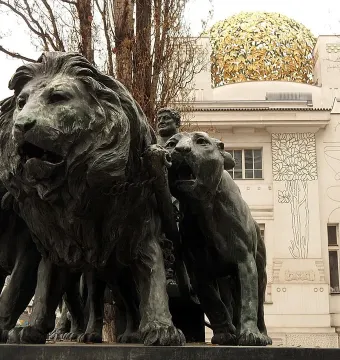
March 2017 © Matthias Nonnenmacher · CC BY-SA 4.0
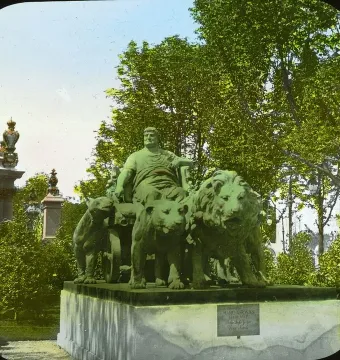
© Photographer Joseph Hawkes, sculptor Arthur Strasser · Public domain
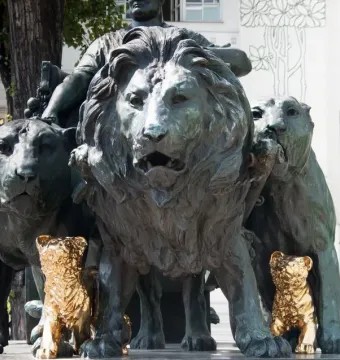
August 2013 © Herge21 · CC BY-SA 3.0
Identification | |
| Title | Marc-Anton-Monument |
| Alternative title | Marc Anton Gruppe, Vienna; Marc Anton im Triumphwagen (Marc Anton in the triumphal chariot); Marc-Anton-Gruppe |
Historical context | |
| Date of creation | 1899–1900 |
| Purpose | Made for the 1900 Paris Exposition Universelle |
Creator | |
| Artist | Arthur Strasser |
| Artist affiliation | Vienna Secession; Munich Secession; Wiener Künstlerhaus (1886–91 and 1907–27) |
| Commissioned by | Austrian Ministry of Education |
Discovery and provenance | |
| Buyer of preliminary model | Ministry of Education |
| Foundry | k.u.k. Kunst-Erzgießerei Wien (Imperial and Royal Art Foundry, Vienna), Gusshausstraße, Vienna |
| Enlarged model | In 1898, an identical plaster model at 5/3 life size was made for the bronze cast; it matched the dimensions of the present monument |
| Award | Reichel Prize |
| Exhibition of preliminary model | Shown in Berlin and at the Wiener Künstlerhaus exhibition in 1896 |
| Preliminary model | In 1896, Strasser made a small green-patinated plaster model titled Marc Antonius Triumwirator, just under 50 cm high |
Physical characteristics | |
| Type | Large bronze monument/sculpture group |
| Weight | Approximately 4 tonnes |
Materials | |
| Material | Bronze |
| Surface treatment | Originally patinated and partly gilded |
Technique | |
| Casting | Bronze cast |
Appearance | |
| Animal figures | A chariot team of three lions: one male lion in the center, flanked by two lionesses; a guided lioness stands to the right of the chariot with closed eyes |
| Style | Secession style |
| Figure characterization | Marcus Antonius is depicted as massive, corpulent, and languid |
| Reliefs | Six bas-reliefs on the rear wall showing scenes from the life of Marcus Antonius |
| Pose | Seated comfortably and reclined in a triumphal chariot |
| Chariot | Very detailed triumphal chariot with a semicircular rear wall |
| Attribute | Command baton/staff |
| Costume | Tunic with a toga draped over it |
| Depicted subject | Marcus Antonius (Mark Antony), the Roman general, politician, and statesman |
Iconography and meaning | |
| Theme | Decadence |
| Art historical interpretation | Seen as making the Fin de Siècle tangible; compared with the atmosphere in Arthur Schnitzler's Lieutenant Gustl |
Location and ownership | |
| Current location | In front of the Vienna Secession building, Friedrichstraße, Vienna, Austria |
| Current status | The provisional installation became permanent and the sculpture remains there today |
| Intended installation site | Babenbergerstraße, in front of the Kunsthistorisches Museum, Vienna |
| Actual first installation | Provisional installation in the garden area next to the Secession building from 20 December 1900 to 5 March 1901 |
History and restoration | |
| War damage | Damaged by shrapnel during the bombing of Vienna on 7 February 1945 |
| Reconstruction | Restored in 1956 |
| Restoration and relocation | Demounted and restored in 2005 during the redesign of Karlsplatz, the reconstruction of the Karlsplatz U-Bahn station, and the construction of a depot for the Secession |
| Restoration cost | Around 100,000 euros |
| Post-restoration pedestal | Placed on a higher pedestal to discourage people from climbing on the monument and sitting on the lions |