
Satyre et bacchante
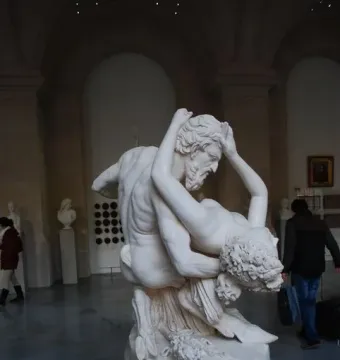
Satyre et bacchante, also known as Satyre lutinant une nymphe, is a marble sculptural group by James Pradier made between 1830 and 1834. When it was shown at the Salon of 1834, the work caused a scandal because of its realism and sensuality. The marble group has been kept in Paris since 1980, in the collections of the French sculpture department of the Louvre. The plaster model made in 1830 is preserved at the Museum of Fine Arts of Lille.
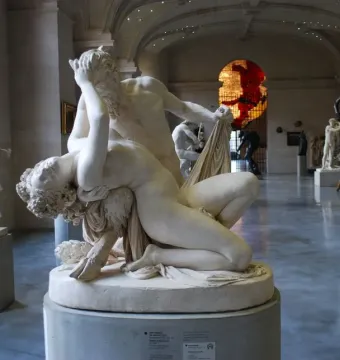
© James Pradier · CC BY-SA 3.0
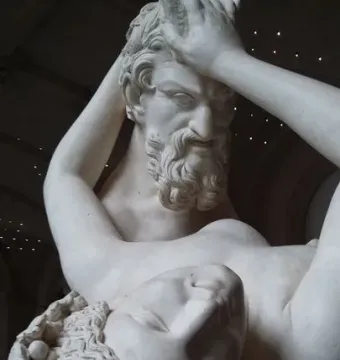
January 2017 © Mscmkt2017 · CC BY-SA 4.0
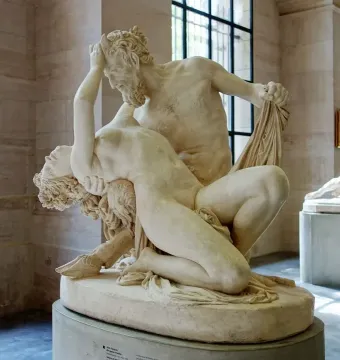
© James Pradier · CC BY-SA 4.0
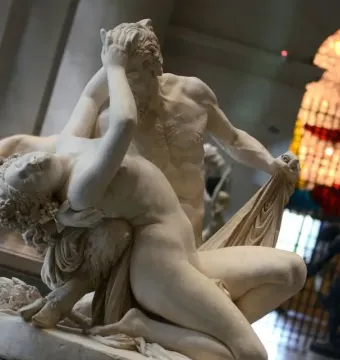
September 2016 © KarenCoutu · CC BY-SA 4.0
© James Pradier · CC BY-SA 3.0
Identification | |
| Title | Satyre et bacchante |
| Alternative titles | Satyre lutinant une nymphe; Satiro e baccante |
| Type | Marble group sculpture |
Historical context | |
| Date of creation | 1830–1834 |
| First plaster model date | 1830 |
| Exhibited at | Salon of 1834 |
| Reception at exhibition | It was rejected by the government and caused a scandal for its realism and the sensuality of the nude |
Creator | |
| Artist | James Pradier |
| Assistant | Antoine Étex |
Materials | |
| Material | Marble |
| Preparatory model materials | Terracotta, then plaster |
Technique | |
| Production method | Carved from a single block of marble |
| Modeling | Pradier modeled the terracotta with help from Antoine Étex, then a plaster model was made before the marble carving |
Physical characteristics | |
| Scale | Life-size |
Iconography and meaning | |
| Possible models for figures | The bacchante was thought by contemporaries to resemble Juliette Drouet; another hypothesis suggests Louise Pradier; the satyr has sometimes been identified as a self-portrait of Pradier, though it may instead recall antique models |
| Contemporary critical interpretation | During the Salon, critics considered the subject anachronistic and saw an influence of Rococo sculpture, comparing it with Clodion and Étienne-Maurice Falconet |
| Related ancient depictions | Attic vases of the 6th century BC; Roman villa frescoes, including those preserved at Herculaneum and Pompeii |
| Bacchante expression | Eyes half-closed with a slight smile |
| Possible source of inspiration | A Herculaneum fresco showing a satyr unveiling or discovering a maenad, preserved in the secret cabinet of the National Museum of Naples |
| Satyr expression | Looks at the bacchante with an expression of desire |
| Bacchante pose and action | Grasps the satyr's hair with her left hand and one of his horns with her right hand |
| Bacchante description | Crowned with grape clusters or vine leaves |
| Satyr pose and action | Kneels on one knee while supporting the bacchante's body with the other leg; holds her shoulder with his right hand and pulls away her drapery with his left, undressing her |
| Satyr description | A half-man, half-goat figure with goat legs, hooves, horns, and a tail |
| Subject | A satyr and a bacchante in a classical erotic scene that could be interpreted as either an erotic game or an attempted rape |
History and restoration | |
| Plaster model location | Palais des Beaux-Arts de Lille, Lille |
| Plaster model finish | Patinated in ochre |
| Restoration finding | A restoration confirmed that the preparatory plaster group was the original model and showed working traces characteristic of a model for carving marble |
Discovery and provenance | |
| Original marble inventory number | RF 3475 |
| Acquisition and ownership history | Purchased by Anatole Demidoff, who took it to Italy; acquired in 1870 by Lord Richard, Marquess of Herford, through the expert M. Manheim, for 10,300 francs; inherited by John Murray Scott; sold in Paris in 1904; later in the G. Potin collection; by 1940 owned by Édouard Labouchère, its last private owner; considered lost after 1940; a photograph was shown at a Paris exhibition in 1955 |
Location and ownership | |
| Current location | Louvre Museum, Paris, Department of French Sculpture collections |
| Current location since | 1980 |
| Acquired by | Louvre Museum |
| Acquisition support | With the support of the Société des amis du Louvre |