
The Veiled Nun
The Veiled Nun is a marble bust made in 1863 by an unidentified Italian artist. Despite its name, the woman portrayed is not a nun. The work was bought in Rome by American banker and collector William Corcoran for $300 and later became one of the most popular pieces in the Corcoran Gallery of Art, where it was displayed from 1874 until the gallery closed in 2014. For many years it was thought to be a copy of an unknown bust, and in 1939 it was attributed to Giuseppe Croff. That attribution was rejected in 2012, when study of the relevant catalog showed significant differences. The sculpture is now in the National Gallery of Art in Washington.
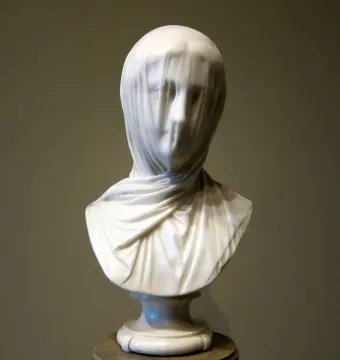
October 2016 © APK · Public domain
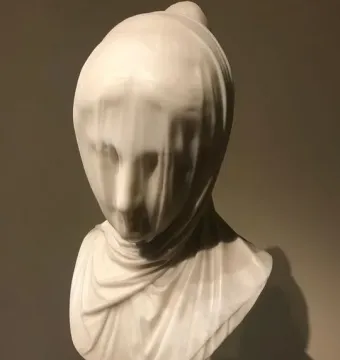
January 2017 © Rrwagner59 · Public domain
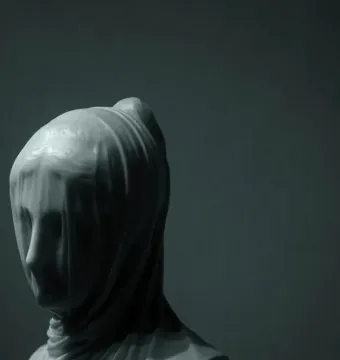
December 2015 © Mike Maguire · Public domain
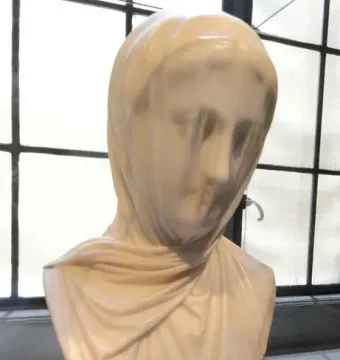
June 2012 © Daderot · CC0
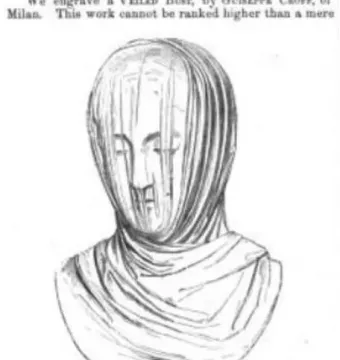
1854 © Unknown authorUnknown author · Public domain
Identification | |
| Title | The Veiled Nun |
| Type | Bust |
| Original Italian title | La Suora velata |
| Alternative French title | La Religieuse voilée |
| French title | La Nonne voilée |
Historical context | |
| Date made | c. 1863 |
| Tradition | Part of the 19th-century tradition of veiled-figure sculptures, which began in Italy in the 18th century |
| Notable related artists | Antonio Corradini, Giuseppe Sanmartino, and Innocenzo Spinazzi |
| Notable related works | The Veiled Christ and Prudence in the Sansevero Chapel, Naples; Raffaele Monti's Veiled Vestal |
| Possible influence on naming | Raffaele Monti's Veiled Vestal may have influenced William Wilson Corcoran in naming the bust |
Creator | |
| Creator | An unidentified Italian workshop |
Physical characteristics | |
| Height | 52.7 cm |
Materials | |
| Material | Marble |
Appearance | |
| Veil effect | The fine details create the illusion that the veil is transparent |
| Hair detail | An elegant hairstyle is visible through the veil |
| Veil decoration | The veil has an embroidered border |
| Depicted figure | A female figure wearing a veil |
Iconography and meaning | |
| Subject interpretation | The figure is not a nun, but rather a wealthy woman or an allegorical figure |
Discovery and provenance | |
| Purchase location | Rome |
| Owned by | William Wilson Corcoran's private collection |
| Purchase year | 1863 |
| Purchased by | William Wilson Corcoran |
| Purchase price | $300 |
Location and ownership | |
| Displayed at | Corcoran Gallery of Art, Washington, D.C. |
| Displayed from | 1874 |
| Displayed until | 2014 |
| Displayed in | the Octagonal Room of what is now the Renwick Gallery |
| Displayed alongside | Hiram Powers' The Greek Slave |
| Current location | National Gallery of Art, Washington, D.C. |
History and restoration | |
| Later attribution | An unknown commercial workshop in Rome |
| Transferred with | 17,000 other works of art |
| Transfer reason | Following the dissolution of the Corcoran Gallery |
| Transferred in | 2014 |
| Transferred to | National Gallery of Art |
| Basis for later attribution | Further expert analysis |
| Attribution changed in | 1939 |
| Reason attribution was rejected | Curators compared a copy of the catalogue and found significant differences; the bust attributed to Croff could not be located |
| Attribution rejected in | 2012 |
| Basis for Croff attribution | A patron noticed similarities to an engraved illustration of a Croff bust in a catalogue of the 1853 New York World's Fair |
| Attribution changed to | Giuseppe Croff (1810–1869), Milanese sculptor |
| Initial attribution | A copy of a bust by an unknown artist |
| Reception | One of the best-known and most popular works in the Corcoran Gallery of Art; highly appreciated by visitors |
Other | |
| Related busts from same model | Two other unsigned busts appear to derive from the same model, in the National Museum of Serbia and Laurier House, Ottawa, Ontario, Canada |
| William Corcoran's role | Founder of the Corcoran Gallery of Art |