
Major General George Henry Thomas
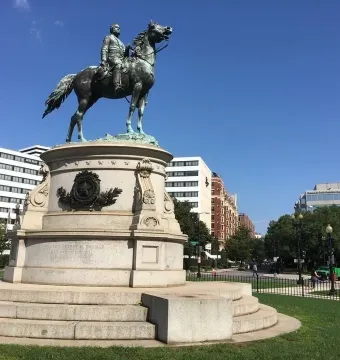
Major General George Henry Thomas is an equestrian sculpture in Washington, D.C., also known as the Thomas Circle Monument. It honors Civil War General George Henry Thomas and stands in the center of Thomas Circle, on the border of the downtown and Logan Circle neighborhoods. The work was sculpted by John Quincy Adams Ward. Its 1879 dedication was attended by President Rutherford B. Hayes, Generals Irvin McDowell, Philip Sheridan, and William Tecumseh Sherman, along with senators and thousands of soldiers. The monument is one of the eighteen Civil War monuments in Washington, D.C., listed together on the National Register of Historic Places in 1978.
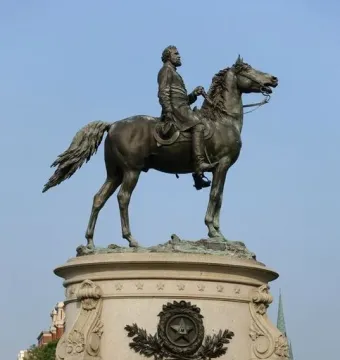
June 2015 © Daderot · Public domain
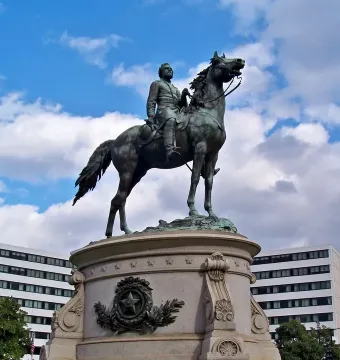
November 2008 © Ben Schumin · CC BY-SA 2.0
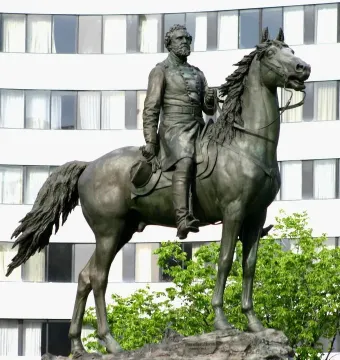
August 2004 © dbking · CC BY 2.0
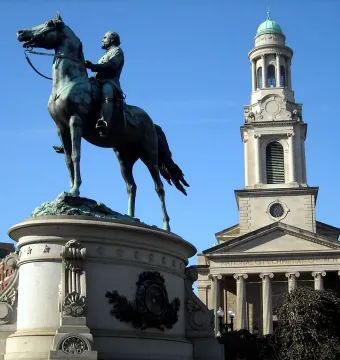
November 2009 © AgnosticPreachersKid · CC BY-SA 3.0
© NPS Photo · Public domain
Identification | |
| Title | Major General George Henry Thomas |
| Alternative name | Thomas Circle Monument; George Henry Thomas Memorial |
| Type | Equestrian statue |
| Subject | Major General George Henry Thomas, a Union general in the American Civil War and principal commander in the Western Theater |
| Nickname of subject | The Rock of Chickamauga |
| Depicts | George Henry Thomas on horseback |
Historical context | |
| Reason for renaming the circle | The circle was renamed Thomas Circle when the monument was installed |
| Reason for former name | Nearby residents planted memorial trees in honor of their respective home states |
| Former location name | Memorial Circle |
Creator | |
| Sculptor | John Quincy Adams Ward |
| Sculptor selected | 1875 |
| Model completed | 1879 |
| Foundry | Bureau Brothers Foundry |
| Base designers | John L. Smithmeyer and Paul J. Pelz |
Discovery and provenance | |
| Pedestal and base final cost | $20,000 |
| Reference materials used by artist | Photographs of Thomas, plus his uniform and saddle loaned by his widow Frances Thomas |
| Material source | Captured Confederate bronze cannons |
| Pedestal and base appropriation | $25,000 appropriated by Congress on 31 July 1876 |
| Cost of sculpture | $40,000 |
| Funding | Paid for by the Society of the Army of the Cumberland |
| Commissioned by | Society of the Army of the Cumberland |
Physical characteristics | |
| Pedestal | Oval granite pedestal with two Baroque volutes at each end |
| Scale | The bronze figures of Thomas and the horse are approximately twice life-size |
| Overall height | About 10 m |
| Statue height | About 5 m |
| Horse pose requirement | Three of the horse's feet had to touch the ground |
| Base | Circular granite base with four steps and four blocks projecting from the pedestal to the lowest step |
| Mounted on | A pedestal |
Materials | |
| Material | Bronze figures; granite pedestal and base |
Appearance | |
| Pedestal decoration | Two Baroque volutes at each end |
| Revision to horse design | After it was pointed out that Thomas only rode stallions, additions were made to the sculpture |
| Pedestal emblems | A bronze badge of the Army of the Cumberland and a laurel wreath on each side |
| Former lighting | Decorative gas lamps previously stood on the base's four blocks |
| Inscriptions | East pedestal: 'ERECTED BY HIS COMRADES / OF THE SOCIETY OF / THE ARMY OF THE CUMBERLAND'; west pedestal: 'MAJ. GEN. GEORGE H. THOMAS / SAN FRANCISCO CAL. / MARCH 28, 1870'; bronze: 'J. Q. A. WARD SCULP 1879'; founders: 'BUREAU BROS & HEATON / FOUNDERS. PHIL' |
| Residual feminine features of horse | The horse's thin head and neck still recall a mare |
| Horse depiction | The horse faces forward with mane and tail blown by the wind |
| Original horse design | The horse was originally designed to be a mare |
| Weapon | A sword hangs at his left side |
| Clothing | Double-breasted military coat and plain riding boots |
| Pose | He holds the horse's reins in his left hand and his hat and gloves in his right hand |
| Depicted action | Thomas is shown inspecting a battlefield from the top of a hill |
| Horse expression and anatomy | Its dilated nostrils, upright ears, tense muscles, and flowing tail convey excitement |
Location and ownership | |
| Park setting | The surrounding park is owned and maintained by the National Park Service |
| Agency | National Park Service, a federal agency of the Department of the Interior |
| Maintenance | Maintained by the National Park Service |
| Ownership | Owned by the National Park Service |
| Specific site | In the center of Thomas Circle, at the intersection of 14th Street, M Street, Massachusetts Avenue, and Vermont Avenue NW, on the border between the Downtown and Logan Circle neighborhoods |
| Location | Center of Thomas Circle, Washington, D.C., United States |
History and restoration | |
| Presentation and acceptance | Presented as an offering to the country and accepted by President Rutherford B. Hayes on behalf of the American people |
| Heritage designation | Contributing property to a historic district |
| Historic district | Civil War Monuments in Washington, D.C. |
| District of Columbia Inventory of Historic Sites | Added on 3 March 1979 |
| National Register of Historic Places | Collectively listed in 1978 as part of the Civil War Monuments in Washington, D.C. |
| Access after reconstruction | After the 2006 reconstruction of Thomas Circle, new sidewalks and landscaping allowed easier visitor access to the monument and surrounding park |
| Gas lamp removal | Removed around 1922 |
| Dedication procession | A two-mile procession led by General Thomas Turpin Crittenden, with about 1,000 soldiers, 1,000 marines and sailors, around 500 Army of the Cumberland veterans, and state troops from Maryland, New York, and Pennsylvania |
| Temporary viewing platform capacity | 1,500 people |
| Dedication decorations | The circle and nearby homes were heavily decorated with flags, streamers, and other decorations; 38 poles were placed around the circle with the flag of each U.S. state then in existence |
| Dedication ceremony | Included prayer, unveiling, and a thirteen-gun salute |
| Dedication music | Seven military bands, with the United States Marine Band first; the ceremony also included 'Hail to the Chief' and 'The Star-Spangled Banner' |
| Dedication route | Started east of the U.S. Capitol and passed the White House en route to the memorial site |
| Dedication attendees | President Rutherford B. Hayes; Generals Irvin McDowell, Philip Sheridan, and William Tecumseh Sherman; senators; and thousands of soldiers |
| Dedication attendance | An estimated 50,000 people |
| Dedicated | 19 November 1879 |
Significance | |
| Significance | One of the eighteen Civil War monuments in Washington, D.C.; considered by art critics and historians to be one of the city's best equestrian statues and one of the best equestrian statues in Washington, D.C.; it increased development in Thomas Circle and the surrounding area |
| Sculptor's other notable work | John Quincy Adams Ward is best known for the statue of George Washington on Wall Street in Manhattan |