
Pink Triangle Park
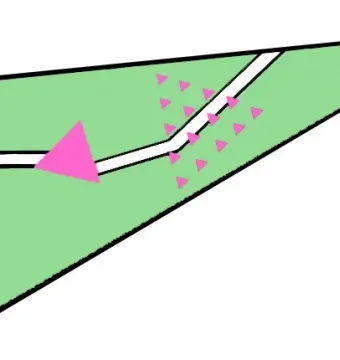
Pink Triangle Park is a memorial complex in San Francisco’s Castro district, created in memory of LGBT people who suffered persecution and discrimination because of their sexual orientation and gender identity. Opened on June 23, 2003, it was designed by artists Robert Bruce and Susan Martin. The triangular park contains 15 three-sided white columns topped with pink triangles, arranged to form an equilateral triangle on a slope. A path runs through the park, with a central platform shaped like a pink triangle. The memorial also recalls the pink triangle as a symbol of grief in the LGBT community and commemorates those persecuted in Nazi camps. It is located near Harvey Milk Plaza, at 17th Street and Market Street.
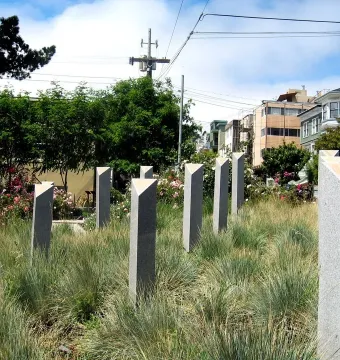
© Ryan Gessner · CC BY-SA 2.0
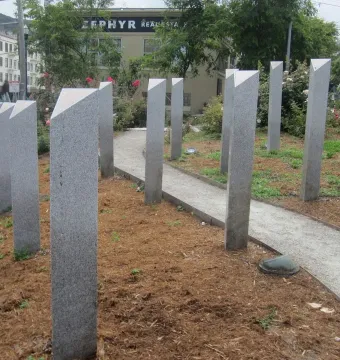
July 2013 © Another Believer · CC BY-SA 3.0
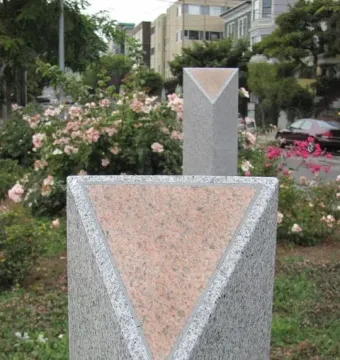
September 2012 © Reinhard Dietrich · CC0
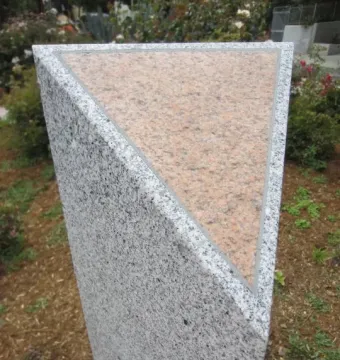
July 2013 © Another Believer · CC BY-SA 3.0
© Isaac Epstein · Public domain
Identification | |
| Title | Pink Triangle Park |
| Historical significance | First permanent free public memorial in the United States dedicated to homosexuals persecuted in Nazi Germany during the Holocaust |
| Original-language name | Memorial Park of the Pink Triangle |
| Type | Memorial park and memorial site |
Historical context | |
| Dedication subject | Thousands of homosexuals persecuted in Nazi Germany during the Holocaust |
| Historical context | The Castro is an established LGBT neighborhood in San Francisco and is associated with Harvey Milk |
Creator | |
| Designers | Robert Bruce and Susan Martin |
| Robert Bruce affiliation | One of the founding members of STOP-AIDS San Francisco |
Discovery and provenance | |
| Founded on | 10 December, the date of adoption of the Universal Declaration of Human Rights |
| Opened by | San Francisco Mayor Willie Brown |
| Opened | 10 December 2001 |
| Commissioned by | Eureka Valley Promotion Association |
| Opening occasion | Human Rights Day |
Location and ownership | |
| Location | Castro district, San Francisco, California, United States |
| Site | At the intersection of Market Street and 17th Street, across from Harvey Milk Plaza, above Castro Street Station of the Muni Metro |
| Size | Just under 370 m² |
| Maintainer | A nonprofit organization whose name is not specified |
Physical characteristics | |
| Number of columns | 15 |
| Column form | Top ends are slanted and flattened |
| Column shape | Triangular in cross-section |
| Arrangement | The 15 columns are arranged in an equilateral triangle on the slope |
| Central feature | A central triangle filled with stones, including pink crystals |
| Elements | 15 triangular granite columns and a central triangular area filled with rocks and pink crystals |
| Shape | Triangular |
| Ground surface | A triangular area covered with pink quartz gravel |
Materials | |
| Column material | Granite |
| Central triangle material | Pink granite |
| Ground material | Pink quartz gravel |
| Additional material | Explanatory plaque |
Iconography and meaning | |
| Conceptual meaning | A physical reminder that persecution of any person or group harms all humanity |
| Commemorated group | Gay, lesbian, bisexual, and transgender people persecuted and discriminated against because of their sexual orientation and gender identity, especially homosexuals persecuted in Nazi Germany |
| Plaque content | The plaque notes that after the fall of the Nazi regime homosexual prisoners were sent back to prisons and were not officially recognized as victims of the Third Reich until 2002 |
| Pink triangle symbolism | A symbol of mourning in the LGBT community and the badge used to mark homosexual prisoners in Nazi concentration camps |
| Pink crystals symbolism | Love, healing, and pride |
| Triangle motif meaning | A reference to the pink triangle Nazis forced homosexual men to wear for identification and public humiliation |
| Column symbolism | Each column represents about 1,000 homosexuals killed in Nazi concentration camps |
History and restoration | |
| Vandalism | In 2008 the memorial was vandalized by far-right vandals with Nazi swastikas |
Significance | |
| Purpose | A memorial to persecuted homosexuals in Nazi Germany and a statement that persecution of one group harms society as a whole |
Other | |
| Visitor interaction | Visitors are encouraged to take a pink crystal as a souvenir |