
Adam Mickiewicz Monument, Kraków
Adam Mickiewicz Monument in Kraków is one of the best-known bronze statues in Poland and a popular meeting place on the Main Market Square in the Old Town. Locals also call it “Adaś,” a diminutive of Adam. The statue honors Adam Mickiewicz, regarded as the greatest Polish Romantic poet of the 19th century, and was unveiled on 16 June 1898, the 100th anniversary of his birth, in the presence of his daughter and son. It was designed by Teodor Rygier. At the poet’s feet, four allegorical groups represent the Fatherland, Science, Courage, and Poetry, and the pedestal bears an inscription dedicating the monument to Adam Mickiewicz and the nation.
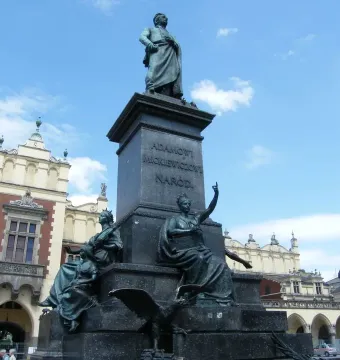
© Itto Ogami · CC BY 3.0
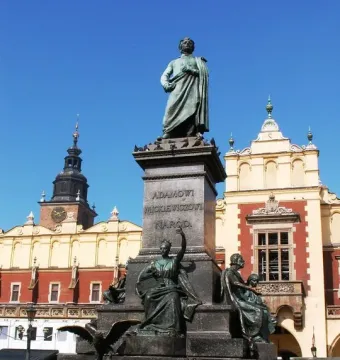
August 2009 © Pedro · CC BY 2.0
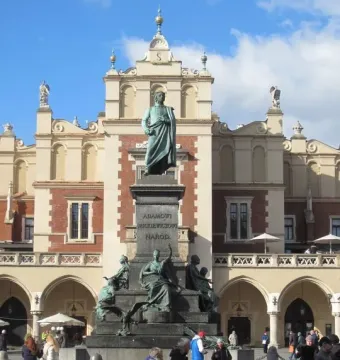
© קובץ על יד · CC BY-SA 4.0
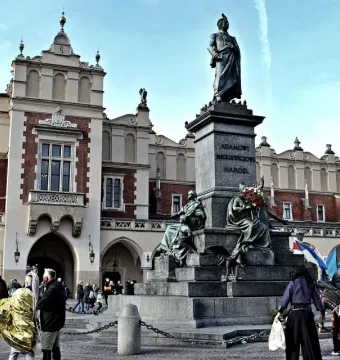
© Txemai Argazki · CC0
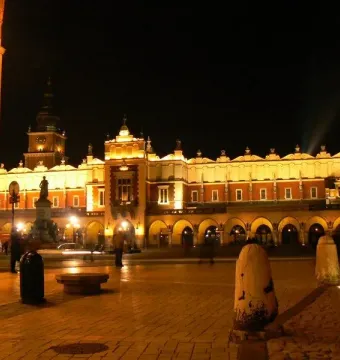
© Michalws · CC BY-SA 3.0
Identification | |
| Name | Adam Mickiewicz Monument in Kraków |
| Alternative name | Adaś |
| Original Polish name | Pomnik Adama Mickiewicza |
| Type | Bronze statue and monument |
| Style | Academic style |
| Subject | Adam Mickiewicz |
Historical context | |
| Purpose | In honor of Adam Mickiewicz, the great Polish Romantic poet of the 19th century |
| Commemorated occasion | Centenary of Adam Mickiewicz's birth |
| Competition period | 1880–1890 |
Creator | |
| Other artists in the competition | More than 60 artists competed, including Jan Matejko, Tomasz Dykas, Walery Gadomski, Antoni Kurzawa, Cyprian Godebski, and Pius Weloński |
| Competition result | Rygier received second place, but his design was ultimately chosen for execution |
| Designer description | A little-known sculptor of the time |
| Designer / sculptor | Teodor Rygier |
Discovery and provenance | |
| Contract date | November 1889 |
| Cost | 164,000 zlotys |
| Funding | Most of the cost was raised through public donations and collections |
| Casting location | Rome |
| Foundry | Nelli company |
| Workshop / production site | A studio on Długa Street, under the supervision of an artistic committee |
| Inspiration | Partially inspired by the transfer of Mickiewicz's remains to Kraków in 1890; the original idea was developed by university students |
Physical characteristics | |
| Height | 10 m |
| Depicted form | A standing poet on a pedestal |
| Depicted elements | Adam Mickiewicz, four allegorical figures, and an eagle |
Materials | |
| Pedestal material | Granodiorite from Piława Górna in Lower Silesia |
| Main material | Bronze |
Technique | |
| Production method | Cast |
Appearance | |
| Allegorical figures | Four figures symbolizing Homeland, Science, Courage, and Poetry |
| Allegorical figure representations | Homeland: a young man raising his arm; Poetry: a woman holding a lyre; Science: an old man teaching a young man; Courage: a knight |
| Allegorical group orientations | Homeland toward Sienna Street; Science toward the north; Courage toward the Cloth Hall; Poetry toward St. Adalbert's Church (south) |
| Inscription on pedestal | Adamowi Mickiewiczowi Naród |
| Inscription translation | To Adam Mickiewicz, the Nation |
Location and ownership | |
| Prominence | One of the best-known bronze statues in Poland; the most frequently photographed monument in Kraków |
| Dedication | Dedicated to Adam Mickiewicz |
| Country | Poland |
| Role in the city | One of the most recognizable symbols of Kraków and a popular meeting place for residents and tourists |
| Specific location | Eastern side of the Main Market Square, between the Cloth Hall and the exit of Sienna Street |
| Location | Main Market Square, Kraków, Poland |
History and restoration | |
| Unveiling date | 16 June 1898 |
| Unveiling context | Unveiled in the centenary year of Adam Mickiewicz's birth |
| People present at unveiling | Mickiewicz's daughter and son |
| Destruction date | 17 August 1940 |
| Destroyed by | German occupation authorities |
| Reconstruction date | 26 November 1955 |
| Reconstruction context | Rebuilt in the centenary year of Adam Mickiewicz's death |
| Recovery of original figures | Most of the figures were recovered in 1946 from a scrapyard in Hamburg (a Glockenfriedhof) and reassembled |
| Restoration significance | Recovery of most figures allowed the monument to be restored to its original appearance |
Significance | |
| Symbolic meaning | A symbol of Polish culture |
| Customs and traditions | Decorated with flowers on Christmas Eve by Kraków florists, and with bouquets at the base on Saint Adam's feast day |
| Recent decoration | During Euro 2012, the monument was decorated with cockades in the national colors of Poland and of the teams playing their matches that day |