
The Minute Man
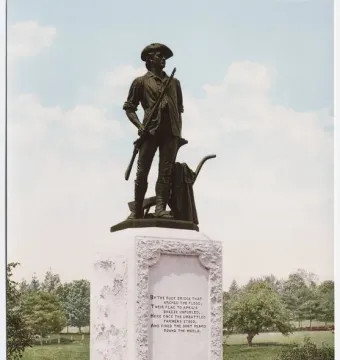
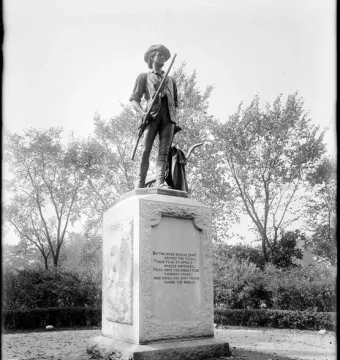
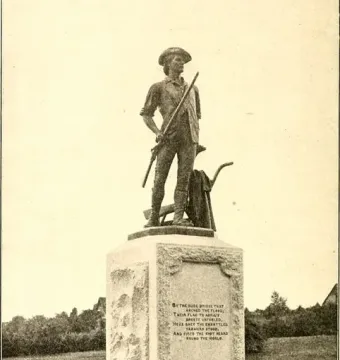
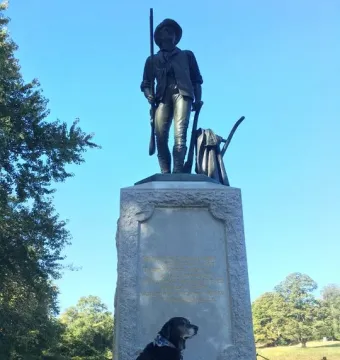
The Minute Man is a sculpture by Daniel Chester French, created between 1871 and 1874 and installed in Minute Man National Historical Park in Concord, Massachusetts. Originally intended to be carved in stone, it was instead cast in bronze using ten Civil War-era cannons appropriated by Congress. The statue shows a young militiaman stepping away from his plow, with a coat draped over it and a musket in his hand, as he joins the patriot forces at the Battle of Concord at the start of the American Revolutionary War. Unveiled in 1875 for the centennial of the battle, the work received critical praise and remains widely admired.
© Unknown authorUnknown author · Public domain
© Abdalian, Leon H., 1884-1967 · Public domain
1905 © Internet Archive Book Images · No restrictions
September 2019 © Mahlynch · CC BY-SA 4.0
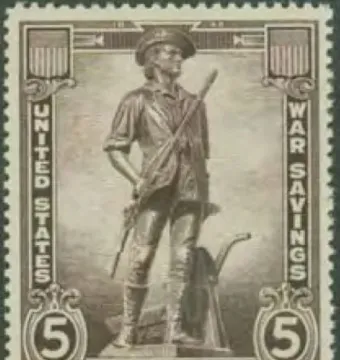
1942 © US Government · Public domain
Identification | |
| Title | The Minute Man |
| Type | Statue |
| Alternative titles | Concord Minute Man; Minuteman Statue; The Concord Minute Man of 1775 |
Creator | |
| Artist | Daniel Chester French |
| Artist nationality | American |
| Notable work by artist | Abraham Lincoln at the Lincoln Memorial in Washington, D.C. |
Historical context | |
| Historical significance | Marks the beginning of the American Revolutionary War |
| Historical event depicted | Battle of Concord, at the beginning of the American Revolutionary War |
| Commemorates | The Battle of Lexington and Concord |
| Created for | the centennial celebration of the Battle of Concord |
| Completed | September 1874 |
| Created between | 1871 and 1874 |
Discovery and provenance | |
| Early study model | A small clay figure made in summer 1871 was rejected by the committee; its appearance is unknown and it was not saved |
| Casting material source | Ten Civil War-era cannons appropriated by Congress |
| Funding for casting | Concord lacked sufficient funds, so Congress appropriated ten Civil War-era cannons for the project |
| Foundry | Ames Manufacturing Works, Chicopee, Massachusetts |
| Plaster sent to foundry | A plaster version of the clay statue was sent to Ames Manufacturing Works in Chicopee, Massachusetts |
| Accepted model | French's second clay model was accepted in 1873 |
| Research anecdote | According to Harold Holzer, young women reportedly brought French supposed colonial artifacts to help with his research |
| Model historical note | First combat death at Concord during the Battle of Lexington and Concord |
| Model occupation | Captain of the militia of the town of Acton |
| Model | Isaac Davis (1745–1775), possibly |
| Research basis | Created after extensive research using powder horns, period buttons, classical sculpture casts, and other colonial-era references |
| Preliminary work began | 1871, before the formal commission |
| Commissioned because | French was from Concord and his father, Henry F. French, was a prominent local lawyer and former judge |
| Commissioned by | a Concord committee including George M. Brooks, John B. More, John S. Keyes, and Ralph Waldo Emerson |
History and restoration | |
| Reworking commission | In 1889, Concord commissioned French to rework the statue for the USS Concord |
| Later copy | The USS Concord also carried a copy of the statue in the 1940s |
| Reworked version changes | Removed some imperfections and made the movement more fluid and natural |
| Reworked version style | Included Beaux-Arts elements |
| Reworked version installation | Installed on the gunboat USS Concord in 1891 |
| Reworked version title | The Concord Minute Man of 1775 |
| Reworked version completion | 1890 |
| Initial reception | Received positive reviews from art critics and the public |
| Unveiling attendees | President Ulysses S. Grant and Ralph Waldo Emerson |
| Unveiling occasion | Centennial celebration of the Battle of Concord |
| Unveiling date | April 19, 1875 |
| Completion of cast version | 1874 |
| Material change | Changed from stone to bronze in 1873 |
| Artist absence at unveiling | French was in Italy studying sculpture and did not attend |
Physical characteristics | |
| Pose resemblance | The pose resembles the Apollo Belvedere |
| Modern art historical interpretation | Modern scholarship, based on French's diaries, rejects the idea that the pose is a direct copy, while recognizing that French used several classical plaster casts, including the Apollo Belvedere, as inspiration |
| Earlier interpretation of pose | Until the late twentieth century, it was assumed the pose was copied from the Apollo Belvedere |
| Possible subject identity | A portrait of Isaac Davis, possibly |
| Figure depicted as | A young farmer turned soldier |
| Subject | A minuteman leaving his plow to join the patriot forces at the Battle of Concord |
Appearance | |
| Action portrayed | Trading his plow for a musket and stepping away from private life toward the impending battle |
| Attributes depicted | A coat draped over the plow and a musket in his hand |
| Hat | A wide-brimmed hat pinned on the right side of his head |
| Powder horn placement | On his back rather than at his hip |
| Facial expression | Alert |
| Gaze direction | Fixed on the battle he is ready to march to |
| Clothing details | The sleeves of his coat and shirt are rolled up |
Location and ownership | |
| Rear pedestal inscription | The date of the battle and the centennial year |
| Second time capsule contents | Girl Scouts USA pins, the United States Bicentennial flag, and a cassette tape |
| Second time capsule | A second time capsule was placed beneath the pedestal in 1975 |
| Time capsule contents | Items from Battle of Concord celebrations, maps, and photographs of the sculpture and sculptor |
| Time capsule under pedestal | A copper time capsule from 1875 |
| Pedestal dimensions | Exact measurements not stated |
| Pedestal design competition | Cabot won the competition; French's brother also submitted a design |
| Front pedestal inscription | The first stanza of Ralph Waldo Emerson's 'Concord Hymn' |
| Pedestal inscriptions | Inscribed on two sides |
| Pedestal form | A simple stone pedestal |
| Pedestal material | Granite |
| Pedestal designer | James Elliot Cabot |
| Intended location | On a local rock or boulder by the town of Concord, on the bank where the Massachusetts militia stood during the battle |
| Current location | Near Old North Bridge in Minute Man National Historical Park, Concord, Massachusetts, United States |
Significance | |
| Critical reception | Received critical praise and continues to be praised by commentators |
| Symbolism | A suffragist symbol; a symbol of the United States National Guard, the Army National Guard, and the Air National Guard |
| Depictions on currency and stamps | Featured on the 1925 Lexington-Concord Sesquicentennial half dollar, the 2000 Massachusetts state quarter, and a stamp |