
Major General Marquis Gilbert de Lafayette
Major General Marquis Gilbert de Lafayette is a statue in the southeast corner of Lafayette Square in Washington, D.C., near the White House. Erected in 1891, it honors Gilbert du Motier, Marquis de Lafayette, and his role in the American Revolutionary War. The square was named for him in 1824 during a visit to the United States. The monument features a bronze statue of Lafayette on a French marble pedestal with four decorated faces, accompanied by seven additional bronze statues, all larger than life size. The statuary was made by Alexandre Falguière and Antonin Mercié.
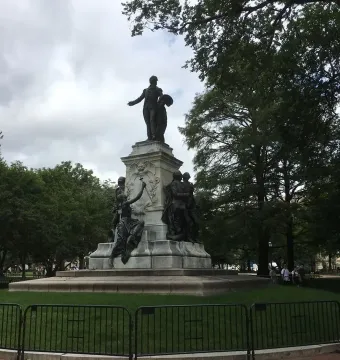
© NPS Photo · Public domain
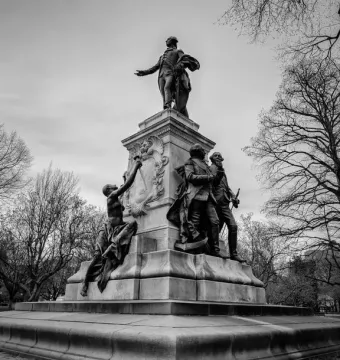
March 2020 © John Brighenti · CC BY 2.0
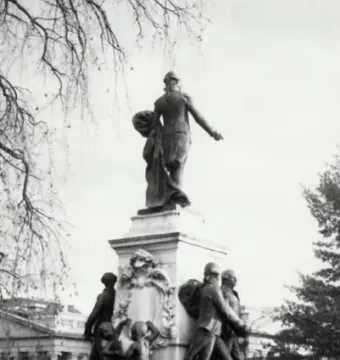
May 2009 © Wikipedia Saves Public Art · Public domain
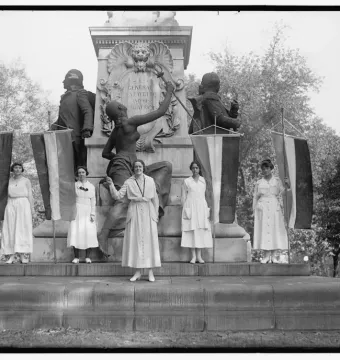
1918 © Harris & Ewing, photographer · Public domain
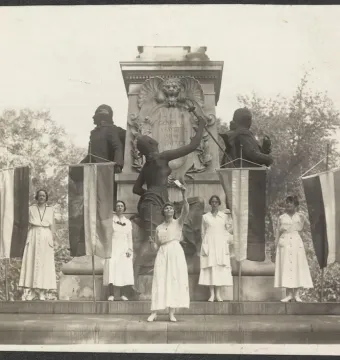
1918 © Harris & Ewing (Photographer) · Public domain
Identification | |
| Title | Major General Marquis Gilbert de Lafayette |
| Type | Statue |
Historical context | |
| Commemoration | Erected to honor Gilbert du Motier, Marquis de Lafayette, and his contributions to the American Revolutionary War |
| Historical period | American Revolution, 1777–1783 |
| Congressional authorization | Authorized by an Act of Congress on March 3, 1885 (23 Stat. 508), with a $50,000 appropriation |
| Commissioned context | Commissioned as one of many monuments erected around the centennial of the American Revolution |
| Proposal history | First proposed in January 1883 by U.S. Senator John W. Johnston of Virginia as an equestrian statue |
| Design selection | A commission selected one of Alexandre Falguière and Antonin Mercié's joint designs in 1887 |
Creator | |
| Sculptors | Alexandre Falguière and Antonin Mercié |
| Pedestal architect | Paul Pujol |
| Founder | Maurice Denonvilliers |
Discovery and provenance | |
| Site objections | The proposed central south-side location in Lafayette Square was rejected because it would have blocked the sightline from the Andrew Jackson statue to the White House; the Treasury Building site was also rejected |
| Planning and site selection | The site was debated after commissioning; Lafayette Square was considered, along with sites near the Treasury Building and the U.S. Capitol |
| Arrival | Arrived in New York City in August 1890 and was then transported by train to Washington, D.C. |
| Shipping | Shipped on the steamer La Normandie in 30 heavy boxes |
| Casting date | 1890 |
| Casting place | Paris |
| Modeling process | First modeled in clay at one-quarter scale, then cast in plaster, enlarged to a full-size model, and used to make sand molds |
Location and ownership | |
| Current location | Southeast corner of Lafayette Square, Washington, D.C., near Pennsylvania Avenue NW and Madison Place, across from the White House |
| Setting | One of four statues on the corners of Lafayette Square |
| Orientation | Faces south toward the White House |
| Ownership and maintenance | Owned and maintained by the National Park Service |
| Square | Lafayette Square |
| Square history | Originally part of President's Park; named in honor of Lafayette in 1824 during his U.S. visit |
Physical characteristics | |
| Height | About high; exact measurement omitted in the source |
| Additional figures | Seven additional bronze statues, all larger than life size |
| Dimensions | About unspecified height and width; numbers omitted in the source |
Materials | |
| Marble source | Derville et C / Marbres, from a French quarry |
| Pedestal material | Marble |
| Statue material | Bronze |
| Foundation material | Granite |
Appearance | |
| Pedestal description | Marble pedestal with four faces decorated with classical mouldings, set on a granite foundation and a slight mound of grassed earth within a circle of granite curb stones |
| Main figure attire | Civilian dress with a long coat bearing the badge of the Society of the Cincinnati, boots, and wig |
| Main figure pose | Gesturing with his right arm, with a cloak over his left arm and his left hand resting on the hilt of his sword |
| South face figure | A seated draped female figure symbolizing America, offering Lafayette a sword and turning to seek his aid |
| East face figures | Comte d'Estaing and the Comte de Grasse in military uniform, conversing |
| West face figures | Comte de Rochambeau and the Chevalier du Portail in military uniform |
| North face figures | Two bronze cherubs before a cartouche |
Iconography and meaning | |
| North inscription | "BY THE CONGRESS / IN COMMEMORATION / OF THE SERVICES / RENDERED BY / GENERAL LAFAYETTE / AND HIS COMPATRIOTS / DURING THE STRUGGLE / FOR THE / INDEPENDENCE / OF THE UNITED STATES / OF AMERICA" |
| Inscription on base | "FONDU PAR MAURICE DENONVILLIERS" |
| Inscription on founder mark | "MAURICE DENONVILLIERS FOUNDEUR / PARIS 1890" |
| South inscription | "TO / GENERAL / LA FAYETTE / AND HIS / COMPATRIOTS / 1777–1783 / DERVILLE FARBRE" |
| West face symbol | A cannon symbolizing command of French armies |
| East face symbol | An anchor symbolizing command of French naval forces |
| Main figure meaning | The pose is commonly interpreted as Lafayette petitioning the French National Assembly to assist the revolutionary Americans |
History and restoration | |
| Installation completion | April 1891 |
| Dedication ceremony | No funds were left to hold a dedication ceremony |
| Cleaning and maintenance | The monument was cleaned in 1910, 1921, 1987, and 2000; in 1987 the foundation and base were recaulked and the statues were cleaned by air abrasion |
| Condition after cleaning | Weather and time had discolored the marble in places, and later weather damage was noted in 2000 |
| Vandalism and repairs | The monument has occasionally been vandalized, and pieces of the base statues were replaced after theft |
| Annual observance | The Sons of the Revolution lay a wreath annually on Lafayette's birthday, September 6 |
| Bicentennial celebration | Lafayette's 200th birth anniversary was celebrated in 1957 |
Significance | |
| Historic designation | One of 14 American Revolution Statuary in Washington, D.C. |
| National Register listing | Collectively listed on the National Register of Historic Places on July 14, 1978 |
| District of Columbia Inventory listing | Added to the District of Columbia Inventory of Historic Sites on March 3, 1979 |
| Contributing property | Contributing property to the L'Enfant Plan and the Lafayette Square Historic District |
| National Historic Landmark status | Lafayette Square Historic District is a National Historic Landmark |