
Alamo
Alamo, also known as the Astor Place Cube or simply The Cube, is an outdoor sculpture by Bernard (Tony) Rosenthal in Astor Place, Manhattan, New York City. Installed in 1967 as part of the “Sculpture and Environment” program, it was intended to be temporary, but local residents asked for it to remain. The sculpture is a black cube made of corten steel, about 2.4 meters on each side and weighing around 820 kg. Its faces are not flat, featuring notches, projections, and ledges. A distinctive feature is that it can be rotated on its vertical axis, and it has become a popular East Village gathering place and a ritual stop for many visitors to New York.
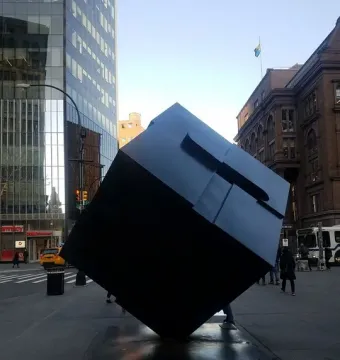
April 2018 © Recover-reputation-online-management · CC BY-SA 4.0
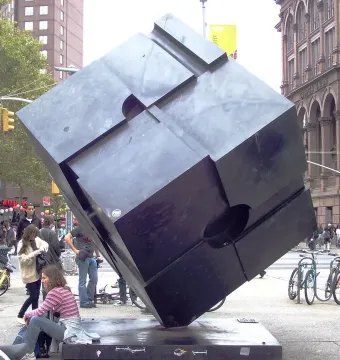
© Beyond My Ken · Public domain
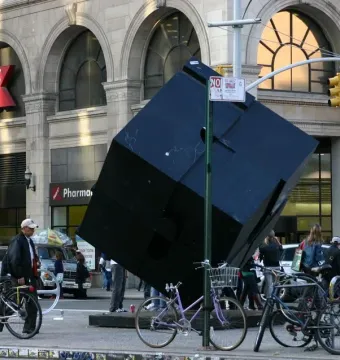
October 2008 · Public domain
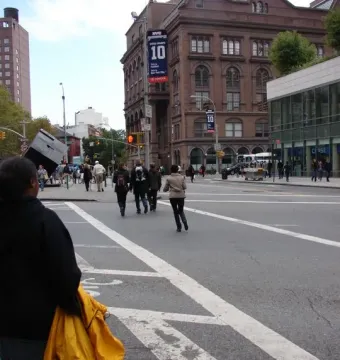
October 2008 · CC BY-SA 3.0
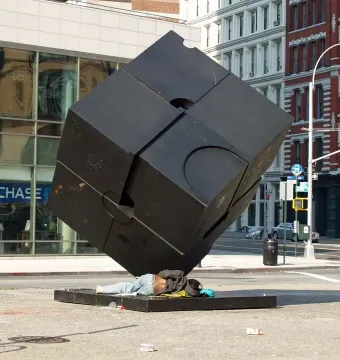
July 2007 © David Shankbone · Public domain
Identification | |
| Title | Alamo |
| Type | Outdoor sculpture |
| Alternative names | Astor Place Cube; The Cube; Cube Rosenthal; officially Endover |
Creator | |
| Artist | Tony Rosenthal |
Historical context | |
| Long-term status | Permanently installed in the East Village after a petition by local residents |
| Installed | 1967 |
| Commission / program | Sculpture and the Environment, organized by the New York City Department of Cultural Affairs |
| Program duration | Six months |
| Number of works in program | 25 |
| Original intended duration | Six-month temporary installation |
| Number of additional works | 24 additional works |
Discovery and provenance | |
| Related sculpture details | Donated by the class of 1965 and installed in 1968 |
| Related sculpture movement | It also rotates, but its axis is sunk into the ground rather than mounted on a separate platform |
| Endover location | University of Michigan campus in Ann Arbor, Michigan |
| Endover donation | Donated by the class of 1965 |
| Endover connection to Rosenthal | Rosenthal earned a Bachelor of Fine Arts there |
| Endover installation date | 1968 |
| Relationship to Endover | Identical to Endover |
| Related identical sculpture | An identical sculpture called Endover (also known as Rosenthal Cube) exists at the University of Michigan in Ann Arbor, Michigan |
| Number of identical cubes | Five |
| Public response | Local residents petitioned the city to keep the sculpture |
| Current role | Popular meeting place in the East Village |
| Placement | Between the Astor Place subway entrance and Cooper Union |
| Related sculpture | Endover |
Physical characteristics | |
| Form | Black cube resting on one corner |
| Dimensions | About 2.4 meters on each side |
| Weight | Around 820 kg |
| Surface | The faces are not flat and have notches, protrusions, cornices, indentations, and ledges |
Materials | |
| Material | Corten steel |
Location and ownership | |
| How it is moved | One person can push it slowly with effort; two or more people can move it easily |
| Location | Astor Place, East Village, Manhattan, New York City, New York, United States |
| Name plaque | A small plaque on the base identifies the sculpture as Alamo |
| Movement | Can rotate around its vertical axis |
Iconography and meaning | |
| Symbolic practice | Some visitors consider rotating it a ritual indicating they have arrived in New York |
| Name origin | Selected by the artist's wife because its scale and mass reminded her of the Alamo Mission |
Other | |
| Popular use | People sit or sleep in its shade |
History and restoration | |
| Off-site removal purpose | Restoration and repainting; to keep it out of harm's way |
| Protective covering reason | Covered in a protective wooden box because of redevelopment of Astor Place |
| Protective covering date | October 2015 |
| Removal for refurbishment date | May 2023 |
| Reinstallation date | 1 November 2016 |
| Work done before 2016 return | $180,000 reconstruction and rust removal |
| Maintenance authority by 2022 | New York City Department of Transportation |
| 2022 condition assessment | Spinning could cause further damage |
| Safety concern | The sculpture was in danger of tipping over if it continued to spin |
| 2022 stabilization measure | Locked in place with metal braces until further work on the pivot could allow it to spin freely again |
| October 2013 event | A fake documentary went viral claiming that a man lived inside the sculpture |
| Refurbishment location | A Connecticut foundry |
| Halloween 2015 event | A man dressed as the Cube stood in its place while Alamo was temporarily absent due to renovation work at Astor Place |
| Renovation year | 2005 |
| 14 December 2011 event | Caltech students covered it with tight clothing, making it resemble the Weighted Companion Cube from Portal |
| Renovation performed by | The artist and his original collaborators |
| Maintenance removal date | 10 March 2005 |
| 2005 maintenance work | Removed by the New York City Department of Parks and Recreation; the artist replaced a missing bolt and made minor repairs |
| Temporary replacement | A makeshift replica made of PVC tubes called the Jello Cube, named in honor of Peter Cooper |
| Return after maintenance | November 2005; returned with a new black coat of paint and ready to rotate |
| Renovation initiated by | NYC Parks |
| Return after refurbishment | August 2023 |
| October 2011 event | Visual artist Olek placed a knitted cover with her camouflage pattern over the sculpture |
| July 2005? | A makeshift replica called the Jello Cube |
| Temporary replacement dedication | Peter Cooper |
| 2003 prank | In June 2003 the sculpture was turned into a giant Rubik's Cube as a prank by the ATF Squad; the effect lasted about 24 hours and city maintenance later removed the paint |
| March 2006 event | The Graffiti Research Lab distributed LED Throwies so people could throw them onto the sculpture and decorate it |
| April 2006 event | A container of chalk was left in the sculpture, leading passersby to draw on it; seven people were arrested for vandalism and city crews cleaned the chalk the next morning |
Significance | |
| Anniversary organizer | Greenwich Village Society for Historic Preservation |
| Anniversary celebrated | 50th anniversary of its installation |
| Anniversary date | November 2017 |