
Stone Flower
Stone Flower is a reinforced concrete monument designed by Bogdan Bogdanović and completed in 1966 at the site of the former Camp III, known as the Ciglana, in Jasenovac. It commemorates the atrocities committed in the camp by the Ustaša regime during World War II, with reference to Serbs, Romani people, Jews, and Croatian dissidents. The monument takes the form of a flower opening its petals toward the sky and the Sun, symbolizing faith in life, rebirth, and the overcoming of suffering. Its base contains six niches divided by concrete walls with water basins along the edges, while a central column rises into the sculpted flower form. The crypt is paved with railway sleepers, and a bronze plaque on the northern side includes verses from Ivan Goran Kovačić’s poem Jama.
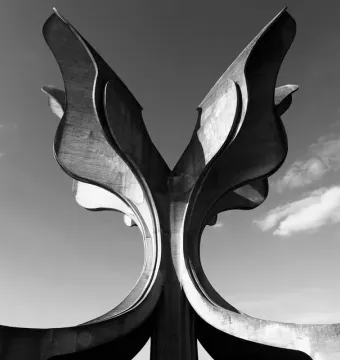
February 2017 © Andrej · CC BY-SA 2.0
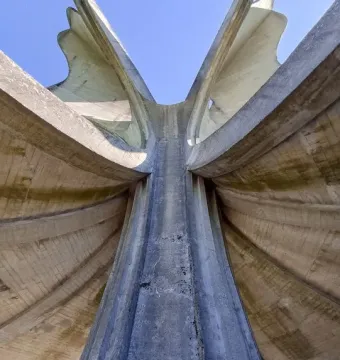
July 2022 © MorenaClara · CC BY-SA 4.0
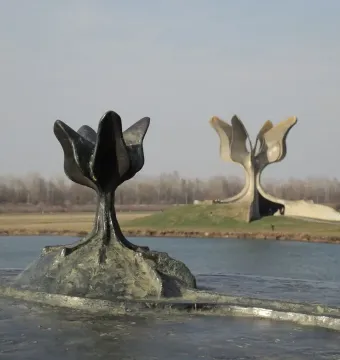
March 2012 © Flammard · CC BY-SA 3.0
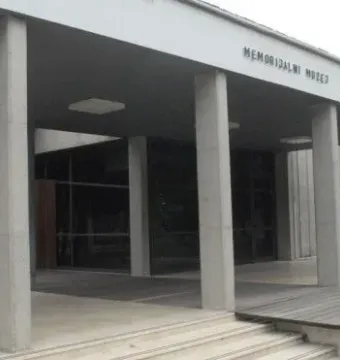
March 2018 © Tina Petra · CC BY-SA 4.0
May 2021 © Andrija12345678 · CC BY-SA 4.0
Identification | |
| Title | Stone Flower |
| French title | Fleur de pierre |
| Type | Memorial monument / monumental sculpture / memorial complex centerpiece |
Historical context | |
| Dedicated to | The victims of the Jasenovac concentration camp |
| Symbolic intention | To create a sign of reconciliation and end interethnic blood feud; to avoid repeating the horrors of the former camp and instead fill the space |
| Commemorated event | The atrocities committed at the Jasenovac concentration camp by the Ustaša regime during World War II |
Creator | |
| Designer | Bogdan Bogdanović, a Yugoslav/Serbian architect and sculptor |
| Design started | 1959 |
| Selected in competition | Selected in a closed competition launched in 1960 by the central committee of the Association of Veterans of the National Liberation War (SUBNOR) |
| Design role | Bogdanović designed the monument and the surrounding landscape |
Discovery and provenance | |
| Construction start | 1964 |
| Completion date | 1966 |
| Construction company | A construction company from Novska carried out the work |
| Construction supervision | Construction began under Bogdanović’s supervision |
| Original site plan | A complex of water channels, embankments, and hills with metallic abstract flowers |
| Design approach | Bogdanović chose to redesign the site symbolically and rejected the original plan in favor of a single 24-meter-high monument |
| Commissioning context | Created as part of a memorial complex dedicated to the victims of fascism |
| Initial memorial initiative | A committee was established in Jasenovac in 1952 to promote construction of a monument |
| Site condition before redesign | By 1959 the area had fallen into disrepair and all structural remains except for a few foundations had disappeared |
Location and ownership | |
| Location | Jasenovac concentration camp site, Jasenovac, Croatia, on the bank of the Sava River near the village of Jasenovac |
| Associated memorial site | Jasenovac memorial site |
| Museum and archive | A museum and archive at the entrance of the site, opened in 1968 and architected by Peter Vovk |
Physical characteristics | |
| Crypt floor | Paved with railway sleepers |
| Site marking | Earth craters symbolically mark the former barracks |
| Support structure | The weight rests on underground Franki piles; diverging struts provide wind stabilization and aesthetic support |
| Interior elements | Within the niches, six trapezoidal slabs reach toward the upper structure |
| Crypt chamber | A memorial room beneath the base of the flower |
| Structure | A base containing six niches divided by concrete walls, with water basins running along their edges; a central column rising from the base and expanding into the sculpted flower form |
| Form | An abstract six-petaled, plant-like flower |
| Height | 24 meters |
Materials | |
| Material | Reinforced concrete; prestressed concrete |
| Plaque material | Bronze |
Technique | |
| Path paving | Former railway sleepers from the camp’s transport track |
| Water feature | Rain forms a circular arrangement of small puddles in the crypt under the monument |
Appearance | |
| Plaque location | Northern side; on the north wall of the memorial room |
Iconography and meaning | |
| Author’s intention | To purify the space |
| Purpose of poem plaque | To quote anti-war poetry by the Croatian anti-fascist poet Ivan Goran Kovačić |
| Plaque content | Verses from Ivan Goran Kovačić’s war poem Jama (The Pit), written as a protest against the violence of war |
| Internal symbolism | An unseen internal structure representing a cosmic plant whose crown reaches the skies while its roots extend into the underworld |
| Theme / symbolism | A flower opening its petals toward the sky and the Sun, representing faith in life and rebirth, and overcoming suffering |
History and restoration | |
| Museum condition in the 1990s | The museum’s holdings were moved out during the Yugoslav Wars and the museum was badly damaged |
| Museum restoration status | The museum has been restored |
| Museum collections returned | Since 2006, the restored museum has again possessed its original holdings |
| Display policy | Only a small part of the exhibits is shown, in favor of a multimedia information offer |
| Condition during and after the Yugoslav Wars | Unlike many other monuments from the Yugoslav period, it was not desecrated or abandoned during and after the Yugoslav Wars |
Significance | |
| Notability | One of the most famous works of Bogdan Bogdanović |
| Award | The site and monument received the Carlo Scarpa International Prize for the best architectural/artistic creation of a space for preserving memories in 2007 |
Other | |
| Commemorative practice | On the Sunday after the memorial day, 22 April, the prisoners’ uprising and the liberation continue to be commemorated separately |
| Relief | A relief by Dušan Džamonja is on the museum wall |