
La Princesse
La Princesse is a 13-metre-long, 37-ton mechanical spider designed by the French artist François Delarozière and built by the performance project La Machine in Nantes. Made of steel and poplar wood, the machine was first presented in Liverpool, England, during the celebrations for the European Capital of Culture 2008. It moved through the city from 3 to 7 September and was controlled by 12 people. The project cost a total of £1.5 million. Delarozière’s work with La Machine and Les Machines de l’île transforms the imaginative worlds of Jules Verne, Leonardo da Vinci, and Nantes’s industrial history into large mechanical objects.
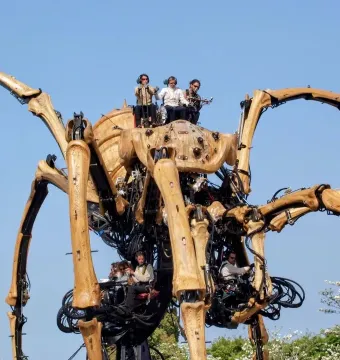
April 2009 © KQuhen · CC BY-SA 4.0
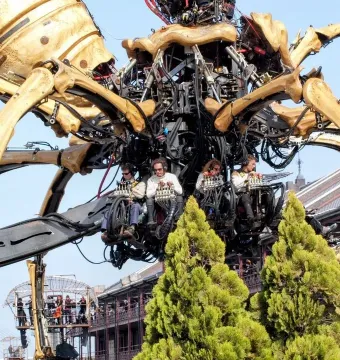
April 2009 © KQuhen · CC BY-SA 4.0
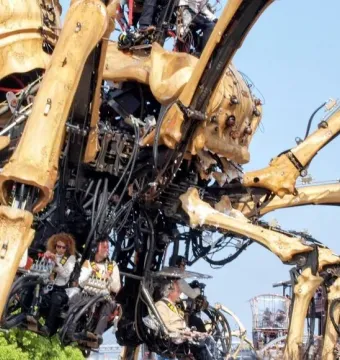
April 2009 © KQuhen · CC BY-SA 4.0
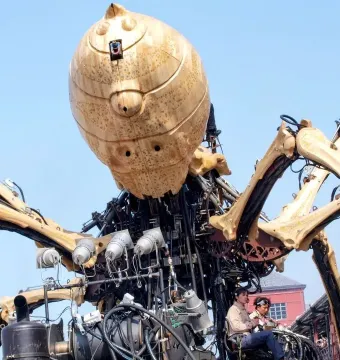
April 2009 © KQuhen · CC BY-SA 4.0

April 2009 © KQuhen · CC BY-SA 4.0
Identification | |
| Title | La Princesse |
| Alternative name | The Liverpool Princesse |
| Type | giant mechanical spider |
Creator | |
| Designer | François Delarozière |
| Creator / builder | La Machine |
Historical context | |
| Artistic inspiration | Jules Verne, Leonardo da Vinci, and Nantes’s industrial history |
| Additional inspiration | the literature of Jules Verne, Gustave Eiffel’s architecture, and Dadaism |
| Associated project founders | François Delarozière and Pierre Orefice |
| Associated project | Les Machines de l'île |
| Project context | Created for Liverpool’s 2008 European Capital of Culture celebrations |
Discovery and provenance | |
| Built in | Nantes, France |
| Built at | Cammell Laird shipyard in Birkenhead |
| Built in secret at | Cammell Laird shipyard in Birkenhead |
| Construction time | about one year |
| Shipped to | Merseyside |
| Associated project location | a warehouse in the port of Nantes |
Physical characteristics | |
| Operating speed | 2 miles per hour |
| Crew distribution | 8 of the 12 crew members operated the legs |
| Crew required | 12 people |
| Height | 15 metres |
| Number of movement axes | 50 |
| Claw length | 2 metres |
| Weight | 37 tons |
| Length | 13 metres |
Materials | |
| Materials | steel and poplar wood |
| Body composition | steel, skin, and poplar wood |
| Material note | the poplar wood turns brown in the sun, aging the creature’s skin |
Technique | |
| Mechanism | complex hydraulics |
| Movement style | the spider “walked” and “crawled” using a traction body and cranes for repositioning |
| Lifting equipment | up to 16 cranes and 6 forklift trucks |
| Transport requirements | 16 cranes, 6 forklift trucks, 8 cherry pickers, and 250 crew |
Appearance | |
| Appearance | an enormous mechanical spider |
| Special effects / abilities | it could shoot flames, spray water, emit sounds, and release smoke |
Iconography and meaning | |
| Symbolic interpretation | the spider symbolized “networking” |
| Organizer intention | to relate to a city that had become one of Japan’s main commercial reference points |
Location and ownership | |
| First public display location | Liverpool, England |
| First public display date | 5 September 2008 |
| First display context | Liverpool celebrations for the European Capital of Culture |
| Second public display location | Yokohama port |
| Second public display dates | 17–19 April 2009 |
| Later exhibition location | Yokohama Red Brick Warehouse |
| Later exhibition dates | 28 April to 27 September 2009 |
| Public access | free to the public |
History and restoration | |
| Permanence plans | there were plans to keep La Princesse permanently in Liverpool, with talks already held with La Machine and a reported funding shortfall of £300,000–£400,000 |
| Arachnophobia criticism | Anxiety UK and other medical associations warned it could frighten viewers with arachnophobia |
| Cost defense | Phil Redmond defended the cost, saying it was cheaper than booking Sir Paul McCartney and brought the project front-page coverage in the South China Morning Post |
| Cost criticism | the TaxPayers’ Alliance called it an outrageous waste of money |
| Funding | £1.5 million from Liverpool Culture Company, funded by the city, the Arts Council, and the Department of Culture, Media and Sport |
| Cost | about £1.5 million; some sources give £1.8–£1.9 million |
| Public reception | mostly positive, though some criticism focused on cost and arachnophobia concerns |
| Performance features | musicians accompanied the procession; it shot flames, sprayed water, used water cannons, smoke, fireworks, flame cannons, huge fans, and snow showers; a performer dressed as the scientist Joseph Browning appeared in the story |
| Performance date in Liverpool | 5–7 September 2008 |
| Final Liverpool action | entered the Queensway Tunnel and disappeared from public view amid fireworks and smoke |
| First performance route in Liverpool | Echo Arena, Albert Dock, Cunard Building, Castle Street, Lord Street, and Ranelagh Place |
| First appearance location | side of Concourse House, Lime Street, Liverpool |
| Audience size | about 400,000 people |
Significance | |
| Critical description | Lyn Gardner of The Guardian described it as leading the city in a joyful dance like an arachnid pied piper, but said it lacked the narrative drive and human dimension of The Sultan’s Elephant |
| Related work | The Sultan’s Elephant |
Other | |
| Special effects designer | Thierry Loridant |
| Reported audience response | the vast majority of the public response was positive and many regarded it as the highlight of Liverpool’s Capital of Culture 2008 celebrations |
| Costume designer | Gaelle Choveau |
| Associated performance | The Sultan’s Elephant |
| Music composer | Dominique Malan |
| Human performer character | Joseph Browning |
| Related objects | The Great Elephant, The Marine Worlds Carrousel, and The Heron Tree |
| Associated company | Artichoke |
| Related categories | Performing arts in the United Kingdom; Culture in Liverpool; Organised events in Liverpool; Fictional spiders; Robotic spiders; Robots of France; Performances |