
Crown Fountain
Crown Fountain is an interactive public artwork and video sculpture located in Millennium Park in Chicago’s community area known as The Loop. Designed by Spanish artist Jaume Plensa and created by Krueck and Sexton Architects, it was first shown in public in July 2004. The work features a shallow black granite pool with a reflective sheet of water between two glass brick towers. The towers display digital video images on LED faces and regularly send water cascading down from May to October. Celebrated for both art and entertainment, it is also known for public controversy, strong accessibility, and its popularity as a gathering place and photo spot.
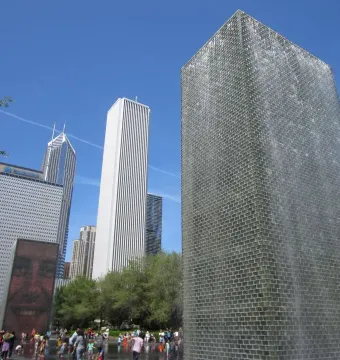
June 2015 © Another Believer · CC BY-SA 4.0
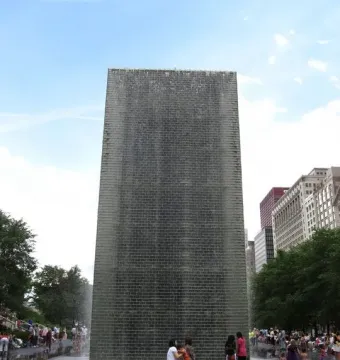
June 2013 © Ken Lund · CC BY-SA 2.0
July 2006 © Amaury Laporte · CC BY 2.0
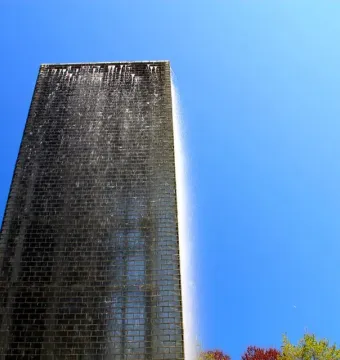
May 2015 © Daniel X. O'Neil · CC BY 2.0
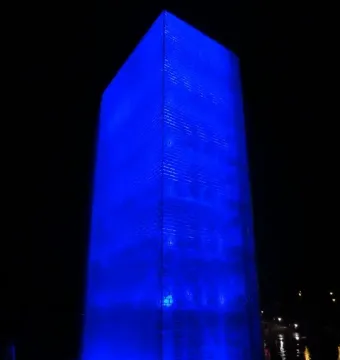
August 2011 © Paul Sableman · CC BY 2.0
Identification | |
| Title | Crown Fountain |
| Alternative name | Squirting Faces |
| Type | Interactive public fountain and video sculpture |
| Alternative name | La Fuente Crown |
Location and ownership | |
| Opening date | July 2004 |
| Location | Millennium Park, The Loop, Chicago, Illinois, United States |
| Part of | Grant Park |
| Specific placement | East of Michigan Avenue and the Michigan Boulevard Historic District; north of Monroe Street and the Art Institute of Chicago; south of Madison Street; between Lake Michigan and Chicago's financial district |
| Ownership / funding detail | The Crown family contributed US$10 million of the total cost; the Goodman family was another major contributor |
| Cost | Approximately US$17 million |
| Operating season | Usually operates from May to October, when weather permits |
Historical context | |
| Setting history | The site was used by the Illinois Central Railroad until 1997 and later contained rail yards and parking lots |
Creator | |
| Artist | Jaume Plensa |
| Architects | Krueck and Sexton Architects |
| Artist nationality | Catalan |
Discovery and provenance | |
| Selection process | Lester Crown and his family organized an informal competition and took part in engineering-related decisions without involving park authorities |
| Concept approval | The Crown family accepted sponsoring an architectural and decorative element in Millennium Park |
| Selected proposal | A video sculpture |
| Commission date | December 1999 |
| Selected proposal date | January 2000 |
| Competition finalists | Jaume Plensa, Maya Lin, and Robert Venturi |
| Funding | Entirely financed by private donors |
| Named after | The Crown family |
| Commissioned by | Lester Crown and his family |
Physical characteristics | |
| Form | Two glass-brick towers with a shallow black granite reflecting pool between them |
| Number of towers | Two |
| Tower height | 15.2 m |
Materials | |
| Materials | Black granite, glass brick, LEDs, and water |
Technique | |
| Video duration per face | Five minutes |
| Post-processing | Digital retouching and editing were used to adjust facial proportions, simulate wrinkles or pursed lips, align the mouth with the nozzle, and correct color, brightness, contrast, saturation, and sunlight visibility |
| Video sequence | A 40-second segment plays backward and forward at one-third speed, followed by 15 seconds of pursed lips, 30 seconds of water appearing to flow from the mouth, and about 15 seconds of smiling as the water stops |
| Video production participants | SAIC students, with participation from Columbia College Chicago students and faculty |
| Video count used | 960 clips |
| Video selection process | About 75 social, ethnic, and religious organizations in Chicago were asked to propose candidates for photographing |
| Display technology | LED screens embedded in the inward-facing sides of the towers display digital videos |
| Video production camera | Sony HDW-F900 high-definition video camera |
| Video production camera cost | About US$100,000 |
| Video production location | School of the Art Institute of Chicago campus |
| Video production subjects | 1,051 individuals, selected mainly from schools, churches, and community groups |
Appearance | |
| Facial framing | Hair and ears do not appear in the images |
| Water effect | Water intermittently cascades down the towers and appears to flow from the subjects' mouths through a front nozzle, evoking gargoyle fountains |
| Image content | Most videos show faces of Chicago residents; some show landscapes |
Iconography and meaning | |
| Representation | Intended to represent Chicago's ethnic, age, and sociocultural diversity |
| Themes | Dualism, light, water, and video technology |
| Relation to previous works | Extends Plensa's earlier use of video technology and works exploring light, LEDs, video, and computer graphics |
| Conceptual inspiration | Inspired by the surrounding water environment, Chicago's nearby shoreline, and the idea of a perpetual water work |
| Artistic aim | An interactive fountain that would be socially relevant to the 21st century and remain visually active even when water is off |
| Dual-face concept | Two randomly selected faces are shown in dialogue with each other |
History and restoration | |
| Cameras incident | Surveillance cameras were installed on top of the fountain after construction, then removed after public protests |
| Pre-construction controversy | Some people questioned whether its height would violate the park's aesthetic tradition |
| Controversy | It was one of the most controversial works in Millennium Park |
Significance | |
| Reception | Praised by residents and critics for its artistic, entertainment, originality, and architectural qualities |
| Public use | A popular meeting place, a favorite subject for photographers, and a public play area where visitors splash in the basin and children play in the water |
| Summer use | Provides relief from summer heat and is often used as a splash area or children's water park |
| Accessibility | Highly accessible because of universal design; visitors can freely interact with the water |
| Cultural impact | It became part of Chicago popular culture and appeared in early episodes of Prison Break |
| Heat-wave role | Used as a cooling refuge in Chicago during official heat advisories and when cooling centers are announced |