
Irish Hunger Memorial
Irish Hunger Memorial is a memorial in Manhattan, New York, located on North End Avenue between Vesey and Barclay Streets. It was built in memory of the Great Famine in Ireland of 1845–1852, during which about one million Irish people died. Construction began on 15 March 2001, with artist Brian Tolle, 1100: Architect, landscape architect Gail Wittwer-Laird, and historian Maureen O’Rourke involved in its design and creation. The memorial covers a quarter acre and is designed as a replica of a typical Irish hillside, with 62 plants native to County Mayo, stone walls from a house in Mayo, limestone from County Kilkenny, and quotations from contemporary observers. It was opened on 16 July 2002 and also honors Irish-American firefighters, police officers, rescue workers, and office workers who died on 11 September.

© Noki Va · CC BY 3.0
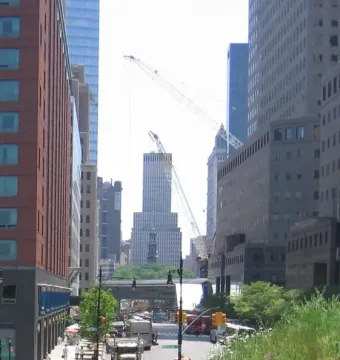
June 2009 © Noroton · Public domain
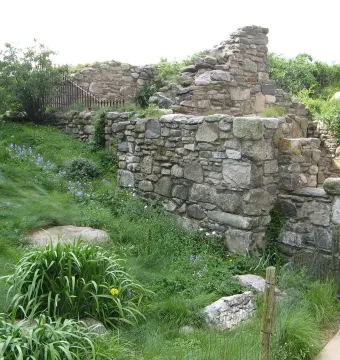
© olekinderhook · CC BY 3.0
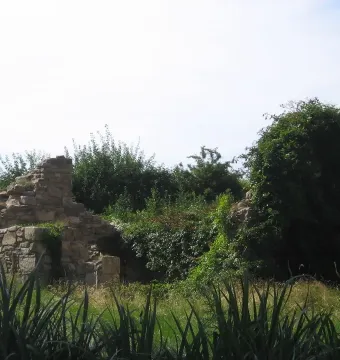
July 2007 © Mr. Kate · CC BY-SA 3.0
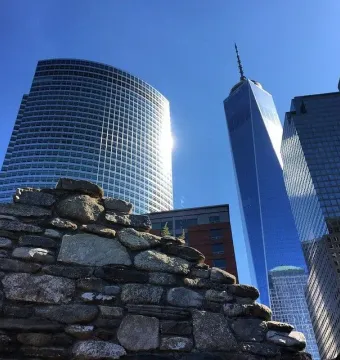
October 2014 © Christopher Michel · CC BY 2.0
Identification | |
| Title | Irish Hunger Memorial |
| Type | memorial sculpture |
| Spanish name | Memorial de la gran hambruna irlandesa |
Location and ownership | |
| Location | Corner of Vesey Street and North End Avenue, Battery Park City, Manhattan, New York City, New York, United States |
| Specific location | North End Avenue between Vesey Street and Barclay Street |
Historical context | |
| Historical period commemorated | 1845–1852 |
| Historical event commemorated | The Great Irish Famine, during which about one million Irish people died of starvation |
| Historical event death toll | About one million Irish people |
| Related migration context | In the decade after 1845, over 900,000 Irish emigrants entered the port of New York; by 1855 Irish-born New Yorkers made up almost one third of the city's population |
| Dedicated to | Raising awareness of the Great Irish Famine (An Gorta Mór) |
Creator | |
| Artist | Brian Tolle |
| Landscape architect | Gail Wittwer-Laird |
| Architecture firm | 1100 Architect |
History and restoration | |
| Temporary closure | Closed in August 2016 for waterproofing work |
| Cottage history | Abandoned in the 1960s |
| Opened | 16 July 2002 |
| Reopened | August 2017 |
| Status during September 11 attacks | Still under construction when the 11 September 2001 terrorist attacks occurred; construction and the surrounding area were affected, but the memorial was completed anyway |
| Completed | 2002 |
| Construction started | March 2001 |
Physical characteristics | |
| Inscription excerpt | A contemporary account describing at least 300 emaciated people in various stages of fever, starvation, and nakedness, many too weak to stand and lying on damp ground |
| Floral planting | 62 plants characteristic of County Mayo, including foxglove and common gorse |
| Lower wall inscriptions | Quotes by contemporaries describing the horrors of the catastrophe |
| Upper slope stones | 32 stones, one from each county of Ireland |
| Passageway | Connects the west side to the ruined stone cottage and the roof |
| Roof detail | Stones placed on the roof with the names of the Irish counties |
| Roof | No roof on the upper walls, echoing the roofless houses of many Irish people during the famine years who removed roofs to prove poverty and qualify for relief |
| Interior | Interior of the cottage ruins |
| North side | Shows the structure's gradual rise |
| Landscape representation | Recreates a 19th-century landscape with a ruined farmhouse |
| Form | Replica of a typical Irish hillside |
| Area | 0.2 hectares |
| West side | Shows the elevated end |
Materials | |
| Landscape materials | Stones, soil, and native vegetation transported from the west coast of Ireland |
| Upper wall material | Stone from a house built in County Mayo in 1820 |
| Lower section materials | Limestone from County Kilkenny and glass |
| Stone provenance | Stones from all counties of Ireland |
| Included structure | An authentic 19th-century Irish cottage from Carradoogan, parish of Attymass, County Mayo, Ireland |
Discovery and provenance | |
| Cottage former ownership | Belonged to the Slack family |
| Cottage donation | The Slack family donated the cottage to the memorial in memory of earlier generations of the family who emigrated to America |