
Throne of Weapons
Throne of Weapons is a sculpture by Cristóvão Canhavato, also known as Kester, made from decommissioned weapons and displayed at the British Museum. It was one of the 100 objects featured in the BBC radio series A History of the World in 100 Objects and has been described as the museum’s most expressive object. The throne includes the artist’s signature, termite traces, and details such as smiling faces on the weapons and a face found in the shape of a rifle butt. It was created through the organization Transforming Arms into Tools, which supplied deactivated weapons to Kester and his group. The arms used include AK-47s, G3s, an AKM, and a PPSh-43, many linked to Mozambique’s civil war.
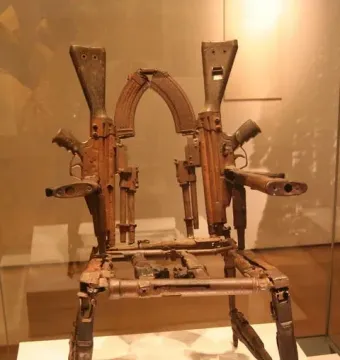
December 2007 © Nic McPhee · CC BY-SA 2.0
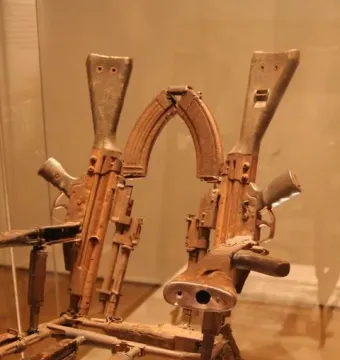
December 2007 © Nic McPhee · CC BY-SA 2.0
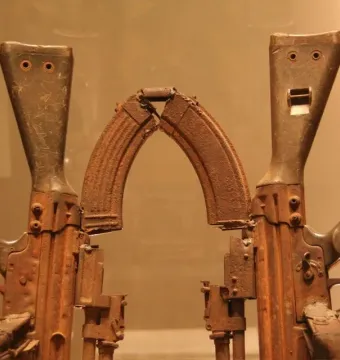
December 2007 © Nic McPhee · CC BY-SA 2.0
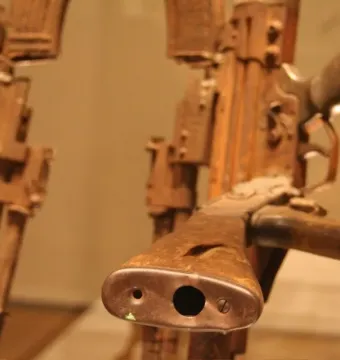
December 2007 © Nic McPhee · CC BY-SA 2.0
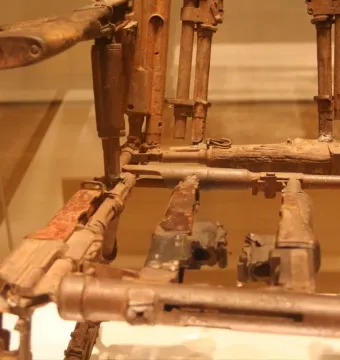
December 2007 © Nic McPhee · CC BY-SA 2.0
Identification | |
| Title | Throne of Weapons |
| Type | Sculpture / throne |
| Original-language title | O Trono de Armas |
| Alternative title | Waffenthron |
Creator | |
| Artist | Cristóvão Estavão Canhavato (Kester) |
| Birth year | 1966 |
| Birth place | Zavala, southern Mozambique |
| Affiliation | Associação Núcleo de Arte artists' cooperative, Maputo |
| Training | Received artistic training in a collective of artists; he already had knowledge of construction engineering |
| Supporting organizations | Christian Aid and a Christian initiative led by Bishop Dinis Sengulane |
| Associated project | Transforming Arms into Ploughshares / Transformação de Armas em Enxadas |
Historical context | |
| End of civil war | The war ended when the Soviet Union collapsed and funding stopped |
| Civil war casualties | About one million people were killed |
| Civil war funding | Financed by South Africa and Rhodesia, involving émigrés from their apartheid regimes |
| Context | Made in response to Mozambique's civil war |
Discovery and provenance | |
| Created | 2002 |
| Acquired by | The British Museum in 2002 |
| Transport to England | Brought to England by Christian Aid as part of the exhibition Swords into Ploughshares. Transforming Arms into Art (German: Schwerter zu Pflugscharen. Transformation von Waffen in Kunst) |
| Brokered by | Julia Fairrie of Christian Aid |
| Included in | A History of the World in 100 Objects (BBC and British Museum), broadcast from 2010 |
Materials | |
| Backrest material | G3 assault rifles designed by Heckler & Koch in Germany and manufactured in Portugal |
| Seat material | Weapons manufactured in Poland and Czechoslovakia |
| Front material | A North Korean-made AKM rifle and a PPSh-43 submachine gun |
| Weapon types used | Mostly AK-47 assault rifles; also G3 assault rifles, an AKM rifle, and a PPSh-43 submachine gun |
| Weapon origins | Manufactured in Portugal, Eastern Europe, North Korea, Poland, Czechoslovakia, and Germany |
| Main material | Decommissioned firearms and other weapons |
| Weapon source | Supplied by Transforming Arms into Ploughshares / Transformação de Armas em Enxadas |
Appearance | |
| Design element | The backrest has a gothic shape resembling the entrance portal of a Gothic church |
| Surface traces | Holes and marks remain from where carrying straps had been attached |
| Figurative details | Smiling faces were added to the weapons |
| Hidden face detail | A human face at the upper end of the right-hand rifle butt, described by the artist as 'found' rather than made, formed by the remains of holes and strap marks |
| Signature | The throne bears the artist's signature; curators also interpreted termite marks as an additional 'signature' |
| Termite marks | Termite damage is visible and was described by curators as an additional 'signature' |
Iconography and meaning | |
| Personal context | The artist said several of his relatives were killed by such weapons |
| Kofi Annan statement | He asked how such weapons were obtained to kill each other, noting that they do not manufacture weapons and sometimes do not have money to buy them |
| Church reference | The gothic backrest is intended to symbolize a church |
| Mozambique flag reference | The AK-47 motif is significant because an AK-47, a hoe, a book, and a star appear on the flag of Mozambique |
| Symbolism | Transforms decommissioned weapons into art; in Africa, chairs can also symbolize authority |
Location and ownership | |
| Owner | The British Museum |
| Location | British Museum |
History and restoration | |
| Exhibition history | Touring exhibit loaned by the British Museum and shown in schools, shopping centres, museums, cathedrals, community spaces, and prisons across the United Kingdom, as well as internationally |
| Display frequency | Shown in more exhibition variants than any other object in the British Museum, according to museum descriptions |
| Related work | Tree of Life, commissioned from the same artist group in 2005 and displayed in the museum's main gallery from February 2005 |
Significance | |
| Museum description | Described by the British Museum as its most 'eloquent object' |