
Agora
Agora is an installation of 106 headless and armless iron sculptures in the south end of Grant Park in Chicago, Illinois. Designed by Polish artist Magdalena Abakanowicz, the figures were made in a foundry near Poznań between 2004 and 2006 and brought to Chicago in 2006 as a permanent loan from the Polish Ministry of Culture. Each hollow iron figure has been allowed to rust, giving it a reddish, bark-like surface. The sculptures appear to be milling about in a crowd, and visitors are meant to walk through them and reflect on the work. The title refers to the public meeting places of ancient Greek city-states.
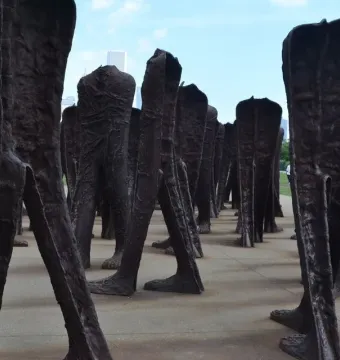
© Frank Skornia · CC BY-SA 3.0
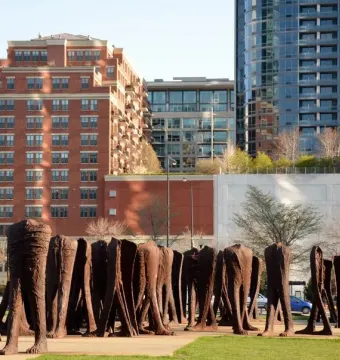
© Roman Eugeniusz · CC BY-SA 3.0
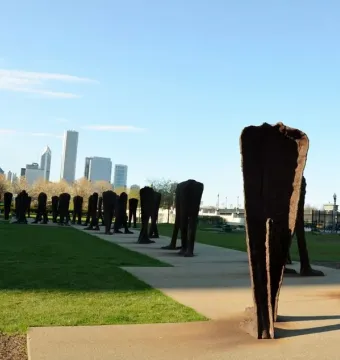
© Roman Eugeniusz · CC BY-SA 3.0
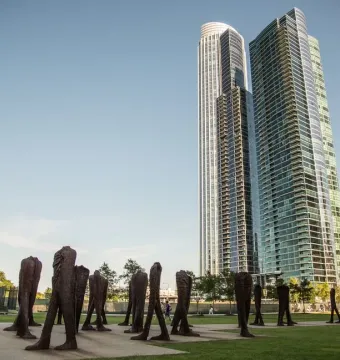
© Tony Webster · CC BY 2.0
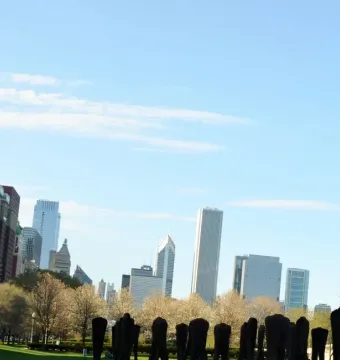
© Roman Eugeniusz · CC BY-SA 3.0
Identification | |
| Title | Agora |
| Type | large-scale sculpture installation |
Historical context | |
| Date made | 2004–2006 |
| Installed in Chicago | 2006 |
Creator | |
| Artist | Magdalena Abakanowicz |
| Artist nationality | Polish |
Discovery and provenance | |
| Funding | private donors, including actor Robin Williams, contributed over $700,000 to bring the work to Chicago by 2006 |
| Brought to Chicago by | Chicago Park District |
| Lender | Polish Ministry of Culture |
| Manufacturing site | foundry near Poznań |
Physical characteristics | |
| Number of figures | 106 |
| Form | headless and armless figures |
| Height of figures | 2.7 m |
| Weight of figures | about 820 kg |
Materials | |
| Material | hollow seamless iron |
| Surface treatment | allowed to rust |
Appearance | |
| Arrangement | the figures appear to be milling about in a crowd; some face each other while others look away |
| Texture | bark-like |
| Color | reddish |
Location and ownership | |
| Ownership/status in Chicago | permanent loan |
| City | Chicago |
| Country | United States |
| Location | south end of Grant Park near Roosevelt Road, Chicago, Illinois, United States |
History and restoration | |
| Alternative proposed locations | BP Pedestrian Bridge, Monroe Street harbor, and Chicago's Museum Campus |
| Transported to Chicago | 2006 |
| Commissioning and installation context | Chicago had hoped for a major work by Abakanowicz for several years; Mayor Richard M. Daley suggested placing it at the south end of Grant Park |
| Commissioned by | Polish Ministry of Culture |
Significance | |
| Scale significance | one of the largest similar installations in the world |
| Interpretation | Kevin Nance of the Chicago Sun-Times suggested the figures seem to think as individuals rather than as a group, and that the piece can be interpreted as a representation of democracy |
| Public response | mixed response from Chicagoans; some loved it and others hated it, with "nothing in between" according to Bob O'Neill |
| Mayor's view | Mayor Daley lauded the work and said, "You've got to go through it yourself to feel the spirit of the artist and each piece of artwork." |
Iconography and meaning | |
| Name meaning | Agora refers to the public meeting places of ancient Greek city-states |
| Artist's thematic background | Abakanowicz said her art draws on her fear of crowds, shaped by growing up during World War II |
| Artist's description of crowds | "mindless organisms acting on command, worshiping on command, and hating on command" |
| Visitor interaction | visitors are meant to walk through the sculptures and contemplate the work |