
Bison Licking Insect Bite
Bison Licking Insect Bite is a prehistoric Upper Paleolithic sculpture from Abri de la Madeleine near Tursac in Dordogne, France, the type site of the Magdalenian culture. Made from reindeer antler, it is a carved and engraved fragment of a spear-thrower. The work depicts an extinct steppe bison with its head turned back and its tongue extended. It was created sometime between 20,000 and 12,000 years ago, with the museum dating given as about 15,000 years. The spear-thrower was already broken into its present form before the carving was made, which explains the unusual pose. The object was formerly in the Musée des Antiquités Nationales in Saint-Germain-en-Laye and is now in the enlarged National Museum of Prehistory in Les Eyzies-de-Tayac-Sireuil.
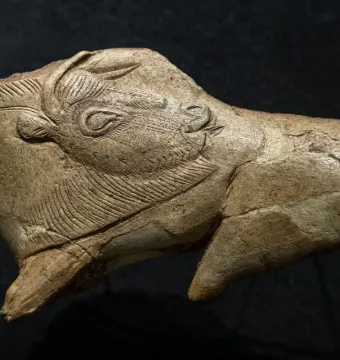
September 2017 © Thilo Parg · CC BY-SA 4.0
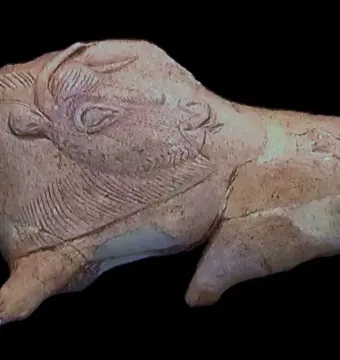
© Ethan Doyle White · CC BY-SA 3.0
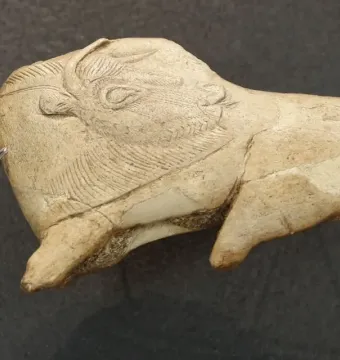
July 2013 © Pymouss · CC BY-SA 3.0
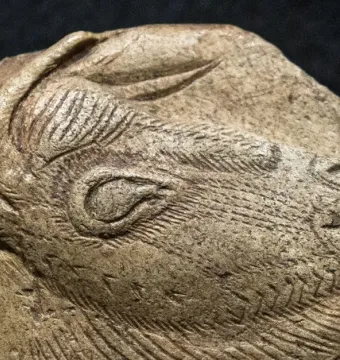
September 2017 © Thilo Parg · CC BY-SA 4.0
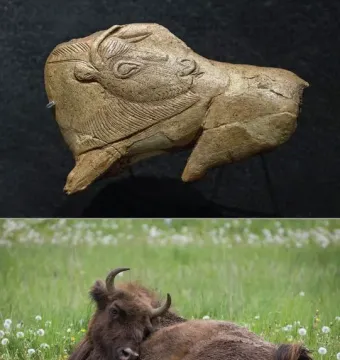
May 2023 © Thilo Parg · CC BY-SA 4.0
Identification | |
| Title | Bison Licking Insect Bite |
| Type | Prehistoric sculpture |
| Title in Portuguese | Bisão Lambendo a Picada do Inseto |
Historical context | |
| Period | Upper Paleolithic |
| Culture | Magdalenian culture |
Discovery and provenance | |
| Discovery location | Abri de la Madeleine near Tursac, Dordogne, France |
| Site significance | Type site of the Magdalenian culture |
| Date range | Created sometime between 20,000 and 12,000 years ago |
| Museum date estimate | 15,000 years old according to the museum |
Materials | |
| Material | Reindeer antler |
Physical characteristics | |
| Height | 10.5 cm |
| Object type | Fragment of a spear thrower |
Technique | |
| Technique | Carved and engraved |
Iconography and meaning | |
| Depicted animal | Bison |
| Animal species | Extinct steppe bison (Bison priscus) |
| Depiction | The bison is shown with its head turned back and its tongue extended, apparently licking an insect bite |
History and restoration | |
| Breakage and engraving sequence | The spear thrower was probably broken into its present shape before the carving was made on the fragment |
| Interpretive explanation | The turned-back head was likely necessary to fit the existing structure of the broken fragment |
Location and ownership | |
| Former location | Musée des Antiquités Nationales, Saint-Germain-en-Laye |
| Current location | Musée National de Préhistoire, Les Eyzies-de-Tayac-Sireuil |
| Relocation note | Transferred to the enlarged National Museum of Prehistory, which opened in 2004 |
| Current museum context | The museum is not far from the place of discovery |