
Hornsby Water Clock
The Hornsby Water Clock, titled Man, Time and the Environment, is a kinetic sculpture, decorative fountain and occasional clock in the Florence Street pedestrian mall in Hornsby, New South Wales, Australia. Unveiled in 1993, it was designed and engineered by Victor Cusack and built by Victor with his foundry floor manager Rex Feakes. The work is made of bronze, stainless steel and glass. Its construction, including changes to the mall, cost over A$1 million and took two and a half years. After years of breakdowns caused by discarded items, the water filtration system was upgraded, and by 2026 many moving parts had been fixed still, so it no longer tells time.
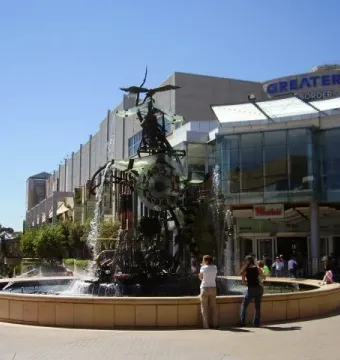
© Milesli · Public domain
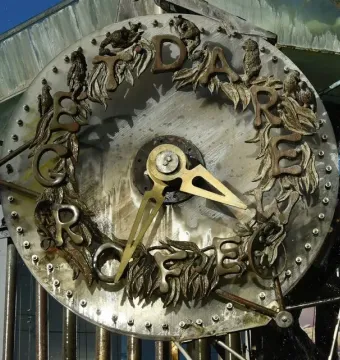
May 2018 © Sardaka · CC BY-SA 4.0
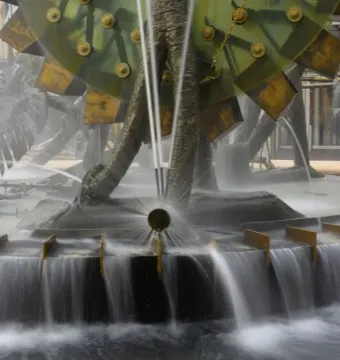
June 2019 © Sardaka · CC BY-SA 4.0
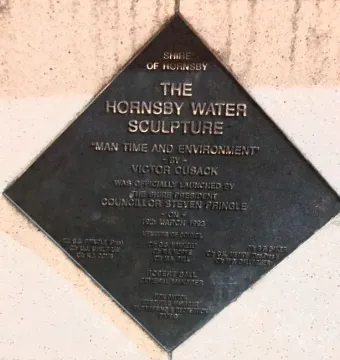
May 2020 © EH James · CC BY-SA 4.0
December 2007 © Peter4Truth · Public domain
Identification | |
| Title | Hornsby Water Clock |
| Alternative title | Man, Time and the Environment |
| Type | kinetic sculpture; decorative fountain; water clock |
Location and ownership | |
| Location | Florence Street pedestrian mall, Hornsby, New South Wales, Australia |
| Country | Australia |
| Specific later location | near the Westfield shopping centre in Hornsby |
| Mounted on | a floating pontoon |
Historical context | |
| Historical prototype | based on a model by Su Song, who built a clock for his observatory around 1088–1092 |
| Pendulum clock design source | based on an unbuilt design drawn up by Claude Perrault in 1669 |
| Claimed status | said to be the largest water-powered pendulum clock ever built |
| Unveiled | 1993 |
| Construction cost | over A$1 million |
Creator | |
| Rex Feakes role | foundry floor manager |
| Constructed by | Victor Cusack and Rex Feakes |
| Designer | Victor Cusack |
Physical characteristics | |
| Height | approximately 8 m |
| Weight | 20 t |
| Pendulum weight | 350 kg |
| Water wheel diameter | 2.3 m |
| Carillon | 17 bells, about 1 tonne total weight, with a metal frame |
Materials | |
| Water clock mechanism | a meniscus-full overflow tank feeds a fixed vessel; excess water drains off while the water level remains constant and the water flowing into a second vessel measures time |
| Carillon material | cast bell bronze |
| Materials | bronze, stainless steel, and glass |
History and restoration | |
| Removal | removed in the early 2000s during renovation of the nearby Westfield shopping centre |
| Damage during removal | damaged during removal, which rendered the clock inoperable |
| Legal action | in 2005, Cusack successfully sued the council to maintain the sculpture under his moral rights as creator |
| Condition by 2015 | the sculpture had again fallen into disrepair |
| Cusack's claim in 2015 | he said the council had neglected basic maintenance |
| Reason for lawsuit | Cusack said its disrepair affected his artistic reputation |
| Council's response in 2015 | the council said the repair was not simple |
| Maintenance update | the water filtration system was upgraded after the damage incidents |
| Construction duration | two and a half years |
| Construction modifications | alterations to the mall were required during fabrication and installation |
| Operational issues | chicken bones and other discarded items caused repeated breakdowns |
| Function as of 2026 | it no longer tells time |
| Condition as of 2026 | many moving parts had been repaired, but the sculpture was fixed in place, the water wheel movement was limited, and the pendulum was fixed to reduce wear and tear |
Appearance | |
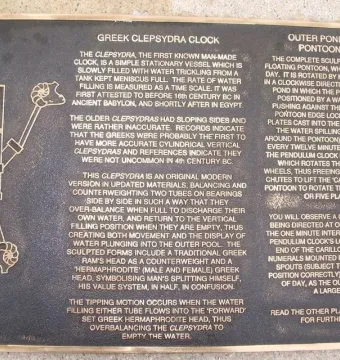
| Explanation plaques | four plaques are attached to the fountain |
| Overall composition | three water-powered clocks and a 17-note bronze carillon, with a fourth time indicator based on a rotating floating pontoon |
| Tube decoration | the tubes are decorated with a head of Hermaphrodite |
| Counterweight decoration | the counterweight is shaped like a ram's head |
| Water wheel counterweight | a Buddha sculpture |
| Plaque content | three plaques explain the three clocks, and one explains the sculpture's overall message |
| Carillon sound range | from the octave above middle C plus three notes above to the G below |
Iconography and meaning | |
| Hour markings | the hours are marked by the letters of 'Dare we forget' |
| Environmental statement | a unique environmental statement about Hornsby's natural environment and the loss of species and habitats |
| Symbolism | it contrasts human creativity with humans' growing inability to coexist with other life on Earth |
| Tribute | it pays tribute to the beauty of the local environment |
| Depicted animals | tawny frogmouth, rainbow lorikeet, pied cormorant, little penguin, Australian pelican, Australian water dragon, blue-tongued lizard, goanna, grey-headed flying fox, brushtail possum, sea eagle, and human |
| Aboriginal art forms | included as a reminder of Hornsby's former strong Aboriginal population |
| Moral message | it calls for human responsibility toward other living beings |
Technique | |
| Seconds display | a glass wheel with 30 markings around the edge, moved by each 2-second half-cycle of the pendulum |
| Clocking mechanism | a pointer sweeps past Roman numerals in the water around the fountain's perimeter as a fourth time indicator |
| Pontoon movement | the complete sculpture rotates clockwise in the basin, with the pontoon locking into 60 stops on the inner pond wall and being released every 12 minutes by the pendulum-driven mechanism |
| Top-drive operation | when one side fills, it tips the mechanism so water drains and the second tank receives water below the sea eagle sculpture |
| Minute and hour movement | the minute hand moves once per minute and the hour hand once every 12 minutes |
| Second-wheel mechanism | a cam on the second wheel releases 100 liters of water every 30 seconds |
| Pendulum clock | water-driven pendulum clock with a 4-second cycle, a 5 m pendulum mounted on a knife-edge, and a top-drive mechanism of moving glass chutes |
| Water wheel clock | a wheel with 20 free-swinging counterweighted buckets that fill at a constant rate, tip when overbalanced, and trigger a release mechanism for the wheel to rotate |
| Counterweighted tubes | two tubes on bearings tip over when full, dump their contents into the basin, and return upright by counterweight |
| Carillon mechanism inspiration | based on a design by Harringtons of Coventry seen in a church in Haywards Heath, Sussex |
| Carillon playing mode | automatically strikes the hour and can also be played manually |