
Yama
Yama is a Holocaust memorial at the corner of Melnikayte and Zaslavskaya streets in Minsk, Belarus. It marks the site where, on 2 March 1942, Nazi German forces shot about 5,000 Jewish residents of the nearby Minsk Ghetto. The original obelisk was created in 1947 by the Soviet Union, and a bronze sculpture titled The Last Way was added in 2000. Created by Leonid Levin and Elsa Pollak, the sculpture shows a group of victims descending the steps of the pit. The memorial also includes figures of a violinist, children, and a pregnant woman, and annual funeral assemblies are held there on 2 March.
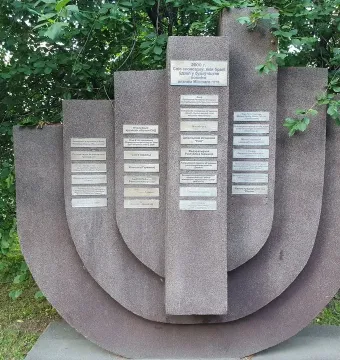
© Aschroet · CC0
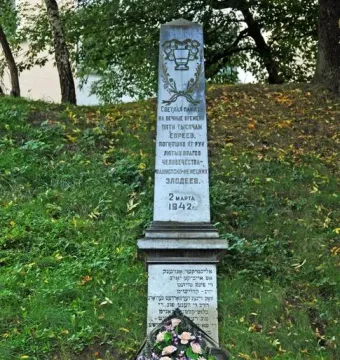
September 2009 © Dennis G. Jarvis · CC BY-SA 2.0
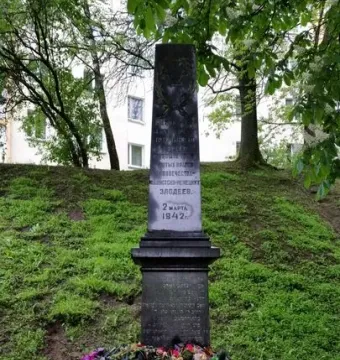
May 2016 © Liadmalone · CC BY-SA 4.0
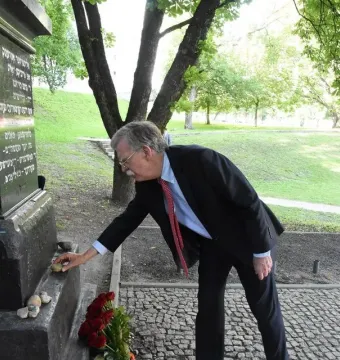
August 2019 © Office of U.S. National Security Advisor · Public domain
April 2009 © Pessimist2006 · Public domain
Identification | |
| Name | Yama |
| Alternate name | Memorial "Yama" |
| Type | Memorial monument |
Historical context | |
| Commemorated event | The shooting of about 5,000 prisoners of the Minsk Ghetto by Nazi German forces on 2 March 1942 |
| Commemorates | Victims of the Holocaust, especially the Jews of the Minsk Ghetto |
| Site significance | Located at the site where about 5,000 Jews from the nearby Minsk Ghetto were shot on 2 March 1942 |
| Earlier memorial | A granite obelisk was erected in 1947 |
| Historical significance | The first monument to Holocaust victims in the USSR on which an inscription in Yiddish was permitted |
Creator | |
| Inscription author | Haim Maltinsky |
| Sculptors | Alexander Finsky; Elsa Pollak |
| Architect | Leonid Levin |
Discovery and provenance | |
| Installed | 2000 |
| Construction period | 8 years |
| Decision to create larger memorial | In the 1990s |
Physical characteristics | |
| Location | Corner of Melnikayte and Zaslavskaya streets, Minsk, Belarus |
| Location within memorial | Along the stairs leading down to the center of the memorial |
| Associated memorial | Yama Memorial |
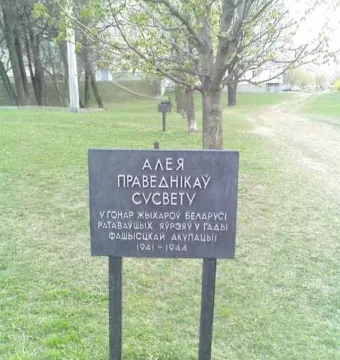
| Associated project | Alley of the Righteous Among the Nations nearby |
Materials | |
| Material | Bronze |
Technique | |
| Construction method | Built entirely by hand; no machinery or excavations were used |
Appearance | |
| Proposed figures in original design | A violinist, children, and a pregnant woman |
| Original design character | Initially planned to be more specific and still rather abstract, with collective images |
| Final style | More expressive and without overt national character |
| Subject | A group of doomed martyrs descending to the bottom of a pit |
Iconography and meaning | |
| Inscription note | The two translations are not exact |
| Nearby features | A deep pit lined with slabs, an obelisk at the bottom, and a round paved black-cobblestone площадка in front of the obelisk; 17 steps lead down to it |
| Inscription languages | Russian and Yiddish |
| Inscription text | To the shining memory of the bright days of five thousand Jews who perished at the hands of sworn enemies of humanity, German-fascist butchers, on 2 March 1942. |
Location and ownership | |
| Annual commemoration date | 2 March |
| Annual commemorations | Mourning memorial meetings are held at the memorial site every year on 2 March |
| Initiators of remembrance events | The Union of Belarusian Jewish Organizations and Communities |
| Related events | Days of Remembrance of the Holocaust are held in Minsk |
| Additional activities | International round tables are organized to study the tragedy of the Jews of Belarus |
History and restoration | |
| Vandalism | The memorial has been vandalized several times |
| Reconstruction details | The work was done manually; no machines were used and no excavations were carried out |
Other | |
| Planned future feature | Trees with plaques bearing the names of people who saved Jews during the German occupation are to be planted nearby |