
Wehrmann in Eisen, Vienna
Wehrmann in Eisen is a sculpture in Vienna and the first of the wooden objects used for war financing during World War I and nailed in exchange for donations. Created by sculptor Josef Müllner in 1914, it shows a knight carved from linden wood and was ceremonially unveiled on 6 March 1915. It was originally placed at Schwarzenbergplatz near the Schwarzenberg Monument. Over time it was moved and reused for further fundraising and commemorative purposes, including a 1934 reinstatement. It is now located by the municipal office at the corner of Felderstraße and Ebendorferstraße, opposite Vienna City Hall on the Ringstraße.
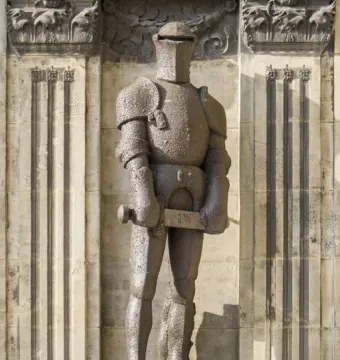
May 2014 © Thomas Ledl · CC BY-SA 3.0 at
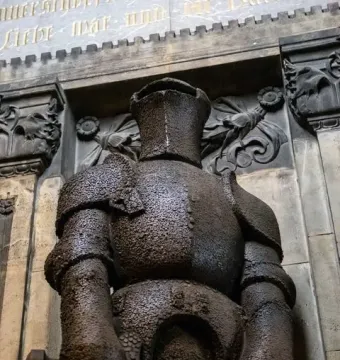
January 2020 © Tsui · CC BY-SA 4.0
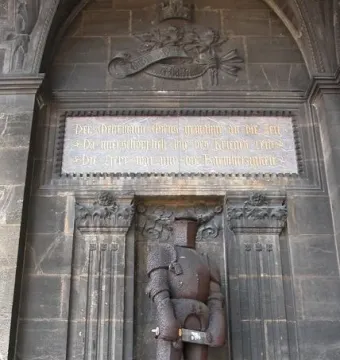
August 2005 © GuentherZ · CC BY-SA 3.0
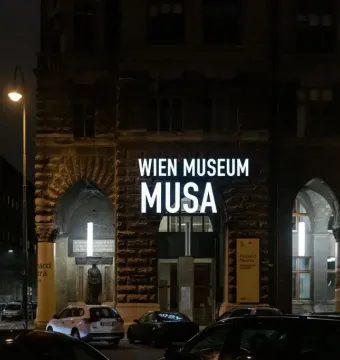
January 2020 © Tsui · CC BY-SA 4.0
October 2018 © Arquus · CC BY-SA 4.0
Identification | |
| Title | Wehrmann im Eisen |
| Type | wooden nailed sculpture / war nailer |
| Alternative names | Wehrmann in Eisen; Eiserner Wehrmann; Iron Soldier; Iron Warrior; Wehrmann in Eisen, Vienna |
Historical context | |
| Patriotic ceremony date | 4 April 1915 (Easter Sunday) |
| Funds raised at Easter 1915 ceremony | 18,000 crowns for the 'widows' and orphans' relief fund of the entire armed forces' |
| Attendance at Easter 1915 ceremony | 1,834 people on Easter Sunday and 1,839 on Easter Monday |
| Bulgarian nailing ceremony date | 21 November 1915 |
| Bulgarian representative | Envoy Andrei Toschew, acting in the name of King Ferdinand I of Bulgaria |
| World War I decline | The practice declined and ended in the third year of the war after wartime hardships and heavy losses in the Verdun and Somme battles weakened confidence in victory |
| Last cross mentioned in the broader practice | Installed in Erzene, Lower Saxony, in January 1918 |
| Second World War | With very small exceptions, nailing wooden figures did not become widespread during World War II |
| Ceremony participants | Elias of Bourbon-Parma performed the symbolic nailing for the troops and army establishments under the command of Archduke Peter Ferdinand of Austria-Tuscany |
| Historical role | The first of the wooden war-financing nail figures set up during World War I |
| Origin of the war-nailing tradition | Vienna, associated with the Stock im Eisen at Stock-im-Eisen-Platz |
| Possible origin hypothesis | The tradition may derive from the legendary nailed spruce trunk displayed at the corner of Kärntner Straße and Graben in Vienna near St. Stephen's Cathedral |
| First documentary mention of the legendary nailed spruce trunk | 1533 |
| Historical context of the practice | The practice began during World War I and was known mainly in southeastern Europe, Austria-Hungary, and Germany |
| First wooden war figures | Began to be installed in March 1915 |
Creator | |
| Idea attributed to | Corvette captain Theodor Graf Hartig of the Austrian Navy |
| Planning and execution | City building director Heinrich Goldemund, commissioned after a unanimous decision of the Vienna municipal council to take over the foundation and maintenance costs |
| Artist | Josef Müllner |
| Artist details | Austrian sculptor (born 1879, died 1968) |
Discovery and provenance | |
| Date made | 1914 |
| Planned relocation outcome | It was not actually installed at the new location |
| Duration at Schwarzenbergplatz | It remained there until 1919 |
| Place made | Vienna |
| Proposed by | A captain corvette of the Austrian Navy, Count [name omitted in the fragment] |
| Commissioning / funding body | A charitable association |
| Installation date | 6 March 1915 |
| Original location | Schwarzenbergplatz, Vienna, near the Schwarzenberg Monument |
| Planned relocation | On 5 May 1918 the Vienna municipal council decided to place the sculpture under the arcades of the house at Rathausstraße/Felderstraße and add a verse by Ottokar Kernstock |
History and restoration | |
| Reinstalled | 1934 |
| Removal status | Dismantled and placed in storage in 1919 |
| 1934 location | In the arcades at the rear of the Vienna city planning house, one of the arcade houses at Felderstraße 6–8 (today MA18 and MUSA) |
| Reason for restoration | Damage caused by souvenir hunters pulling nails out of the figure |
| Restoration date | 2007 |
| Associated fundraising use in 1934 | Ten memorial books were purchased from the donations, in which the names of fallen Austrians were written and which are kept in the crypt |
| Postwar removal | According to Tristan Loidl, after the war the sculpture was removed from Schwarzenbergplatz and stored in a depot, from where soldiers of Infantry Regiment 'Alt Starhemberg Nr. 2' took it to the regimental museum |
| Purpose of 1934 use | To collect money again for the conversion of the Outer Burgtor into a heroes' monument |
Physical characteristics | |
| Style / historical costume | Medieval knight imagery with armor |
| Depicted figure | A knight in medieval plate armor |
Materials | |
| Nails | Metal, silver, or gold nails |
| Material | Linden wood |
Technique | |
| Participant rewards | A commemorative postcard, badge, or certificate; names entered into a memorial book kept by the City of Vienna |
| Early daily nail count | About 1,600 nails per day in the first week, according to a newspaper report of 14 March 1915 |
| Use in fundraising | Nails were driven into the figure in exchange for donations |
| Associated practice | Metal, silver, or gold nails could be driven into the figure in exchange for donations |
| Minimum donation required to nail a nail | At least one crown |
| Estimated number of nails | Around 500,000 nails |
| First nails driven by | Archduke Leopold Salvator representing Emperor Franz Joseph I; German ambassador Tschirschky-Bögendorff on behalf of Kaiser Wilhelm II; and Turkish ambassador Hüseyin Hilmi Pasha on behalf of Sultan Mehmed V, as allies in the war |
| First nail donors | Archduke Leopold Salvator, the German ambassador, and the Turkish ambassador, as military allies |
| Early participation | About 1,400 people nailed nails into the sculpture during the first two days |
Iconography and meaning | |
| Social pressure / interpretation | Citizens who did not participate could be seen as unpatriotic or even as traitors |
| Symbolic meaning | Combined patriotism with religiosity and embodied the ideal of courage and honor |
| Subject depicted | A warrior depicted as a knight in medieval plate armor |
Location and ownership | |
| Specific location | In the arcade of the Startgalerie Artothek (MUSA) museum, at the corner of an unspecified street and Ebendorfa, opposite the City Hall on Ringstrasse |
| Current site | At the Amtshaus, on the corner of Felderstraße and Ebendorferstraße, opposite the City Hall on the Ringstraße |
| Location | Vienna, Austria |
Significance | |
| Comparative remark in 1916 | The author considered the fundraising amount unsatisfactory for a city of Vienna's size and compared it unfavorably with Drohobych in Galicia |
| Visitor access restriction in 1916 | By September 1916 access at Schwarzenbergplatz was only possible during limited hours or for registered groups because visitor numbers had fallen sharply |
| Reported fundraising total by 10 August 1916 | About 700,000 crowns had been collected so far |
| Described status in 1915 | Called the 'new landmark of Vienna' |
| Related forms of nailed figures mentioned | War figures, shields, city coats of arms, iron crosses, historical or legendary figures, animals, airplanes, submarines |
| Most common forms among such figures | Shield and medieval knight |
| Other cities/examples mentioned | Salzburg, Berlin, Regensburg, Merseburg, Silandro, Istanbul, and German clubs in the USA |
Other | |
| Related sculpture mentioned | "Iron Knight" ("Zaliznyi Lytsar") in Lviv, installed on 2 April 1916 by sculptor Jan Nalborczyk and architect Witold Doliński; 263 cm high; opened by Mayor-general Franz Rimal; raised 151,513 crowns by the end of the year; later transferred to the Historical Museum of the city |
| Another related sculpture mentioned | "Knight in Armor" in Lviv, created by Oberleutnant Emerik Bak, installed on 14 May 1916 in a brick pavilion on the Market Square; symbolized defensive capability and independence; one day of nail driving raised about 400,000 crowns |