
Rainy Taxi
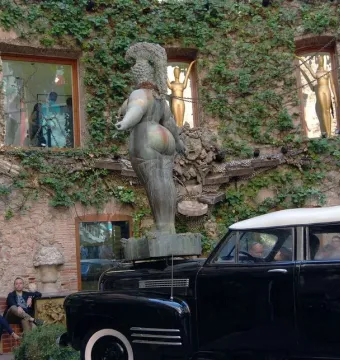
Rainy Taxi is a 1938 surrealist and Dadaist artwork by Spanish artist Salvador Dalí. The version displayed at the Dalí Museum in Figueres transforms a Cadillac Series 62 convertible from Dalí’s collection into a black taxi. It features a driver wearing a shark hat and a woman in an evening dress seated in the back, surrounded by a wet interior where lettuce, chicory, and Burgundy snails appear to grow. Rain falls inside the car through an ingenious piping system that can be activated by visitors using a 1 euro coin. The front is topped by a giant mascot-like radiator figure, a copy of Ernst Fuchs’s La grande Esther. The work is currently exhibited in the entrance patio-garden of the Dalí Theatre-Museum in Figueres, Catalonia.
© Kippelboy · CC BY-SA 3.0
© Harvey Barrison · CC BY-SA 2.0
© Harvey Barrison · CC BY-SA 2.0
© jordi domènech · CC BY-SA 3.0
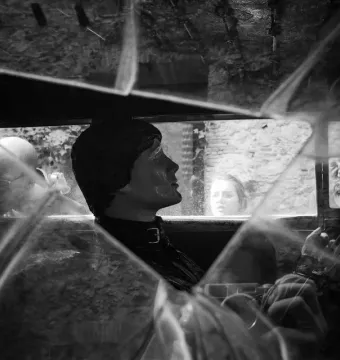
© Nicolas Perriault · CC BY 3.0
Identification | |
| Title | Rainy Taxi |
| Type | Sculpture / installation |
| Alternative titles | Le Taxi pluvieux; la Cadillac pluvieuse; Cadillac Lluvioso; The Rainy Taxi; Mannequin Rotting in a Taxi-Cab |
Historical context | |
| Date | 1938 |
| Style | Dadaist surrealist art |
| Work status | Created in several versions |
Creator | |
| Artist | Salvador Dalí |
| Artist nationality | Spanish |
| Artist life dates | 1904–1989 |
| Notable claim | Described by Dalí as the largest surrealist monument in the world |
Discovery and provenance | |
| Main hall designer | Marcel Duchamp and Wolfgang Paalen |
| Travel and exile context | Dalí and Gala visited the United States with this car and later spent eight years in New York from 1939 to 1947, fleeing Spain and Europe during World War II |
| Vehicle provenance | The Cadillac came from Salvador Dalí's personal collection and was offered by him to Gala Dalí; it was used during the couple's travels in the United States in the 1930s |
| Water installation supervision | Wolfgang Paalen was responsible for supervising the water installations |
| Model claim | Dalí stated that there were only six examples of this Cadillac model and claimed examples were owned by Franklin Roosevelt, Clark Gable, and Al Capone |
| Exhibition organizers | André Breton and Paul Éluard |
| Later version | Installed in 1974 at the Dalí Theatre-Museum in Figueres after the building was transformed into a museum |
| Second version recreation | Recreated in New York in 1939 |
| First version creation | Created in Paris in 1938 |
| First exhibition | Exhibited in 1938 at Galerie Beaux-Arts, Paris, for the Exposition Internationale du Surréalisme |
Materials | |
| Base vehicle | A Rolls-Royce for the Paris version; a New York yellow taxi cab for the New York version; a 1938 Cadillac Series 62 convertible with a V8 engine for the museum version |
Physical characteristics | |
| Composition | An actual automobile with two mannequin occupants |
| Vehicle transformation | Transformed into a black taxi |
Appearance | |
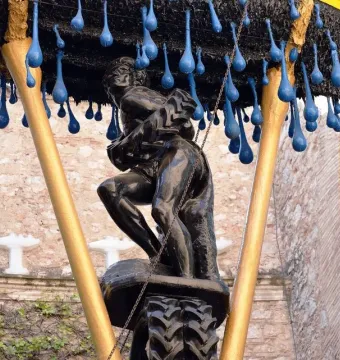
| Front hood element | A Trajan's Column made of tires |
| Driver figure | A chauffeur with a shark head, seated in the front seat and wearing a shark hat |
| Passenger figure | A woman in an evening dress seated in the back seat, with tousled hair |
| Interior environment | Lettuce and chicory grow around the passenger, with live Burgundy snails crawling across her body |
| Rain effect | Rain falls inside the car, creating a damp, wet setting |
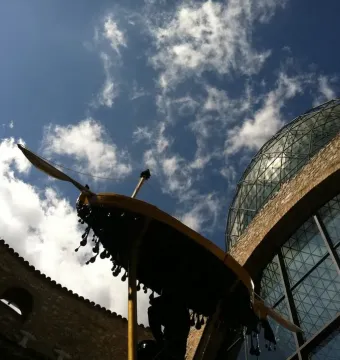
| Upper hood element | A giant leaking boat atop a man tied up with a tire |
| Radiator mascot | The Great Esther, a realistic fantasy sculpture by Austrian sculptor Ernst Fuchs, serves as a giant radiator cap on the front hood |
| Radiator mascot details | Decorated with a mane and harnessed by two chains |
Technique | |
| Interactive feature | Activated by the public using a €1 coin slot |
| Rain mechanism | An ingenious system of pipes |
Location and ownership | |
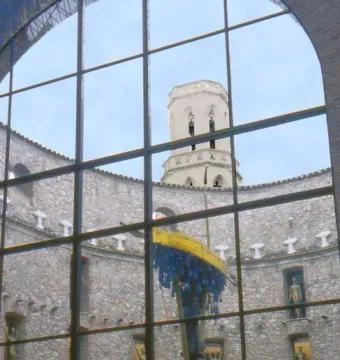
| Current location | Entrance courtyard patio-garden of the Dalí Theatre-Museum in Figueres, Catalonia |
| Associated museum | Dalí Theatre-Museum (Museu Dalí) in Figueres, Catalonia |
| Exhibited version | The version displayed at the Dalí Theatre-Museum in Figueres |
| Reconstruction status | A reconstruction of the original installation is installed in the open courtyard |
| Surroundings | Surrounded by Art Deco golden mannequins in the former theater boxes and by other Dalí works on the patio walls, including statues, monsters, and drawers |
Significance | |
| Interpretation | It illustrates the extravagant and delirious side of the interwar period and the two World Wars in an artistic, intellectual, and humorous way |
| Historical context | Associated with the international popularity of surrealism, which was then very much in vogue internationally |
Other | |
| Reference to other site | Its statues, monsters, and drawers recall the sculptures of the Monster Park near Rome |