
La Défense de Paris
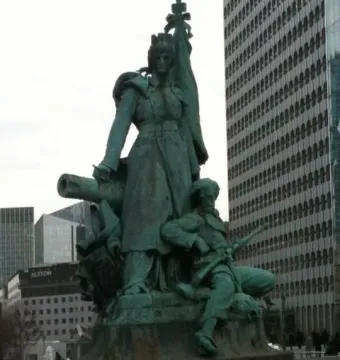
La Défense de Paris is a bronze statue by French sculptor Louis-Ernest Barrias. It commemorates the French dead from the Siege of Paris in 1870–71 during the Franco-Prussian War. The sculpture group was unveiled west of Paris on 12 October 1883, on an existing plinth near the crossroads between Courbevoie and Puteaux. The surrounding area later became known as La Défense after the statue. The work was removed from its original site, relocated around 1965, moved several times, and was placed at its current location near the Arche de la Défense in 2017.
January 2012 © Meta W. · CC BY-SA 3.0
© Anonyme, photographe · CC0
June 2012 © Mariordo (Mario Roberto Durán Ortiz) · CC BY-SA 3.0
July 2024 © GFreihalter · CC BY-SA 4.0
December 2010 © Jean-Pierre Dalbéra · CC BY 2.0
Identification | |
| Title | La Défense de Paris |
| Alternative title | La Défense |
| Type | commemorative bronze sculptural group |
Historical context | |
| Date | 1878 |
| Commissioning year | 1879 |
| Historical context | Created in the context of the Third French Republic's commemorative monument tradition, after the Republican government came to power in 1879 |
| Site significance | The place where French National Guard soldiers assembled before the Battle of Buzenval on 19 January 1871, the last attempt by the defenders to break out of the siege of Paris |
| Political context | Commissioned after the Republican government came to power in France in 1879 |
Creator | |
| Artist | Louis-Ernest Barrias |
Discovery and provenance | |
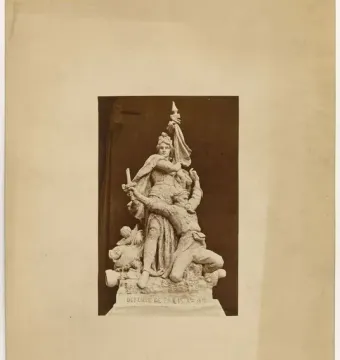
| Preparatory model | A plaster model, circa 1880, patinated to resemble bronze; shown at the Paris Salon in 1881; now in the Petit Palais |
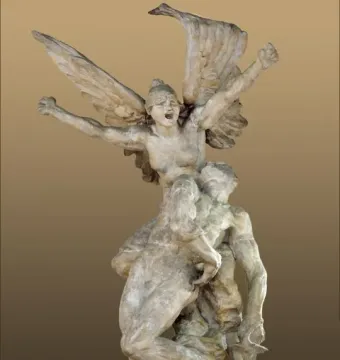
| Rejected proposal | Auguste Rodin's L'Appel aux armes (The Call to Arms) |
| Competing artists | Around 100 French artists were invited, including Gustave Doré, Auguste Bartholdi, Albert-Ernest Carrier-Belleuse, Alfred Boucher, Alexandre Falguière, Auguste Rodin, Lequien, and Moreau |
| Competition | A competition was organized for the monument; Barrias won after five rounds of voting |
| Commissioning body | Government of the Seine department |
Physical characteristics | |
| Number of figures | Three |
| Composition | A three-figure group symbolizing Paris, the military service, and the suffering civil population |
| Figures | A woman in National Guard uniform with a mural crown, leaning on a cannon and holding a flag; a young soldier loading his Chassepot rifle; and a sad young woman |
Materials | |
| Material | Bronze |
| Model material | Plaster with patina |
Technique | |
| Foundry | Thiébaut Frères foundry |
Iconography and meaning | |
| Alternative interpretation | According to Henri de Frémont, the woman may represent the insurgent Commune against the Versailles government rather than the City of Paris |
| Symbolism | The three figures summarize the heroism of the defense of Paris and form a united family facing adversity |
| Interpretation | A metaphor for national reconciliation |
| Subject | The defense of Paris in the Franco-Prussian War, especially the Siege of Paris of 1870–71 |
| Purpose | To commemorate the defense of Paris and France during the Franco-Prussian War and to mark the reintegration of Paris into the French nation after the Paris Commune |
| Commemorated group | The French military and civilian dead from the Siege of Paris in 1870–71 |
Location and ownership | |
| Original location | At the crossroads of Courbevoie, west of Paris, on the site later known as La Défense roundabout, in present-day Puteaux, Hauts-de-Seine |
| Original site names | Carrefour de Courbevoie; Rond-point de Courbevoie; De la Demi-lune; De Chantecoq; De l'Empereur; Rond-point de la Défense |
| Intended site | The crossroads of Courbevoie at the far end of the Bois de Boulogne, on the extended Axe historique closing the perspective of the Arc de Triomphe |
| Original plinth | Mounted on a reused granite plinth 5 meters high that had previously supported a bronze statue by Charles Émile Seurre of Napoleon I |
| Original setting | Surrounded by an iron grille with four gas lanterns |
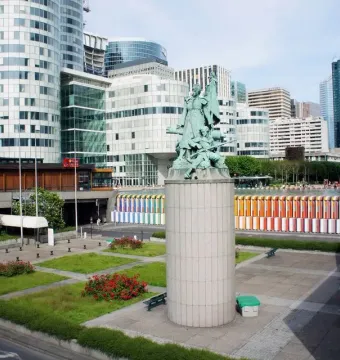
| Current location | Near the Grande Arche de la Défense, on the esplanade in the La Défense business district, between the Grande Arche and the Seine |
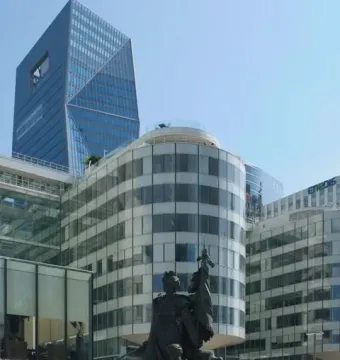
| Current site context | At the heart of the La Défense business district, which developed from the 1950s and extends into Nanterre and Puteaux |
History and restoration | |
| Temporary removal | For several years it was hidden in storage during the development of the La Défense business district and the construction of La Défense station on RER line A |
| Later relocation | In 2017 it was moved to a more visible location near the Arche de la Défense |
| Unveiling ceremony | Unveiled by Interior Minister Pierre Waldeck-Rousseau; the ceremony included a 21-gun salute, a military parade, and a performance of La Marseillaise by the Republican Guard |
| Movement history | The monument was removed and moved several times during the development of La Défense; it was stored for a time in 1964 on a construction site, moved in 1965 to a nearby plinth, and reinstalled on 21 September 1983 |
| Site renaming | After the unveiling, the site was renamed Rond-point de la Défense |
| Audience at unveiling | About 100,000 people |
| Unveiling date | 12 August 1883 |
Significance | |
| Naming legacy | It gave its name to the La Défense area; the commune of Courbevoie was also known as La Défense, and the name was later used for the business district and the telephone prefix for Courbevoie |
| Related artistic examples | Compared with Rodin's The Burghers of Calais and Jules Dalou's The Triumph of the Republic |
| Related work by artist | Barrias used a similar triple composition for his memorial sculpture in Saint-Quentin, Aisne |