
Laçador Statue
Laçador statue is a bronze sculpture in Porto Alegre, Rio Grande do Sul, showing a gaucho in traditional pilchas holding a lasso in his right hand. It is the official symbol of the city by municipal law from 1992. The work was declared a historic heritage site of Porto Alegre in 2001 and moved in 2007 from its original location at Largo do Bombeiro to its current site, O Laçador, in front of the first terminal of Salgado Filho International Airport. The statue was created by the Pelotas-born sculptor Antônio Caringi, who used folklorist Paixão Côrtes as the model for the figure. It stands 4.45 meters tall on a trapezoidal granite pedestal.
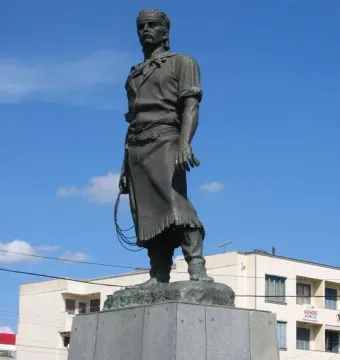
April 2006 © Felipe Rech Meneguzzi · CC BY-SA 2.5
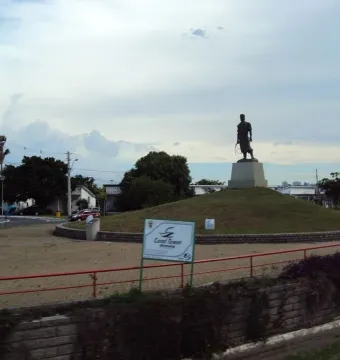
© Bravotata · CC BY-SA 3.0
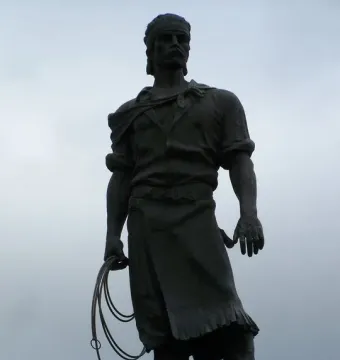
February 2010 © Cornelius Kibelka · CC BY-SA 2.0
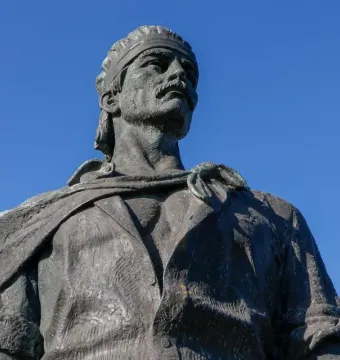
March 2019 © Luciano Lanes/PMPA · Attribution

February 2026 © Governo RS · CC BY-SA 4.0
Identification | |
| Title | Laçador |
| Type | Sculpture; monument |
| Alternative names | Monument to the Laçador; O Laçador |
Historical context | |
| Commission context | Created for a 1954 competition in Porto Alegre for the Exposition of the IV Centenary of the founding of the city of São Paulo, at the invitation of the State Secretariat of Agriculture |
| Competition result | Won by Antônio Caringi; other submitted projects were by Vasco Prado and Fernando Corona |
| Original version | The winning model was originally in plaster and was displayed in the central space of the Rio Grande do Sul pavilion; after the event it was intended to be offered to the city of São Paulo |
| Public reception | It was very well received by the gaucho public, leading to popular demand for installation in Porto Alegre |
Creator | |
| Artist | Antônio Caringi |
| Artist origin | Pelotas |
| Model | Paixão Côrtes |
| Model details | A 26-year-old researcher of the rural culture of Rio Grande do Sul who posed for the artist dressed in gaucho attire and wearing his collection of gaucho clothing and accessories |
Physical characteristics | |
| Height | 4.45 m |
| Weight | 3.8 tonnes |
| Pedestal | Trapezoidal granite pedestal, 2.10 m high |
| Depicted object | A lasso in the right hand |
| Depicted figure | A pilchado gaucho |
Materials | |
| Original version material | Plaster |
| Primary material | Bronze |
Iconography and meaning | |
| Function | Symbol of Rio Grande do Sul |
| Official status | Official symbol of Porto Alegre by municipal law of 1992 |
| Symbolic status | Symbol of Porto Alegre |
Location and ownership | |
| Site description | The Sítio do Laçador covers 4,000 square meters, has six differentiated spaces in the colors of Rio Grande do Sul, and is used for events and demonstrations |
| Relocation details | Moved about 600 meters from its former site; the new placement is on a coxilha/mound and in a more elevated position |
| Relocation reason | Planned construction of the Leonel Brizola viaduct at the former site |
| Relocation date | 11 March 2007 |
| Original location | Largo do Bombeiro, later at Avenida dos Estados in the São João neighborhood, northern Porto Alegre |
| Current location | Sítio do Laçador, in front of the first terminal of Salgado Filho International Airport, on Avenida dos Estados, Porto Alegre, Rio Grande do Sul, Brazil |
History and restoration | |
| Inauguration | 20 September 1958, at Largo do Bombeiro, on the 123rd anniversary of the Farroupilha Revolution |
| Acquisition | Acquired by the city government |
| Heritage status | Declared historical heritage of Porto Alegre in 2001 |
| Condition and restoration | Cracks were found in 2016; the statue was removed in September 2021 for restoration and returned in early 2022 |
| Restoration project | Organized by the city government through the Projeto Construção Cultural - Resgate do Patrimônio Histórico, with support from several institutions and companies; estimated cost R$ 900,000 |
| Restoration documentation | A public seminar presented the restoration stages, a book was published about the recovery work, and a documentary film directed by Jaime Lerner was announced |
Significance | |
| Visibility | The elevated placement makes it clearly visible to people arriving in Porto Alegre via BR-116 |