
Horse Tamers
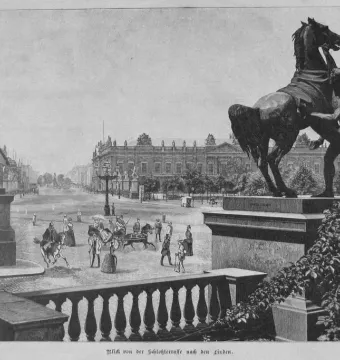
Horse Tamers are two bronze equestrian statues depicting a horse trainer and his horse. They were placed from 1846 to 1950 on the leisure garden terrace of Berlin Palace. After the palace was demolished in 1950 by the communist government of the German Democratic Republic, the statues, which had survived the bombings of the Second World War, were transferred to Heinrich-von-Kleist Park in the Tempelhof-Schöneberg district of Berlin. The sculptor, Peter Clodt von Jürgensburg, also made additional casts for the Royal Palace of Naples and the Anichkov Bridge in Saint Petersburg.
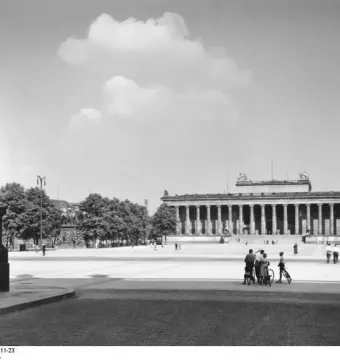
© Hagemann, Otto · CC BY-SA 3.0 de
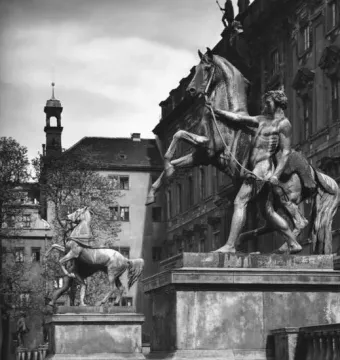
© Hagemann, Otto · CC BY-SA 3.0 de
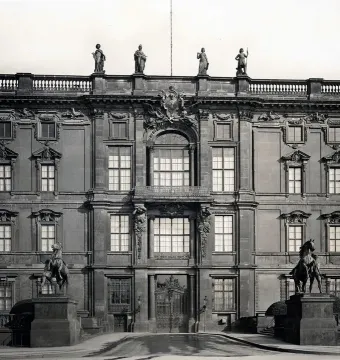
January 1900 © Andreas Schlüter (1660-1714) · Public domain
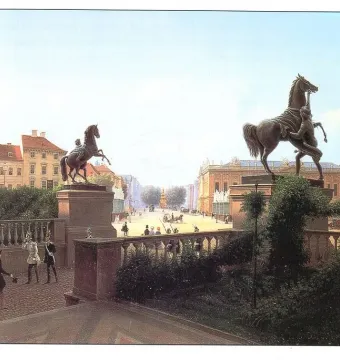
© Клодт. · Public domain
© various · Public domain
Identification | |
| Title | Horse Tamers |
| Original German title | Rossebändiger |
| Type | Two bronze equestrian statues |
| Number of sculptures | Two |
| Subject | Two horse tamers and their horses |
Creator | |
| Sculptor | Peter Clodt von Jürgensburg |
| Artist nationality | Russian sculptor of Baltic German descent |
Historical context | |
| Placed at Berlin Palace until | 1950 |
| Installed at Berlin Palace | 1844 |
| Terrace completed | 1846 |
| Created | 1842 |
Discovery and provenance | |
| Original patron | Russian Tsar Nicholas I |
| Gift recipient | Prussian King Frederick William IV |
| Gift context | Nicholas I gave Frederick William IV two casts after he saw the originals on the Anichkov Bridge in 1842 |
| Additional casts made for | The Anichkov Bridge in Saint Petersburg and the Royal Palace of Naples |
Physical characteristics | |
| Height | About 4 meters |
Materials | |
| Material | Bronze |
Iconography and meaning | |
| Related motif | They also referred to the two horse tamers on the roof of the Old Museum |
| Depicts | A horse trainer and his horse |
Location and ownership | |
| Associated works at original location | The Lion Fighter and the Amazon by Albert Wolff and August Kiß, displayed in front of the Old Museum |
| Original location in Berlin | In front of Portal IV of the Berlin Palace |
| Site selection | Alexander von Humboldt and Christian Daniel Rauch |
| Current location | Heinrich-von-Kleist Park, Tempelhof-Schöneberg district, Berlin, Germany |
| Later location in Berlin | Eastern part of the Lustgarten terrace in front of the north facade of the Berlin Palace |
History and restoration | |
| Moved from Berlin Palace | 1945 |
| Survived World War II | Yes, without damage |
| Transfer context | Moved before the demolition of Berlin Palace in 1950 by the GDR |
| Current discussion | Reinstallation at the original site is being discussed in connection with the reconstruction of the palace as the Humboldt Forum |
Significance | |
| Contemporary nicknames | "disabled progress" and "accelerated regression" |
| Albert Geyer's description | "The splendid works of art, well suited in scale, are an ornament to the palace terrace and thus to the palace" |
| Public use history | Used as a backdrop for political gatherings and speeches in 1919 and 1932 |
| Postwar assessment by Georg Pniower | Described as "too small and only a makeshift" |
| Support for reinstallation | Infratest dimap poll: 44% of Germans and 51% of Berliners support it |
| Supporters | Wilhelm von Boddien, Manfred Rettig, and Klaus von Krosigk |
| Historical significance in Saint Petersburg | The horse tamers on the Anichkov Bridge are regarded as a landmark of Saint Petersburg |
| Attribution to Nicholas I | He is said to have remarked: "The man creates nobler horses than any prize-winning stallion." |
Other | |
| Depicted in images | Shown on a painting by Wilhelm Brücke (1852) and in several historical photographs and views of Berlin Palace |