
Trenton Battle Monument
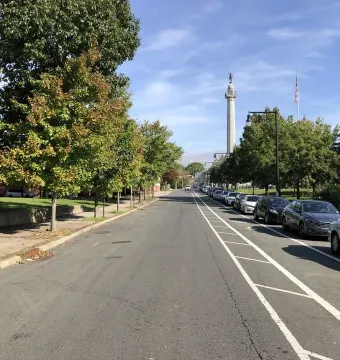
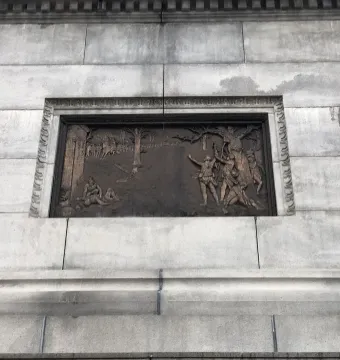
Designed by John H. Duncan, the architect of Grant’s Tomb, the Trenton Battle Monument is an early example of Beaux-Arts architecture in America. Its design is based on the 1671 London monument to the Great Fire, and its height matches that structure. The monument features a hollow Roman-Doric fluted granite column on a slightly darker granite pedestal, capped by an observation pavilion reached by electric elevator. Thirteen electric lights encircle the top. Above all rises a bronze statue of George Washington by William Rudolf O’Donovan. The base includes bronze reliefs by Thomas Eakins and a third panel by Charles Henry Niehaus, along with bronze continental soldier figures guarding the entrance.
1995 © Unknown authorUnknown author or not provided · Public domain
October 2023 © Famartin · CC BY-SA 4.0
© CWaaben · CC BY-SA 4.0
December 2023 © Famartin · CC BY-SA 4.0
June 2018 © Charles Waaben · CC BY-SA 4.0
Identification | |
| Title | Trenton Battle Monument |
| Type | Monument / memorial sculpture |
Historical context | |
| Base and pedestal erected | Spring 1892 |
| Dedication attendance | Eight governors of the original thirteen states attended |
| Dedication occasion | 112th anniversary of the surrender of General Lord Cornwallis at the Siege of Yorktown in Virginia |
| Dedicated | October 19, 1893 |
| Statue installed | September 5, 1893 |
| Capstone raised | August 31, 1893 |
| Cornerstone laid | December 26, 1891 |
| Funding | New Jersey legislature appropriated US$15,000; Congress appropriated US$30,000; citizens contributed US$15,000 |
| Property acquisition | The Trenton Monument Association acquired the property in 1886 |
| Planning began | 1843 |
| Historical significance of site | Built on the high point where American artillery was placed during the Battle of Trenton, commanding the streets and helping prevent a Hessian counterattack |
| Purpose | Commemorates the American victory at Trenton and Washington's role in it |
| Commemorated event | Battle of Trenton, American victory led by General George Washington on December 26, 1776 |
Creator | |
| Relief panel sculptor | Thomas Eakins |
| Third relief sculptor | Charles Henry Niehaus |
| Designer notable work | Grant's Tomb |
| Top statue sculptor | William Rudolf O'Donovan |
| Designer | John H. Duncan |
Discovery and provenance | |
| Monument Park acquisition | Acquired under the provisions of an ordinance approved on June 28, 1893 |
Physical characteristics | |
| Style | Early Beaux-Arts architecture in the United States |
| Design inspiration | The Monument in London, a 1671 structure commemorating the Great Fire of London |
| Height relationship to inspiration | Intentionally the same height as the London monument |
| Form | Hollow fluted Roman-Doric column with a small round pavilion and pedestal |
Materials | |
| Main materials | Granite and bronze |
| Base material | Slightly darker stone for the base to give the appearance of greater solidity |
Technique | |
| Access to observation platform | Electric elevator |
Appearance | |
| Panel 3 | The Surrender of the Hessians |
| Plaque | A bronze tablet on the north side of the pedestal, presented by the Society of the Cincinnati of New Jersey |
| Soldier figure 2 | Private Blair McClenachan of the Philadelphia Light Horse Troop, a unit that also took part in the battle |
| Soldier figure 1 | Private John Russell, a member of Colonel John Glover's Marblehead Regiment from Marblehead, Massachusetts, known for transporting Washington's army across the ice-choked Delaware River on the night of December 25–26, 1776 |
| Entrance guardians | Two bronze figures of Continental soldiers at the entrance |
| Lighting | Thirteen electric lights around the column just above the cap, illuminating the monument at night |
| Panel 2 | The Opening of the Fight, showing Alexander Hamilton's battery about to fire down King Street |
| Relief panels | Three bronze relief panels at the base depicting scenes from the Battle of Trenton |
| Washington depiction | Shown as he appeared at the opening of the engagement, with his right hand extended directing Continental artillery fire down King Street (now Warren Street) |
| Crowning statue | A colossal bronze statue of General George Washington, facing south toward the Assunpink Creek |
| Observation platform | Small round pavilion serving as an observation deck with views of the city and the surrounding battlefield area |
| Panel 1 | The Continental Army Crossing the Delaware River |
Location and ownership | |
| Location | Five Points area of Trenton, New Jersey, United States, at the intersection of Warren (King) Street, North Broad (Queen) Street, Brunswick Avenue, Pennington Avenue, and Princeton Avenue |
| Site name | Monument Park at Five Points |
| Original bronzes | The original Thomas Eakins bronze reliefs were on the monument from 1895 until 1969; they were then replaced by duplicate castings |
| Current location of original bronzes | New Jersey State Museum |
| Current status of original bronzes | On permanent view |
History and restoration | |
| Landscape change | The immediate vicinity has undergone various changes since dedication |
| National Register listing | Listed on the National Register of Historic Places in 1977 |
| City development context | Trenton developed from a small village in 1776 |
| Current visual description | Washington still looks out over the city |
| Temporary exhibition venue | Corcoran Gallery of Art in Washington, DC |
| Archival photographs | Glass plate negatives of the views are in the permanent collection of the Castner archive at the New Jersey State Museum |
| Visitor documentation | Grant Castner photographed the view from the top on December 25, 1896 |
| Elevator status | No longer operable, so the observation deck cannot be visited |
| Electric elevator opened to public | December 25, 1896 |
| Removal date of original bronzes | 1969 |
Significance | |
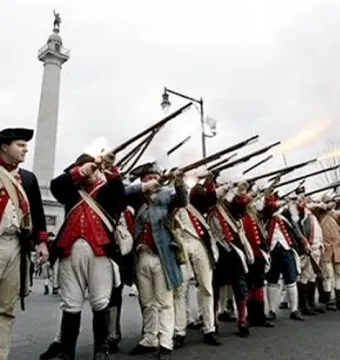
| Public function | Serves as a focal point for local commemorations of the American Revolution |
| Associated events | Annual reenactments and community programs begin at the site |
| Heritage corridor role | Anchors the northern end of the Ten Crucial Days heritage corridor linking Washington Crossing, Trenton, and Princeton |