
Albert Pike Memorial
Albert Pike Memorial is a public artwork in Washington, D.C., honoring Albert Pike, a Confederate officer, poet, lawyer, and influential Scottish Rite Mason. Located near 3rd and D Streets NW in Judiciary Square, the monument originally featured two bronze figures sculpted by Gaetano Trentanove. Today, only the base and the Goddess of Masonry remain. Dedicated in 1901, it drew thousands of Masons in a celebratory parade. The monument is one of 18 Civil War monuments in Washington, D.C. listed on the National Register of Historic Places in 1978. Long controversial, the statue of Pike was torn down and burned by protesters in June 2020.
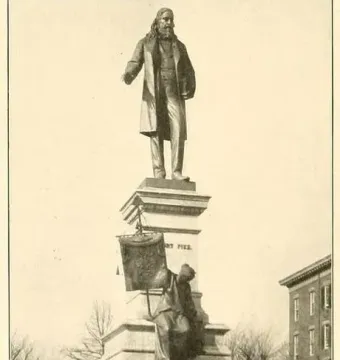
1903 © Unknown authorUnknown author · Public domain
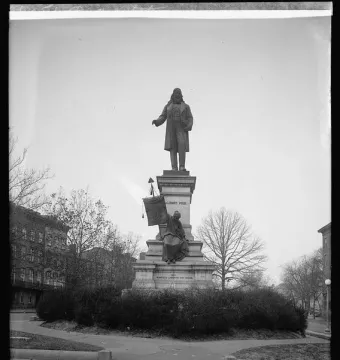
© National Photo Company Collection · Public domain
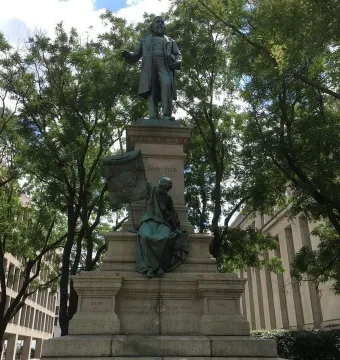
© NPS Photo · Public domain
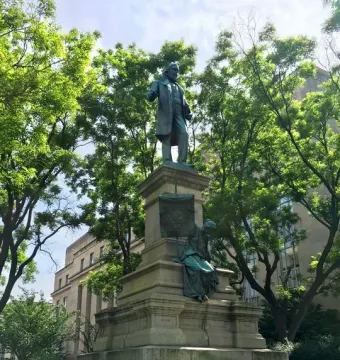
© NPS · Public domain
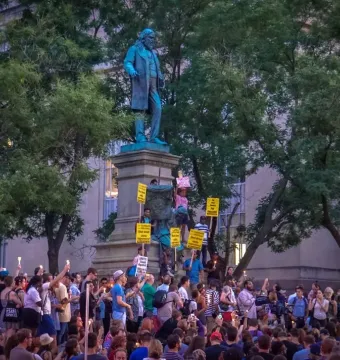
August 2017 © Ted Eytan · CC BY-SA 2.0
Identification | |
| Title | Brigadier General Albert Pike |
| Type | Outdoor memorial sculpture |
| Memorial name | Albert Pike Memorial |
Historical context | |
| Honoree | Albert Pike (1809–1891), a Confederate brigadier general, poet, lawyer, and influential figure in Scottish Rite Freemasonry |
Creator | |
| Sculptor | Gaetano Trentanove |
| Sculptor nationality | Italian-American |
| Commissioned by | The Supreme Council, Southern Jurisdiction of the Scottish Rite (SC-SJ) |
| Related work by sculptor | Daniel Webster Memorial in Washington, D.C. |
Discovery and provenance | |
| Dedication date | October 23, 1901 |
| Dedication ceremony | A large temporary reviewing stand was built at the base of the monument; the unveiling flag was lowered by senior Masons; the ceremony included a band performance, a prayer by Mason chaplain Charles Alvin Smith, a speech by Frederick Webber, and an acceptance speech by H. B. F. McFarland |
| Dedication participants | Members of the Grand Lodge of Masons of the District of Columbia, the SC-SJ, the Northern Jurisdiction of the Scottish Rite, and the Royal Order of Scotland |
| Dedication attendance | Thousands of Masons marched in a celebratory parade |
| Dedication timing | Planned to coincide with the centennial of the SC-SJ |
| Cornerstone laid | July 4, 1900 |
| Excavation | Summer 1899 |
| Nearby site context | Near the former Temple House at 433 3rd Street NW, the site of the current Tax Court building, where Pike had lived |
| Original site | A triangular lot bordered by 3rd Street, D Street, and Indiana Avenue NW, Washington, D.C. |
| Site approval | Congress approved the memorial site on April 9, 1898 after Masons assured lawmakers it would portray Pike as a civilian rather than a soldier |
| Foundry | Fonderia Galli |
| Fabrication | Washington Granite Monumental Company |
| Funding | $15,000 raised by members of the SC-SJ |
Physical characteristics | |
| Composition | A bronze sculpture on a granite base |
| Base style | Beaux-Arts |
| Figures | Two bronze figures |
| Base material | Granite |
| Current composition | Only the base and the sculpture of the Goddess of Masonry remain |
Materials | |
| Sculpture material | Bronze |
| Base material | Granite |
Appearance | |
| Goddess of Masonry | A bronze figure on the north side of the base, wearing a long Greek robe, looking downward, with crossed ankles and dangling feet, holding the Scottish Rite banner on a staff in her right hand |
| Inscription | Inscriptions are present on the memorial, but the text is not specified in the fragment |
| Pike depiction | Albert Pike is depicted as a civilian and Masonic leader, not as a soldier or Confederate officer |
| Book | Possibly Morals and Dogma of the Ancient and Accepted Scottish Rite of Freemasonry |
| Pike clothing | A crossed or double-breasted vest and a long coat |
| Pike pose | Right arm extended; left hand holding a book |
Iconography and meaning | |
| Honoree portrayal | Pike was presented at the ceremony as a kind, literary, and civilian man, with only limited reference to his Confederate service |
| Meaning | The memorial honored Pike as a civil and Masonic figure rather than for his Confederate military role |
| Masonic connection | Pike became a Mason in 1850 and served as Sovereign Grand Commander of the Supreme Council, Southern Jurisdiction from 1859 until his death in 1891 |
| Masonic writing | He compiled Morals and Dogma of the Ancient and Accepted Scottish Rite of Freemasonry, an influential philosophical document in the organization |
Location and ownership | |
| Maintenance | National Park Service |
| Removal and reinstallation | Removed in 1972 during construction of Interstate 395 and reinstalled in September 1977 near its former site |
| Historic designations | Listed on the National Register of Historic Places on September 20, 1978 as one of 18 Civil War monuments in Washington, D.C.; listed in the District of Columbia Inventory of Historic Sites on March 3, 1979; contributing property to the Pennsylvania Avenue National Historic Site established on September 30, 1965 |
| Unique distinction | The only outdoor sculpture in Washington, D.C. honoring a Confederate general |
| Ownership | National Park Service (a unit of the U.S. Department of the Interior) |
| Original ownership | Public land in Washington, D.C., obtained after Masons lobbied Congress for permission |
| Setting | Between the Frances Perkins Building of the U.S. Department of Labor and the headquarters of the Metropolitan Police Department |
| Location | Reservation 188, southwest corner of 3rd and D Street NW, Judiciary Square neighborhood, Washington, D.C., United States |
History and restoration | |
| Controversy | The monument generated controversy throughout its history, with critics objecting to honoring a Confederate general and describing Pike as a traitor, racist, or symbol of racism and bigotry |
| Early opposition | Members of the Grand Army of the Republic opposed the monument in 1898, arguing that honoring a Confederate general in Washington, D.C. would disgrace Union soldiers |
| 1990s protests | From the 1990s, removal efforts intensified over alleged Ku Klux Klan ties; in late 1992 LaRouche movement members, including James Bevel, protested for removal and draped the statue with KKK-like clothing; the Washington, D.C. city council passed a removal resolution in December 1992; James Bevel and Anton Chaitkin were later convicted of unlawful statue climbing |
| 1993 condition assessment | The Smithsonian Institution's Save Outdoor Sculpture! program inspected it in 1993 and judged it well maintained |
| 2017 vandalism | After the Unite the Right rally, protesters gathered at the monument, called for it to be torn down, and vandalized it with red paint |
| 2019 removal proposal | In July 2019, Delegate Eleanor Holmes Norton introduced House bill H.R. 4135 directing that the statue be removed |
| 2020 destruction | On June 19, 2020, protesters pulled the statue down with ropes and chains, doused it with a flammable liquid, and set it on fire during protests after the killing of George Floyd |
| Immediate aftermath | Police extinguished the flames and left; the National Park Service removed the statue the next day; the pedestal was covered in graffiti and later cleaned |
| 2020 jurisdiction | Because the memorial was in a federal park, it was under the jurisdiction of the National Park Service and the U.S. Park Police, not local police |
| Federal prosecution | On July 2, 2020, the U.S. Department of Justice announced the arrest and charging of a man accused of helping destroy the statue; the charges were later dropped |
| Restoration | The refurbished statue was reinstalled in 2025 in keeping with historic preservation laws and executive orders by Trump |