
Enghausen Cross
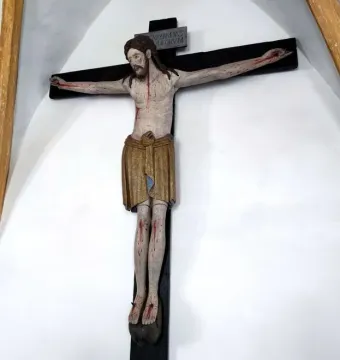
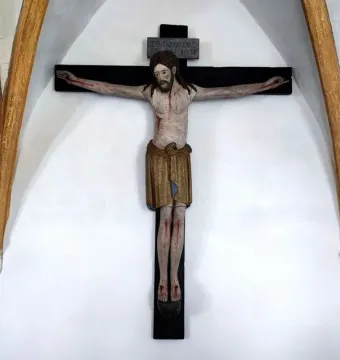
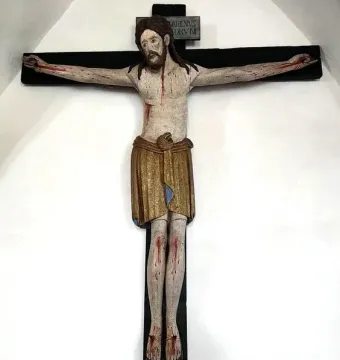
The Enghausen Cross is a wooden crucifix measuring 232 x 178 cm, dated to the late 9th century. It is kept in the Church of the Finding of the Cross in Enghausen, in the municipality of Mauern in the district of Freising. Considered the oldest surviving monumental crucifix, it was extensively restored from 2004 to 2006 after centuries of environmental damage and dirt. Scientific C-14 analysis, later confirmed by reference and cross-check samples, placed it in the final decade of the 9th century, supporting a late Carolingian dating and suggesting a possible connection with the coronation of Arnulf of Carinthia in 895.
May 2026 © Helmlechner · CC0
May 2026 © Helmlechner · CC0
May 2026 © Helmlechner · CC0
July 2018 © Didi43 · CC BY-SA 4.0
May 2026 © Helmlechner · CC0
Identification | |
| Title | Enghausener Kreuz |
| Type | Monumental wooden crucifix |
| Original language name | Croce di Enghausen |
Historical context | |
| Date | Late 9th century, probably c. 890–900 |
| Historical period | Late Carolingian period |
Creator | |
| Possible patron | Possibly commissioned or donated by King Arnulf of Carinthia |
Discovery and provenance | |
| Historical context of provenance | The monastery was transferred to Bishop Waldo of Freising in 895 and was especially promoted by Arnulf |
| Related church dedication change | The church in Enghausen was later rededicated from Saint Stephen to the Finding of the Holy Cross |
| Associated church relationship | The church of Enghausen was incorporated into the canonry of Sankt Kastulus in the 11th century and belonged to the monastery's ecclesiastical jurisdiction for a long time |
| Proposed origin | Hypothesized to come from the former Benedictine church and later collegiate church of Sankt Kastulus in nearby Moosburg |
| Possible transfer to Enghausen | It may have been handed over to the subsidiary church of Enghausen when the Sankt Kastulus church was rebuilt in the Gothic or late Gothic period |
| Possible origin | Long suspected to come from the former Benedictine and later collegiate church of St. Kastulus in nearby Moosburg |
| Original location | Former Benedictine church and later collegiate church of St. Kastulus in nearby Moosburg |
Physical characteristics | |
| Dimensions | 232 × 178 cm |
| Corpus dimensions | 188 × 175 cm |
Materials | |
| Material | Wood |
Technique | |
| Dating method | Radiocarbon (C-14) analysis, later confirmed by reference and control samples |
| Restoration | Restored from 2004 to 2006 due to unstable paint layers, dirt accumulation, and unstable environmental conditions |
| Paint stratification | Twelve paint layers or states identified; only traces of the first five survive |
| Surface finish | Polychromed |
Appearance | |
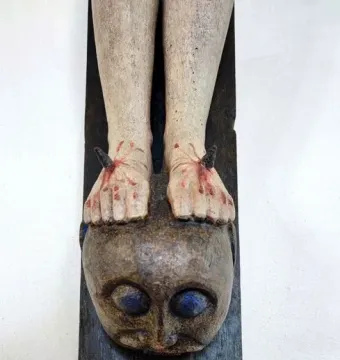
| Depiction of Christ | Christ is nailed to the cross with four nails and stands on a suppedaneum shaped like a demon's head |
| Christ image interpretation | Christ is shown as the divine man, looking at the viewer in dignity and majesty as redeemer and conqueror of death and suffering |
| Christ hairstyle | Hair style consistent with Carolingian depictions |
| Headgear | No crown of thorns or royal crown |
| Polychromy history | The present gilded appearance probably dates to the 17th century; the oldest visible version likely dates to the 17th century |
| Loincloth color | Dark red in the earliest versions; now golden |
| Wounds and blood streams | Painted in the early modern version and not carved accordingly |
Iconography and meaning | |
| Stylistic attribution | Consistent with Carolingian Christ iconography and differs from Romanesque and later depictions |
Location and ownership | |
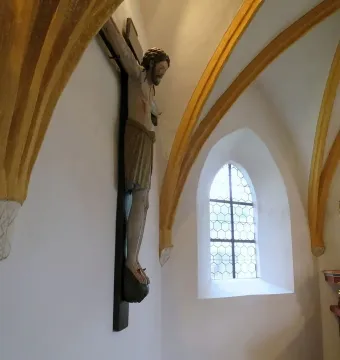
| Current location | Church of the Finding of the Cross (Hl. Kreuzauffindung) in Enghausen, municipality of Mauern, district of Freising |
History and restoration | |
| Return date | 5 May 2006 |
| Post-restoration decision | Returned to Enghausen by bishop's order rather than transferred to the Diocesan Museum of Freising |
| Security measures | The church of Enghausen received a new alarm system to protect the cross |
| Papal display | Displayed above the cathedra during Pope Benedict XVI's public Mass in Riem, Munich, on 10 September 2006 |
Significance | |
| Significance | Considered the oldest surviving monumental crucifix, and possibly the oldest surviving monumental cross overall; also described as the largest among the oldest surviving crucifixes |
| Related comparable works | The Cross of Gero and the Miraculous Cross of Elspe |
| Research impact | The re-dating revised earlier stylistic hypotheses about its origin and had significant consequences for local art history and the historiography of Christ's representation |