
Tomb of Giuliano de' Medici, Duke of Nemours
The Tomb of Giuliano de' Medici, Duke of Nemours is a funerary monument by Michelangelo, created between 1520 and 1534. It is located in the Medici Chapel beside the Basilica of San Lorenzo in Florence. This is the second tomb Michelangelo made for the Medici family. The composition is in close visual harmony with the chapel’s architecture. Giuliano is shown holding a baton in his left hand, symbolizing command over papal troops, and two coins in his right hand, an allusion to his generosity. He wears classical armor over a strong, muscular body, recalling the imagery of Roman emperors. Below the figure are two other sculptures: Night and Day.
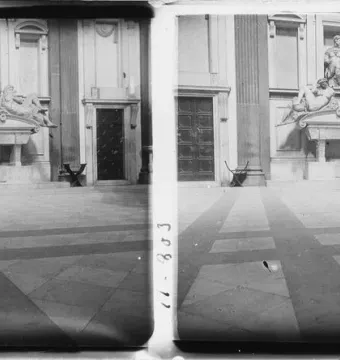
© Josep Salvany i Blanch · Public domain
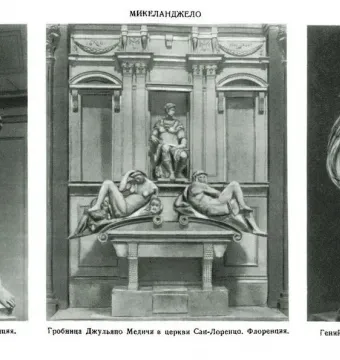
1938 © Неизвестен · Public domain
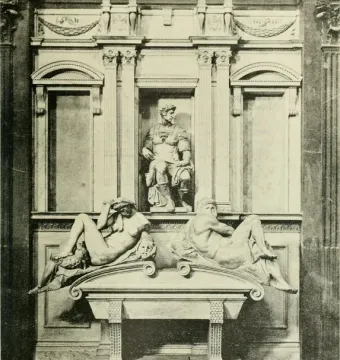
1904 © Burger, Fritz, 1877-1916 · No restrictions
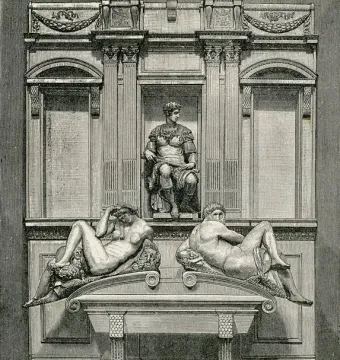
1894 © Giuseppe Barberis · Public domain
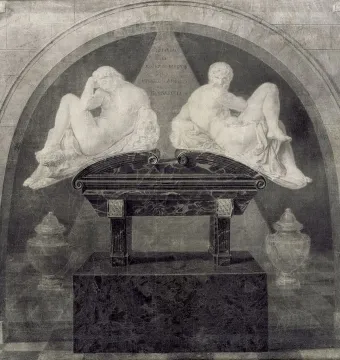
1830 © Joseph-Marie Vien the younger · Public domain
Identification | |
| Title | Tomb of Giuliano de' Medici, Duke of Nemours |
| Type | sculptural and architectural complex |
| Alternative name | Night and Day (Tomb of the Medici) |
Historical context | |
| Project name | New Sacristy (Sagrestia Nuova) |
| Part of | the decoration of the New Sacristy (Sagrestia Nuova) in the Medici Chapel, Basilica of San Lorenzo, Florence |
| Related monumental setting | A twin environment modeled on Brunelleschi's Old Sacristy (Sagrestia Vecchia) |
| Purpose | A princely sepulchre for Giuliano de' Medici, Duke of Nemours, and Lorenzo, Duke of Urbino; also intended to include the earlier Medici Magnifici Lorenzo (d. 1492) and Giuliano (d. 1478) |
| Historical context | Conceived after the deaths of Giuliano de' Medici in 1516 and Lorenzo, Duke of Urbino, three years later, which ended the legitimate line of the main branch of the Medici family and deeply distressed Pope Leo X |
Creator | |
| Artist | Michelangelo Buonarroti |
Discovery and provenance | |
| Final architectural structure established | 1524, by Michelangelo for Pope Clement VII |
| Completion status | The work continued for a long time and ended with fewer statues than originally planned |
| Tomb models prepared | 1524 |
| Work resumed | 1524, after interruption caused by the pope's death |
| Construction began | 1521 |
| Planning began | around 1519 |
| Commissioned to | Michelangelo |
| Commissioned by | the Medici family |
Physical characteristics | |
| Sarcophagus top | crowned by a broken catenary arch with scrolls at the ends |
| Attic decoration | low-relief festoons, amphorae, ribbons, a scroll-like keystone, and dice with pairs of balusters at the pilaster positions |
| Attic | present above the projecting entablature, emphasizing the model of the Roman triumphal arch with three openings, though freely reinterpreted |
| Model for upper structure | reinterprets the Roman triumphal arch with three openings |
| Side niche design | each side niche has an arched pediment, volutes decorated with fish scales, and grotesque dragons in relief above the pediment with ribbon-like undulating tails |
| Architectural elements of upper section | fluted pilasters with fanciful capitals, a central rectangular niche with an entablature, a smooth plaque above it, and two symmetrical side niches |
| Vertical division | tripartite vertical division, also present in the lower part |
| Upper register | more articulated, separated from the lower part by a dentilled cornice with a frieze of mascarons |
| Figures on the arch | personifications of the phases of the day: Night on the left and Day on the right |
| Decorative motifs on outer sides of the piers | ram skull friezes, medallions with protruding cords, and a shell motif |
| Lower register | simpler, with plain panels that serve as a sober background for the statues |
| Sarcophagus support | supported by two upright feet or piers |
| Overall design | The tombs are integrated into the wall and form a direct relationship between the architectural members, the sarcophagus, and the statues |
| Unrealized side-niche statues | statues representing Heaven and Earth for the two lateral niches |
| Unrealized figures | two personifications of infernal rivers intended for the foot of the tomb |
| Actual number of statues realized | three |
| Planned number of statues | five or seven |
| Components | Idealized portrait of Giuliano de' Medici; Night; Day |
| Dimensions | 650 × 470 cm |
Materials | |
| Burial container | the duke's remains are in a marble chest |
| Material | marble |
| Prototype for sarcophagus | Inspired by an ancient sarcophagus in the Pantheon |
Iconography and meaning | |
| Symbolism of the coins | allusion to Giuliano de' Medici's generosity |
| Thematic relation to other tomb figure | the portraits of both Giuliano and Lorenzo look toward the Madonna and Child, the end and consolation of human suffering |
| Thematic interpretation of Night and Day | a reflection on the passage of time and human destiny |
| Interpretive reading of pose | reference to the active life in Neoplatonic doctrine |
| Iconographic references | references to statues of Roman emperors |
| Comparison | The pose is similar to Moses |
| Symbolism of the baton | symbol of command over papal troops |
| Interpretation of broken line above the sarcophagus | symbolic opening through which the soul can rise and find an image in the idealized portrait of Giuliano in the central niche |
| Meaning of shell motif | Christian motif of the pilgrimage of the soul |
Appearance | |
| Clothing/armor | ancient-style armor covers a strong, muscular body |
| Pose/attributes of the figure | The figure holds a baton in the left hand and two coins in the right hand |
| Portrait pose | seated, with both hands on the baton of command, head and legs turning sharply to the right |
Location and ownership | |
| Location | Medici Chapel, Basilica of San Lorenzo, Florence |
| Current location | San Lorenzo, Florence, in the Medici family church |
| Subject | Giuliano de' Medici, Duke of Nemours |
| Subject commemorated | Giuliano de' Medici, Duke of Nemours; Lorenzo, Duke of Urbino; and the earlier Medici Magnifici Lorenzo and Giuliano |
History and restoration | |
| Realism | The work does not reproduce the subject's actual features; Michelangelo refused to practice portrait likeness |
| Anecdote about likeness | According to the sources, someone pointed out the dissimilarity to the artist, but Michelangelo replied that in ten thousand years no one would notice that detail |
Other | |
| Language of source text | Italian |
| Related figures pictured in the article fragment | Night, Day, and a detail photographed by Paolo Monti in 1975 |
| Photo caption information | Paolo Monti photographed a detail in 1975 |
| Sculpture title | Tomb of Giuliano de' Medici, Duke of Nemours |
| Date of creation | 1520–1534 |
| Date | datable to 1524–1534 |
| Date of portrait figure | 1526–1534 |
| Date of Night figure | 1526–1531 |
| Date of Day figure | 1526–1531 |