
Pacifica
Pacifica is a statue created by Ralph Stackpole for the Golden Gate International Exposition held on Treasure Island in San Francisco Bay from 1939 to 1940. It was Stackpole’s largest sculpture and stood 25 meters above the entrance to Cavalcade of the Golden West in the Court of Pacifica. The work was dedicated to the heroic explorers of the lands of the Pacific Ocean and represented world peace and friendship among the peoples of the Pacific region. It served as a beacon of the exposition.
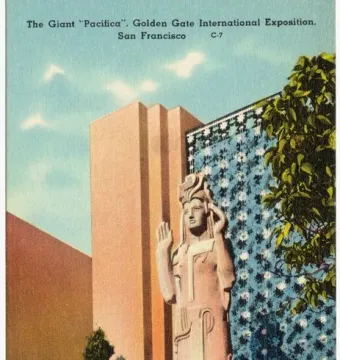
© Tichnor Brothers, Publisher · Public domain
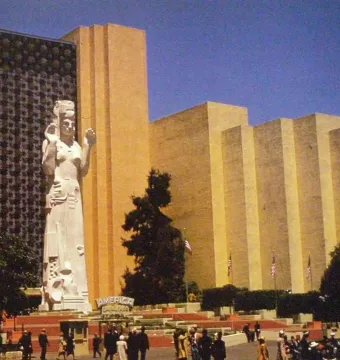
1939 © Unknown authorUnknown author · Public domain
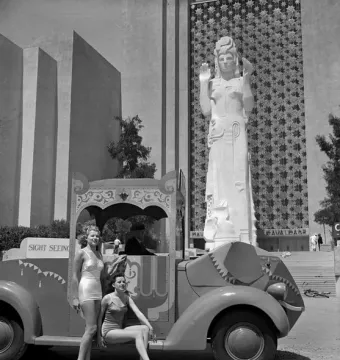
October 2011 © AC Transit · CC BY 2.0
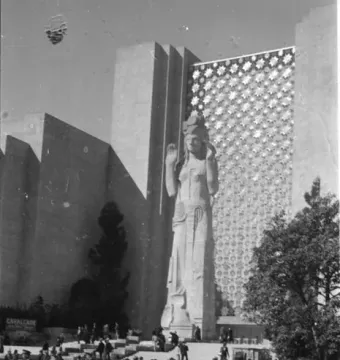
© Dsbiehl · CC BY-SA 3.0
October 2011 © AC Transit · CC BY 2.0
Identification | |
| Title | Pacifica |
| Type | statue |
Creator | |
| Artist | Ralph Stackpole |
Historical context | |
| Related context | the U.S. Navy bought Treasure Island in 1941 and turned it into a naval base; most exposition structures were demolished |
| Exhibition location | Treasure Island in San Francisco Bay |
| Exhibition dates | 1939 to 1940 |
| Exposition role | theme statue and beacon of the exposition |
| Description | the largest and most visible sculpture Stackpole ever made |
| Dedicated to | the heroic explorers of the territories of the Pacific Ocean |
| Exposition visitors | some 16 million visitors |
| Created for | the 1939–1940 Golden Gate International Exposition |
Iconography and meaning | |
| Symbolism | world peace and friendship among the peoples of the Pacific region |
Physical characteristics | |
| Alternative size | a 3 m final model, preceded by an initial 8 cm figure |
| Height | 25 m |
Technique | |
| Construction method | the model was divided into cross sections, enlarged eight-fold with a pantograph, and assembled on scaffolding |
Materials | |
| Support structure | bent and shaped iron |
| Surface | wire mesh covered with plaster |
History and restoration | |
| Demolition date | January 22, 1941 |
| Proposed after the exposition | Stackpole proposed recasting the sculpture in a more permanent material and placing it on an island in San Francisco Bay, such as Alcatraz or Angel Island, in a manner similar to the Statue of Liberty in New York Harbor; the proposal was not seriously considered by civic leaders |
| Proposed materials | steel, stone, or concrete |
| Production time | two years |
| Reproduction | a 2.40 m reproduction exists in the garden of the City College of San Francisco Ocean Campus, next to the Diego Rivera Theatre |
| Reconstruction project | The Pacifica II Statue Project is working to reconstruct Pacifica on Treasure Island |
| Intended permanence | temporary installation |
| Working process | about fifty attempts were made before the final model |
| Method of destruction | dynamited |
| Fate | destroyed in 1942 |
Location and ownership | |
| Proposed display context | like the Statue of Liberty in New York Harbor |
| Proposed location | an island in San Francisco Bay, such as Alcatraz or Angel Island |
| Reconstruction site | Treasure Island |
| Foundation launch location | across from Treasure Island in Berkeley |
| Night appearance | colorful and mystical, with Pacifica appearing in regal splendor |
| Court | Court of Pacifica |
| Backdrop | in front of the Great Window, a 30-meter-high stone wall that acted like a curtain and was inlaid with metal stars and small tubes that made sound in the breeze |
| Placement at exhibition | above the entrance to Cavalcade of the Golden West, in the Court of Pacifica |
| Floral setting | orange calendulas, ranunculus, and red, yellow, and purple anemones, said to be very fragrant and to add a romantic touch |
| Backdrop lighting | 75 amber, 150 red, and 300 blue floodlights, each 200 watts, controlled by a thyratron |
| Lighting | illuminated by two 1,500-watt underwater floodlights |
| Surroundings | surrounded by works by eight other sculptors depicting inhabitants of the Pacific shores |
| Nearby feature | a circular fountain at the center of the court |
Discovery and provenance | |
| Life caption | a peaceful, contemplative, almost praying female figure |
| Publication | Life magazine |
| Photographed by | Alfred Eisenstaedt |
Other | |
| Associated name | The Pacifica Statue |
| Association with Pacifica Foundation | purported to be its inspirational namesake |
| Associated organization | Pacifica Foundation |
| Associated station | KPFA |
| Foundation founding context | founded in response to revulsion at warmongering propaganda on commercial radio at the outbreak of the Cold War and the Korean War, and fear that such messaging unopposed would lead to nuclear war |
| Foundation launch date | 1949 |
| Foundation mission | to develop a private but non-commercial media network for long-form education and discussion of non-violent relations locally, nationally, and worldwide |