
Equestrian Statue of Frederick William IV
The Equestrian statue of Frederick William IV stands before the Alte Nationalgalerie in Berlin-Mitte and commemorates the Prussian king Frederick William IV (1795–1861). Designed by Gustav Blaeser and executed by Alexander Calandrelli between 1875 and 1886, it is made in the style of Realism and is considered one of the masterpieces of the Berlin school of sculpture. The monument is 9.60 meters high in total, with a 5.20-meter main figure showing the king in uniform with ermine on horseback. Its bronze sculptural parts are set on a granite architectural base, decorated with allegorical and relief figures.
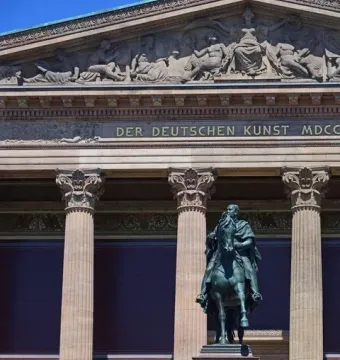
June 2022 © Dosseman · CC BY-SA 4.0
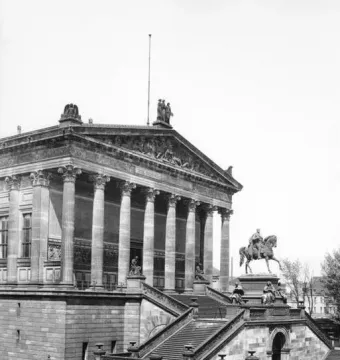
© Frankl, A. · CC BY-SA 3.0 de
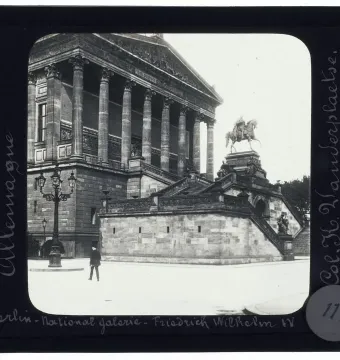
1905 © Vanderplaetse, K. (verzamelaar) · Public domain
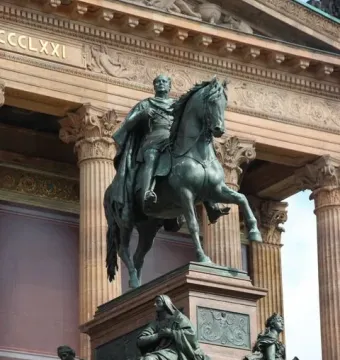
August 2016 © Gary Todd · CC0
March 2020 © OTFW · CC BY-SA 3.0
Identification | |
| Title | Equestrian statue of Frederick William IV |
| German title | Reiterstandbild Friedrich Wilhelms IV. |
| Type | Equestrian statue |
Historical context | |
| Subject | King Frederick William IV of Prussia |
| Purpose | Created for the founder of Museum Island |
Creator | |
| Designer | Gustav Blaeser |
| Executed by | Alexander Calandrelli |
History and restoration | |
| Date | 1875–1886 |
Physical characteristics | |
| Set membership | One of the originally six equestrian statues oriented toward Berlin Palace |
| Figure height | 5.20 meters |
| Orientation | Aligned toward Berlin Palace |
| Height | 9.60 meters |
Materials | |
| Materials | Bronze sculpture with granite architectural parts |
Technique | |
| Style | Realism |
Appearance | |
| Main figure depiction | Frederick William IV in uniform with ermine, mounted on horseback, head turned toward Berlin Palace, holding the reins |
| Subsidiary figures | Allegories of Religion, Poetry, History, and Philosophy |
| Reliefs | Front: a boy; right: Cologne Cathedral; back: a girl; left: trophies |
| Pedestal inscription | "DEM GEDAECHTNISS KOENIGS / FRIEDRICH WILHELM IV. / KOENIG WILHELM. 1886." |
Significance | |
| Art-historical significance | Considered one of the masterpieces of the Berlin School of sculpture |