
Winkelrieddenkmal
Winkelrieddenkmal is a memorial to Arnold von Winkelried, the Swiss legend who is said to have sacrificed his life at the Battle of Sempach in 1386. The monument was promoted in Stans as a representative memorial and a regional symbol with national significance. After two competitions and years of discussion, Ferdinand Schlöth’s model was selected for execution in 1857. He worked on the sculpture in Rome, and the finished marble work was completed there in 1865. The statue was transported to Switzerland, brought from Lucerne to Stansstad by Lake Lucerne, and then moved to Stans, where it was erected on 1 August 1865. The memorial was protected by a hall designed by the Swiss architect Ferdinand Stadler.
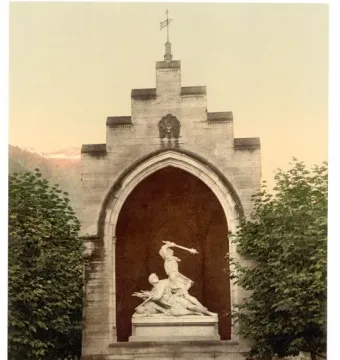
© Photochrom Print Collection · Public domain
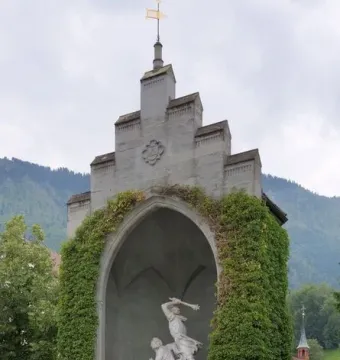
August 2009 © Ikiwaner · GFDL 1.2
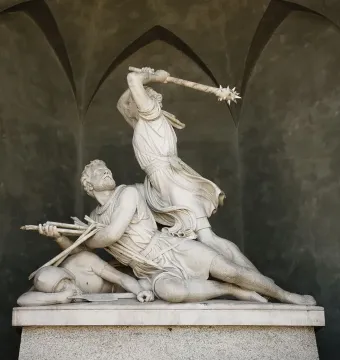
August 2009 © Ikiwaner · CC BY-SA 3.0
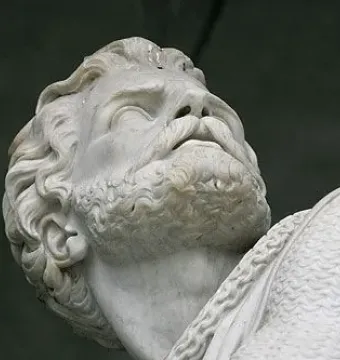
August 2005 © Picswiss · CC BY-SA 3.0

1901 © Unknown authorUnknown author · Public domain
Identification | |
| Title | Winkelried memorial |
| Type | Monument; war memorial for Arnold von Winkelried |
| Other title | Winkelrieddenkmal |
Iconography and meaning | |
| Commemorated person | Arnold von Winkelried |
| Subject legend | Swiss legend says Winkelried sacrificed his life in the Battle of Sempach on 9 July 1386 by throwing himself into Habsburg pikes to open a passage for the Swiss attack |
| Historical event | Battle of Sempach |
| Purpose | Memorial erected in memory of Arnold von Winkelried; intended by the people of Stans mainly as a representative monument for the town rather than solely as a commemoration of the hero, and to attract visitors |
| Local significance | Chosen by the people of Stans because Winkelried was a regionally known national figure |
Discovery and provenance | |
| Commission date | 22 September 1859 |
| Initiator | Anton Albert Durrer (1793–1865) |
| Initiative context | He submitted a proposal to the municipal council of Stans on 14 July 1853, on the occasion of the Federal Shooting Festival of 1853 in Lucerne, and organized a fundraising campaign |
| Initiator's view of older statue | He considered the Winkelried statue on the central fountain of Stans, erected in 1723, to be dated |
| Design competition | First competition approved on 30 September 1853; results were unsatisfactory by 1854; a second competition was held in June 1856 and another was announced in 1857 but did not produce satisfactory results |
| Payment | 15,000 Swiss francs initial payment |
Creator | |
| Hall architect | Ferdinand Stadler |
| Workshop location | Via Quattro Fontane, Rome |
| Artist description | Basel sculptor working in Rome |
| Artist | Ferdinand Schlöth |
History and restoration | |
| Reason for larger workshop | Schlöth rented a larger workshop there because it better suited the requirements of the planned memorial |
| Inauguration | Officially inaugurated in September 1865 in the presence of the artist, together with the completed hall |
| Plaster model | He finished a plaster model before the end of 1859 and sent photographs of it to his clients in Switzerland |
| Marble block | A Carrara marble block was purchased with money received in December 1861 |
| Final approval | May 1862 |
| Small copy | Because final approval was delayed, Schlöth began work on a smaller copy of the memorial; it was offered for sale in Basel in 1864, bought by Heinrich Moser, intended as a gift for the victor of the national shooting competition in Schaffhausen in 1865, and later bought back by Moser from the winner |
| Completion | Finished in Rome in 1865 |
| Reception during execution | The work in progress received wide acclaim from visitors to Schlöth's workshop, including Ludwig II of Bavaria |
| Transport | In June 1865 the statue was transported via Marseille to Lucerne, then by a specially built wagon to Lucerne, shipped across Lake Lucerne to Stansstad, and from there moved to Stans |
| Hall commission | Stadler was directly entrusted with the task in 1858; a further competition in 1857 had failed to produce satisfactory results, and the definitive commission followed after about six more years when the location and other questions were clarified |
| Installation date | 1 August 1865 |
Materials | |
| Main material | Carrara marble |
Location and ownership | |
| Protective structure | Neo-Gothic marble hall designed to protect the memorial |
| Placement context | Situated between the church and the town hall |
| Location | Dorfplatz (village square), Stans, canton of Nidwalden, Switzerland |
| Heritage listing | Included in the list of cultural properties in Stans |
| Model location | A model of the monument is on display at Swissminiatur in Melide |
Physical characteristics | |
| Depiction | Group of three figures |
Appearance | |
| Formal interpretation | An attempt to contain a heroic gesture within a harmonious, classically influenced triangular form |
Significance | |
| Art-historical significance | Presented as a new form of war memorial |
| Reception and influence | It remained without followers; an exception is the Fontana Monument in Chur (1903) by Richard Kissling, which translates the three-figure group into a two-figure composition |