
Melville Monument
Melville Monument is a large column in St Andrew Square, Edinburgh, built between 1821 and 1827 as a memorial to Scottish statesman Henry Dundas, 1st Viscount Melville. Designed by William Burn and modelled on Trajan’s Column in Rome, it rises to about 45 metres and is topped by a 4.2-metre statue of Dundas by Francis Leggatt Chantrey and Robert Forrest. Robert Stevenson also advised on the engineering. The monument became controversial in the 21st century because of claims about Dundas’s role in delaying the abolition of the slave trade. It remains one of Edinburgh’s most prominent landmarks.
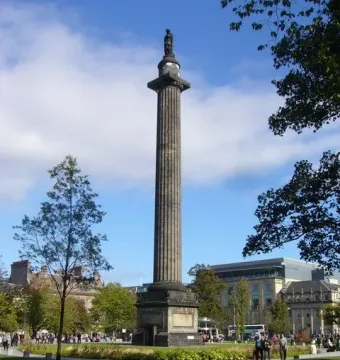
September 2009 © kim traynor · CC BY-SA 2.0
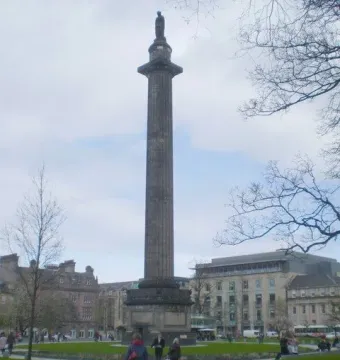
April 2008 © Tom Sargent · CC BY-SA 2.0
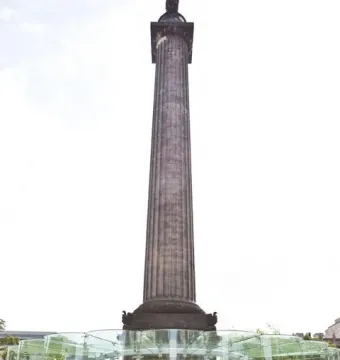
August 2011 © Scottish Government · CC BY 2.0
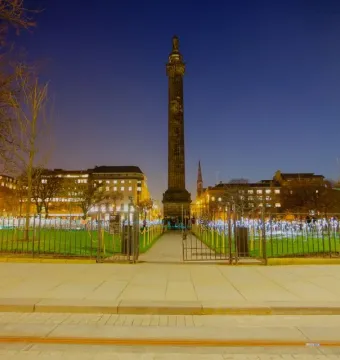
March 2014 © Chris Fleming · CC BY-SA 2.0
July 2021 © CPClegg · CC BY-SA 4.0
Identification | |
| Title | Melville Monument |
| Type | monumental column with statue |
| Named after | Henry Dundas, 1st Viscount Melville |
Historical context | |
| Planning began | Soon after Henry Dundas's death in 1811 |
| Initial initiative | Raised at a Pitt Club of Scotland meeting in May 1814 |
| Construction period | 1821–1827 |
| Foundation stone laid | 28 April 1821, the anniversary of Dundas's birth |
| Erection date | 1821 |
| Completed | 1827 |
| Paid off | 1837 |
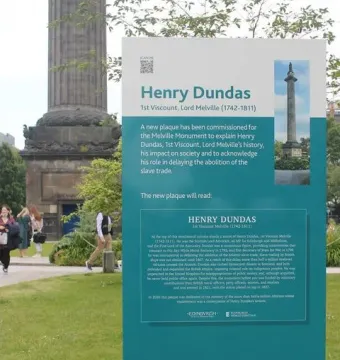
| Historical controversy | In the 21st century the monument became controversial because of claims that Dundas delayed the abolition of the slave trade in the British Empire |
| Purpose | Memorial to Scottish statesman Henry Dundas, 1st Viscount Melville |
Creator | |
| Statue carver | Robert Forrest |
| Designer | William Burn |
| Statue designer | Francis Leggatt Chantrey |
| Engineering advice | Robert Stevenson |
Discovery and provenance | |
| Construction cost | Builder's contract: £3,192; Stevenson-related changes: £1,000; total cost: £8,000 |
| Earlier proposed sites | North-east edge of Calton Hill; Arthur's Seat; Picardy Place; top of Leith Walk; Melville Street and what is now Walker Street in the West End |
| Contractors | J. & J. Rutherford |
| Builder | William Armstrong |
| Construction method | Built using an iron balance crane; Robert Stevenson also recommended strengthening the foundations and building the shaft from solid blocks rather than rubble infill |
| Legal settlement | Patrick Walker sued the committee for breach of engagement and claimed £10,000 damages; the committee settled for £408 |
| Site ownership | At one stage the site was private property of Sir Patrick Walker outside the city boundaries |
| Committee | Melville Monument Committee |
| Final site agreement | January 1821 |
| Statue added | The committee agreed to include a statue in 1822 |
| Initial design | Column modelled on Trajan's Column in Rome, with no statue in Burn's first plan |
| Funding | Supported by subscriptions from sailors, later also from the public and Pitt Club appeals |
| Committee composition | Initially led by naval officers, with civic and legal figures also represented |
| Committee convener | Vice Admiral Sir William Johnstone Hope |
| Patrons and campaign drivers | Royal Navy officers, especially Sir William Johnstone Hope |
Physical characteristics | |
| Statue height | Approximately 4.2 m (14 ft) |
| Statue construction | 15 blocks secured by gunmetal bolts |
| Statue weight | About 18 tons |
| Column diameter | Around 3.7 m (12 ft) at the base, tapering to 3.2 m (10.5 ft) at the top |
| Pedestal dimensions | Approximately 5.5 m (18 ft) on each face and 6.3 m (21 ft) high |
| Overall height | About 45 m (150 ft) |
| Column height | About 35.5 m (117 ft) |
Materials | |
| Material of pedestal and column | Cullalo sandstone |
| Material of statue | Nethanfoot and Threepwood sandstone |
Appearance | |
| Form | Column with a square pedestal, two-stage drum, and surmounting statue |
| Stylistic features | Doric capital with egg-and-dart moulding; shaft vertically fluted rather than decorated with reliefs; vertical slits illuminate the interior; square pedestal with corner eagles and oak-leaf swags |
| Interior access | Door in the west face of the pedestal gives access to a spiral staircase inside the shaft |
| Statue depiction | Dundas is shown in the robes of a peer, facing west along George Street, with his left hand on his chest and his right foot slightly overstepping the pedestal |
| Statue condition in design and comparison | Chantrey's 1818 depiction of Dundas in Parliament Hall is similar; the great height exaggerates the statue's robes, hair, and eyebrows |
Iconography and meaning | |
| Subject significance | Dundas is presented as a defender of Scotland as an equal partner in the Union rather than a colony |
Location and ownership | |
| Ownership and maintenance | The St Andrew Square proprietors provided the site free of charge and the city council agreed to maintain the structure |
| Current status | Category A listed building since 1966 |
| Town council responsibility | The town council agreed to accept responsibility for the monument on completion |
| Location | St Andrew Square, Edinburgh, Scotland |
| Visibility | Visible from ships in the Firth of Forth and to sailors travelling from Leith to Edinburgh via Leith Walk |
| Urban context | St Andrew Square was part of James Craig's New Town scheme and was largely occupied by commercial properties by the time of construction |
| Location context | In the centre of St Andrew Square in Edinburgh's New Town, where it provides a visual terminus to the east end of George Street |
History and restoration | |
| Explanatory plaque | The Institution of Civil Engineers placed an explanatory plaque in 2003 at the western entrance to the garden |
| Plaque controversy | A City of Edinburgh Council plaque installed in October 2021, based on the Edinburgh Slavery and Colonialism Legacy Review, was later the subject of a March 2023 planning committee vote to remove it; the council later said it did not intend to remove the plaque |
| Statue restoration | The statue was especially difficult to restore and required a special scaffold around the top of the monument |
| Restoration context | Restoration coincided with a £2.4 million refurbishment of St Andrew Square, which concluded with the square opening for full public access for the first time in its history |
| Conservation | Edinburgh World Heritage supported conservation in 2008 as part of its Twelve Monuments scheme |
| Statue erection | Summer 1827; brought from Forrest's workshop in twelve carts and installed block by block via pulleys on an external scaffold |
| Plaque at base | A plaque states that the monument was paid for by officers and men of the Royal Navy |
| Damage | Lightning struck the monument on 14 July 1837 |
| Protective railing | Installed around the base in 1833; removed by 1947 |
| Debt and financing | The project went into debt and remained difficult to finance for years; requests for support were sent round every ship in the Navy in summer 1826, followed by a public appeal in February 1827 |
| Completion state in 1822 | By August 1822 the column was almost complete, without its statue, when George IV visited Edinburgh |
| Temporary storage | The face was stored in a wooden case in the gardens before installation |
Significance | |
| Landmark status | One of Edinburgh's most prominent and important memorials |
| Historical interpretation | Described by C.G. Desmarest as imperial in character and context and part of a broader movement to honour heroes of Britain's empire |
| Cultural interpretation | Discussed in relation to antiquarian nationalism and Unionist nationalism in Scotland |
| Critical reaction | The Caledonian Mercury compared it unfavourably with Lord Hill's Column and the Britannia Monument, though most contemporary reactions were positive |
| Cultural references | Featured as the home of the main character in the children's television series Hububb |
| Later creative works | Inspired Jack Docherty's short story Statuesque for BBC Radio 4's Short Works series and Tom Fairley's Sunken Statues project, which won the grand prize at the 2021 John Byrne Awards |
| Documentary | Featured in the BBC Scotland documentary Scotland, Slavery, and Statues |