
Bashaw
Bashaw is a lifesize sculpted portrait of a Newfoundland dog by Matthew Cotes Wyatt, commissioned in 1831 by John Ward, 4th Viscount Dudley and Ward. Intended for Dudley House in London, it was unfinished when Lord Dudley died in 1833 and remained with Wyatt until his death in 1862. Made of coloured marbles and hardstones, with topaz, sardonyx, and black lava eyes, bronze snake with ruby eyes, and gilt bronze cushions, it was originally set with gems. The work was exhibited at the Great Exhibition in 1851 and later sold several times before being bought by the Victoria and Albert Museum in 1960.
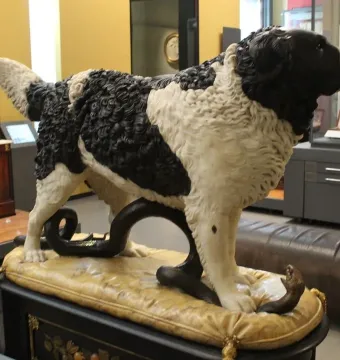
February 2024 © 14GTR · CC0
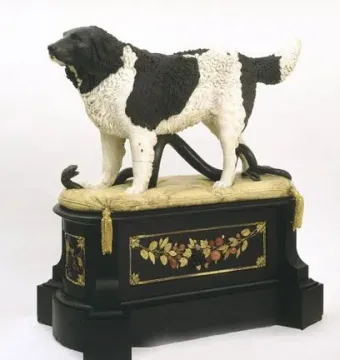
© VAwebteam · CC BY-SA 3.0
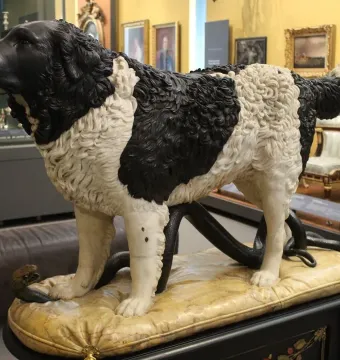
February 2024 © 14GTR · CC0
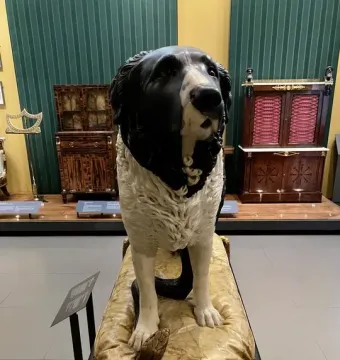
September 2022 © No Swan So Fine · CC BY-SA 4.0
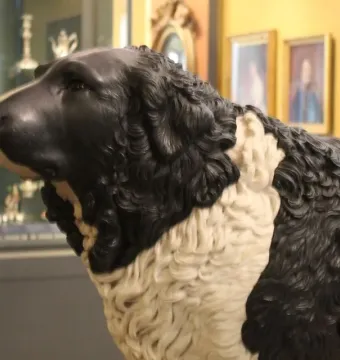
February 2024 © 14GTR · CC0
Identification | |
| Title | Bashaw |
| Type | statue |
| Subject | the dog Bashaw, a black-and-white Newfoundland |
Historical context | |
| Commissioned by | John Ward, 4th Viscount Dudley and Ward |
| Commission date | 1831 |
| Intended location | Dudley House, London |
| Completion status | unfinished at Lord Dudley's death in 1833; Wyatt spent another year finishing it after the heirs declined to buy it |
Creator | |
| Sculptor | Matthew Cotes Wyatt |
| Artist's background | son of the architect James Wyatt; painter and designer as well as sculptor |
Discovery and provenance | |
| Auction history | attempted sale at Christie's in 1887 by James Wyatt, then sold to John Corbett of Impney Hall, Droitwich, Worcestershire; later sold to Edward Stevens of Prescott House, Stourbridge in 1906; resold in 1957; purchased by the Victoria and Albert Museum in 1960 for £200 |
| Ownership after commission | remained in Wyatt's possession until his death in 1862 |
| Later provenance | after Wyatt's death, it passed to his son James |
| Posed for by the subject | more than 50 times during the first two years of work |
Physical characteristics | |
| Scale | life-size |
| Depiction | a placid Newfoundland dog standing on a cushion with its right front paw pressing down on a snake, gaze directed upward and to the side |
| Base | an elaborately shaped pedestal with leaf and fruit appliqués |
Materials | |
| Cushion | marble edged with gold-plated bronze |
| Original decoration | originally set with gems |
| Pedestal decoration | stone and gold-plated bronze appliqués |
| Snake | bronze |
| Snake eyes | ruby |
| Dog eyes | topaz, sardonyx, and black lava |
| Main materials | black and white marble; bronze; gold-plated bronze; topaz; sardonyx; black lava; ruby |
Appearance | |
| Fur treatment | the coat was to be made of naturally colored fur |
| Dog color | black and white |
| Snake type | probably a cobra |
| Pose interpretation | the placid dog contrasts with the coiled energy of the snake |
Iconography and meaning | |
| Title reference | the title refers to the bronze cobra beneath the dog's feet |
| Exhibition title | The Faithful Friend to Man Trampling Underfoot his Most Insidious Enemy |
Location and ownership | |
| Current location | Victoria and Albert Museum, London |
History and restoration | |
| Exhibited at | The Great Exhibition in 1851 |
| Exhibition role | centrepiece of an exhibition of Wyatt's works in 1834 |
| Exhibition result | unsold at the Great Exhibition; later unsold at the 1887 Christie's sale |
Significance | |
| Rarity | described as unique among nineteenth-century dogs' portraits |
| Catalogue description | described as "the most elaborate [portrayal] of a quadruped ever produced by ancient or modern art" |
| Base significance | the elaborate base reflects Wyatt's abilities in decorative arts |
| Dog portrait tradition | dog portraits were occasionally painted in the nineteenth century, but this sculpted work was exceptional |