
Statue of Giovanni delle Bande Nere
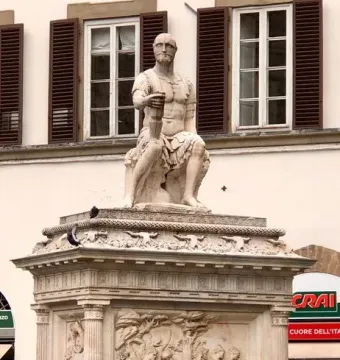
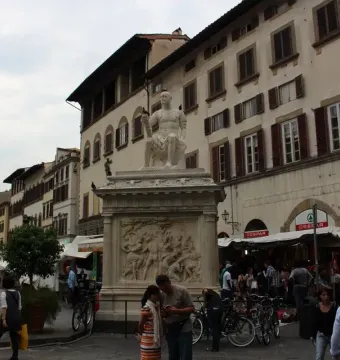
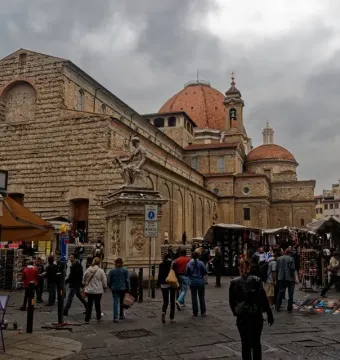
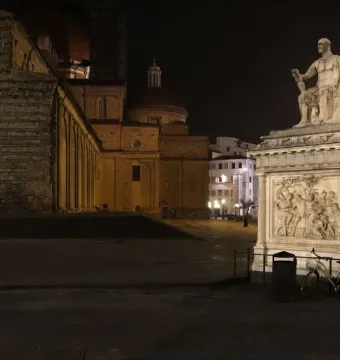
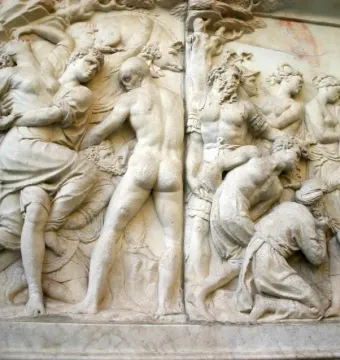
The Statue of Giovanni delle Bande Nere is an Italian Renaissance marble sculpture by Baccio Bandinelli and his workshop. It stands in Piazza San Lorenzo in Florence, Tuscany, Italy. Work on the monument began in 1540 and continued until after 1560. Although the base and statue were always intended to be together, they were not placed together until 1850. Giovanni is shown seated somewhat uncomfortably, wearing a metallic cuirass and holding a baton of command on his knee, without a helmet or army boots. The plinth is richly decorated with festoons, bucranium, Doric columns, and bas-reliefs, including scenes of soldiers bringing booty and captives before a ruler and the Medici coat of arms.
April 2019 © Marie Thérèse Hébert & Jean Robert Thibault · CC BY-SA 2.0
© tiger rus · CC BY 3.0
April 2010 © Txllxt TxllxT · CC BY-SA 4.0
March 2020 © Francesco Bini · CC BY-SA 4.0
© G.dallorto · Attribution
Identification | |
| Title | Monument to Giovanni delle Bande Nere |
| Type | Monument / statue |
| Subject | Giovanni delle Bande Nere (1498–1526), Medici condottiero and father of Cosimo I de' Medici |
| Alternative title | Monumento a Giovanni delle Bande Nere |
Historical context | |
| Original intended location | Inside the Neroni Chapel in the Basilica of San Lorenzo, Florence |
| Design presented | Presented to the duke in 1540 |
| Contract terms | A statue of the condottiero and two reliefs in the pedestal, to be completed within two years |
| Purpose of commission | To commemorate Giovanni delle Bande Nere |
| Commissioned by | Cosimo I de' Medici |
| Commission date | 1540 |
Creator | |
| Sculptor | Baccio Bandinelli and his workshop |
| Scholarship attribution | Baccio Bandinelli |
| Work period | 1540 to after 1560 |
Discovery and provenance | |
| Completion status at artist's death | The ensemble was still far from complete when Bandinelli died in 1560; the bas-reliefs remained unfinished |
| Initial installation | Placed in the Sala Grande of Palazzo Vecchio in 1592 |
| Base history | The pedestal remained for a long time in the Neroni Chapel in the Basilica of San Lorenzo, then was moved to the Piazza in 1620 by order of Cosimo II de' Medici |
| Later installation | The statue, kept in Palazzo Vecchio, was placed on the pedestal in 1850 under the direction of engineer Alessandro Manetti |
| Relocation in Piazza San Lorenzo | Moved closer to the church steps in 1939 during the rearrangement of Piazza San Lorenzo |
History and restoration | |
| Controversy | From the start, the statue was controversial because it was debated whether an armed soldier should serve as a monument in a church, and whether it was appropriate to depict Giovanni seated |
| Fountain conversion | In 1812 Giuseppe Del Rosso transformed the pedestal into a fountain for public utility, allowing people to water animals there |
| Restoration history | A first undocumented restoration, probably in the 1960s, followed by another worksite opened in 1995; a further restoration of the whole monument began in 2012 |
Physical characteristics | |
| Pose | Seated, somewhat uncomfortably |
| Object held | A command staff or baton of command resting on his knee; also interpreted as a broken spear or the projectile that killed him |
| Pedestal shape | Almost cubic |
| Basin | Large ellipsoidal marble basin |
| Clothing and armor | Wearing a metallic cuirass / Roman-style lorica musculata over his torso, without a helmet or army boots |
Materials | |
| Main material | Marble, including white Carrara marble |
| Fountain basin material | Carrara marble |
| Pedestal and basin material | Carrara marble |
Appearance | |
| Inscriptions and names | The pedestal was commonly called the 'Base of San Lorenzo'; a 19th-century plaque refers to it by that name and says the monument was restored in 1850 to host the statue |
| Relief subject | Soldiers bringing prisoners and booty to their captain; coats of arms and Medici emblems on the short sides |
| Symbolic reference | The lion head alludes to the Florentine marzocco |
| Fountain details | A white Carrara marble lion head from which water flows |
| Pedestal decoration | Doric columns at the corners, a heavy cornice, and an upper molding with bucrania, garlands, a twisted torus, and a Greek-key plinth |
Location and ownership | |
| Current location | Piazza San Lorenzo, Florence, Tuscany, Italy |
| Associated site | San Lorenzo |
Significance | |
| Purpose of decorative program | According to Bandinelli, the pedestal decoration was conceived as a base for the statue |
Other | |
| Nickname | Gran Capitano Ebbe |