
Ángel Custodio
Ángel Custodio is a monumental sculpture by Enrique Carbajal "Sebastián" located in Puebla de Zaragoza. It was inaugurated on November 7, 2003, during the municipal administration of Luis Eduardo Paredes Moctezuma. The sculpture stands 17 meters tall and is made of iron, finished in a yellow color from acrylic enamel with bronze. Although it has technical and sculptural relevance, it was widely criticized by specialists and residents for its appearance and for seeming out of place in a traditional neighborhood of Puebla. Over time, it has been compared to different forms, including a pair of fallopian tubes, crab pincers, and even a two-headed snake.
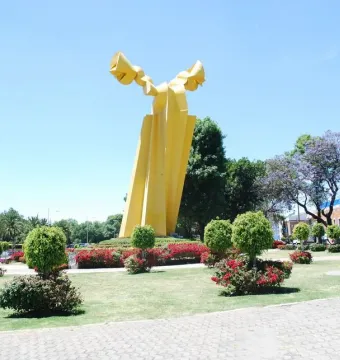
April 2016 © Thelmadatter · CC BY-SA 4.0
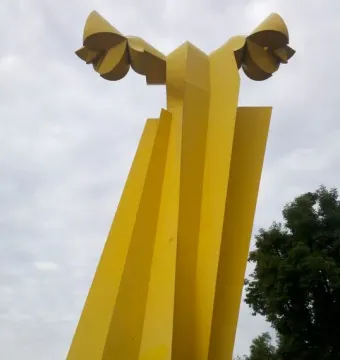
July 2014 © CUTI1 · CC BY-SA 3.0
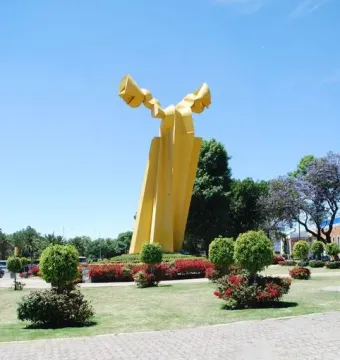
April 2016 © Thelmadatter · CC BY-SA 4.0
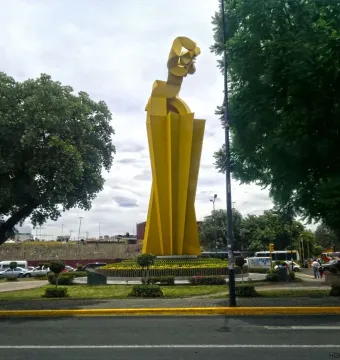
© AaLaNd Legram · CC BY-SA 3.0
May 2025 © El Pantera · CC BY-SA 4.0
Identification | |
| Title | Ángel Custodio |
| Type | monumental outdoor sculpture |
Creator | |
| Artist | Enrique Carbajal "Sebastián" |
Location and ownership | |
| Location | Analco neighborhood, Puebla, Puebla, Mexico |
| Associated landmark | Temple of Santo Ángel Custodio, Analco neighborhood |
Historical context | |
| Commission context | There was no prior public call or competition for the commission |
| Inauguration date | 7 November 2003 |
| Municipal administration at inauguration | Luis Eduardo Paredes Moctezuma |
| Planning note | In 2017, during planning for Line 3 of the Red Urbana de Transporte Articulado, relocation of the monument and others in the area was considered but later discarded |
| Local context at inauguration | Until 2003, Puebla did not have public sculptures of this size that also used unconventional forms and materials |
| Cost | 3 million pesos |
Physical characteristics | |
| Color | yellow |
| Height | 17 meters |
| Number of stars | 26 |
Materials | |
| Paint/finish | acrylic enamel with bronze |
| Stars material | Black marble |
| Material | iron |
Appearance | |
| Subject | An angel embracing the city of Puebla |
| Additional symbolism | A set of steps ending in 26 black marble stars |
| Style | Abstract |
| Materials and form note | The sculpture uses unconventional forms and materials |
Iconography and meaning | |
| Name origin | A tribute to the patron of the Temple of Santo Ángel Custodio in the Analco neighborhood |
| Possible interpretations | A winged victory; crab claws; a two-headed serpent |
| Artist interpretation | The figure of an angel emerges from an explosion of geometry, form, and color on a cosmic carpet where two stars collide; the forms reveal gears of Puebla's progress and wings with flowers that precede tomorrow's harvest |
Other | |
| Associated element | A chest-shaped time capsule was placed under the sculpture |
| Time capsule purpose | To be opened when the city turns 500 years old |
| Time capsule opening date | 2031 |
| Time capsule date | 2003 |
| Time capsule contents | Letters written by people from Puebla containing their hopes and wishes for the future |
Significance | |
| Municipal intention | To create an icon presenting the city with a contemporary spirit |
| Critical reception | Widely criticized by specialists and the people of Puebla for its appearance |
| Criticism nickname | "Monumento a las trompas de Falopio" ("monument to the fallopian tubes") |
| Criticism of civic identity | Some considered it inappropriate because it did not represent the "true spirit of the city" |
| Artists' criticism | Artists and specialists felt displaced because they were not considered for a sculpture of this magnitude |
| Religious criticism | Some criticized the work from a religious point of view and said the municipal government wanted to impose religious iconography |
| Technical evaluation | Despite criticism, it was considered to have relevance on a technical or plastic level |
| Contextual judgment | It was judged inappropriate for the traditional neighborhood of Puebla where it was placed |
| Survey result | It received the most votes in an online poll of the ugliest sculptures in Mexico |
Discovery and provenance | |
| Interpretation source | Roberto Martínez Garcilaso |