
Double Herm of Socrates and Seneca
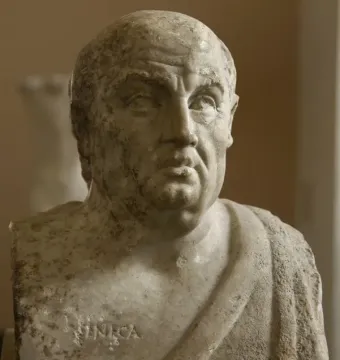
The Double Herm of Socrates and Seneca is a Roman double herm from the first half of the 3rd century, now in the Antikensammlung in Berlin. It was found in 1813 on the Caelian Hill in Rome, on the grounds of the Villa Mattei/Villa Celimontana near the church of Santa Maria in Domnica, and was acquired for the Berlin museums in 1878. The sculpture is especially important because it preserves the only securely identified portrait of Seneca. Socrates is identified by a Greek inscription, while Seneca is named in a Latin inscription. Both busts are joined at the back, with herm-shaped torsos. Socrates appears bearded and satyr-like, while Seneca is shown clean-shaven with a receding hairline and a furrowed brow.
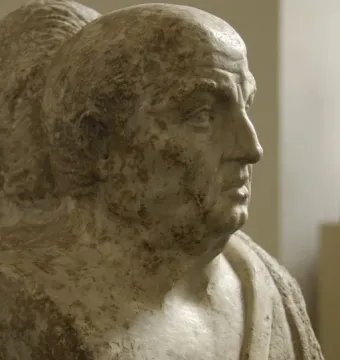
2008 © Sergey Sosnovskiy · CC BY-SA 4.0
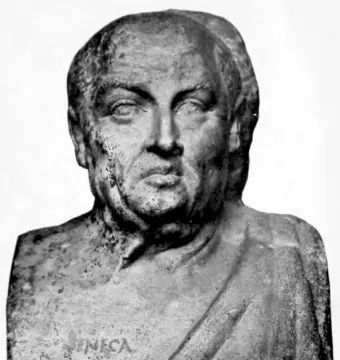
1907 © Frank Justus Miller / Lucius Annaeus Seneca · Public domain
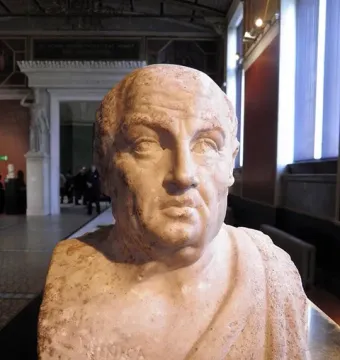
October 2012 © Carole Raddato · CC BY-SA 2.0
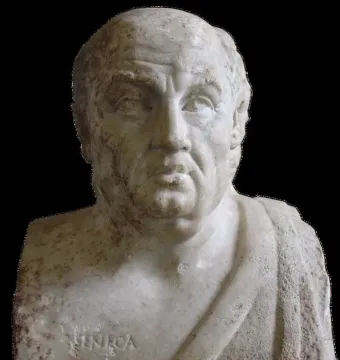
January 2019 © Alvaro Marques Hijazo · CC0
May 2008 © Sergey Sosnovskiy · CC BY-SA 2.0
Identification | |
| Title | Double Herm of Socrates and Seneca |
| Type | Roman double herm |
| Depicted figures | Socrates and Seneca the Younger |
Historical context | |
| Date | First half of the 3rd century AD |
Discovery and provenance | |
| Discovery date | 1813 |
| Discovery place | Caelius, Rome, on the grounds of Villa Mattei / Villa Celimontana near the church of S. Maria in Domnica |
| Acquired by Berlin museums | 1878, by Wolfgang Helbig |
Location and ownership | |
| Current location | Antikensammlung Berlin, Altes Museum, Lustgarten, Berlin |
| Former display location | Pergamon Museum until the reunification and reorganization of the two Berlin collections after German reunification |
Physical characteristics | |
| Composition | The two philosophers are joined at the back of the head, and their chests are cut in herm-like form |
Materials | |
| Material | Not stated in the input |
Appearance | |
| Clothing | Both figures wear a philosopher's or rhetorician's cloak over the left shoulder; Socrates also wears an undergarment |
| Socrates depiction | Bearded and rendered in a satyr-like form |
| Seneca depiction | Shaven, with a receding hairline, wide-open eyes, raised brows, and a small full-lipped mouth set deep in the face |
Iconography and meaning | |
| Socrates identification | Identified by a Greek inscription; the identification is considered secure and supported by comparison with other portraits of Socrates |
| Seneca identification | Identified by a Latin inscription on the side of the bust; this is the only securely identified likeness of Seneca |
| Seneca portrait use | Used today to identify other portraits and statues of Seneca |
| Pairing interpretation | The pairing likely reflected the patron's personal preference; the reason is otherwise unclear, though it may be connected with both philosophers' deaths by poison |
| Genre context | Double herms were a common ancient art form, especially for philosophers and poets; in Greece they were displayed in public spaces, and in the Roman Empire in private spaces |
| Literary parallel | A similar oppositional presentation appears in Plutarch's Parallel Lives |
Significance | |
| Art historical importance | Especially important for scholarship because it preserves the only securely identified likeness of Seneca |