
Maraş lion
The Maraş lion is a Late Hittite basalt sculpture of a lion with a hieroglyphic inscription. It was discovered on the citadel of Kahramanmaraş, formerly Maraş, in 1883 and is now displayed in the Kahramanmaraş Archaeological Museum. The sculpture is in very good condition and measures 0.41 metres high, 0.73 m long, and 0.23 m wide. Its head and front legs are carved in the round, while other surfaces are left unworked, probably because they were not visible in its original setting. The inscription names Halparuntiyas III of Gurgum and suggests a date at the end of the 9th century BC.
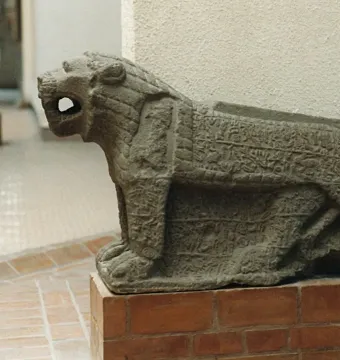
September 1991 © Klaus-Peter Simon · CC BY-SA 3.0
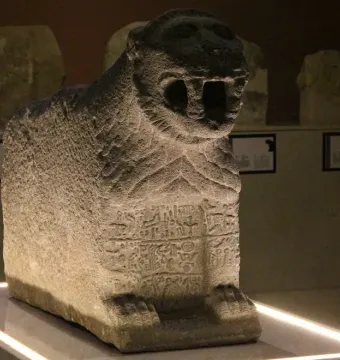
September 2014 © Klaus-Peter Simon · CC BY-SA 3.0
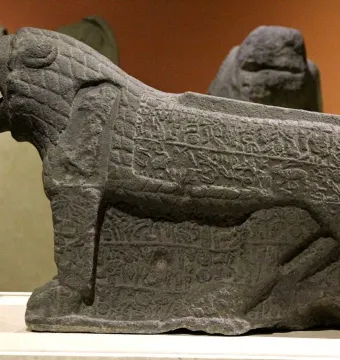
September 2014 © Klaus-Peter Simon · CC BY-SA 3.0
Identification | |
| Title | Maraş lion |
| Type | Late Hittite lion sculpture |
| Subject | Lion |
| Alternative names | Maraş 1; Maraş B/1 |
Historical context | |
| Art historical context | Massive lion sculptures are a recurrent feature of Hittite art, especially in the Neo-Hittite period |
| Political context | Neo-Hittite kingdom of Gurgum |
| Capital of kingdom | Kahramanmaraş |
Creator | |
| Attributed ruler | Halparuntiyas III |
Discovery and provenance | |
| Original museum location | Archaeological Museum in Istanbul |
| Related second lion | A second, slightly larger uninscribed lion was left in situ by a gate of the fortress |
| Replica cast | A plaster cast was made for the Berlin Museums |
| Discovery date | 1883 |
| Discovery context | Found during their Anatolia journey |
| Discovery location | Castle/citadel of Marʿasch (present-day Kahramanmaraş), Anatolia |
| Discovered by | Carl Humann and Otto Puchstein |
Materials | |
| Material | Basalt |
Physical characteristics | |
| Dimensions | Height 0.41 m; length 0.73 m; width/thickness 0.23–0.25 m |
| Condition | Very good condition |
Technique | |
| Hypothesized function of back platform | Hawkins suggested it served as a pedestal for a statue |
| Back surface | A smooth flat surface continues into a platform on the back up to the neck |
| Carving technique | Head and front legs fully carved in the round; left side in high relief on the inscribed plaque between the feet and body; right side, back, left hindquarters, and tail unworked |
Appearance | |
| Head | Round head with Assyrian influence |
| Facial features | Eyes, nose, and ears are clearly visible |
| Mouth | Open mouth with a row of teeth and large fangs touching each other |
| Mane | Stylized mane extends to the shoulders and halfway down the front legs |
| Body details | Diamond-shaped tufts are visible on the belly/chest |
| Paws | Toes and claws are clearly worked on the front paws and visible on the hind legs |
| Damaged figure in mane | A badly damaged standing man on an animal, probably a lion, appears in a recessed area above the left front leg within the mane |
Iconography and meaning | |
| Possible significance of depiction | The ruler standing on a lion may indicate posthumous divinisation |
| Interpretation of damaged figure | It may represent the author of the text; Hawkins interpreted it as the introductory amu-figure, with amu as the Luwian hieroglyphic EGO symbol meaning 'I' |
Inscription | |
| Inscription extent | A six-line hieroglyphic text begins next to the figure, runs to the tail, and continues in boustrophedon form over the body, legs, and the space between them |
| Inscription break | The text breaks off between the front feet at the beginning of a seventh line |
| Possible continuation of inscription | It is suspected to have continued on another surface, either on a statue standing on the lion's back or on a second portal lion |
| Inscription content | Halparuntiyas, king of Gurgum, son of Laramas, grandson of Halparuntiyas, and great-grandson of Muwatalli; he declares loyalty to the gods, especially Tarhunza and Runtiya, veneration of his ancestors, and his deeds |
| Presence of inscription | Hieroglyphic inscription |
Location and ownership | |
| Current location | Kahramanmaraş Archaeological Museum |
History and restoration | |
| Transfer to Turkey | Transferred on 30 August 2013 by decision of the Ministry of Culture and Tourism |
Significance | |
| Scholarly discussion | Discussed by numerous scholars, including Ekrem Akurgal, Helmuth Theodor Bossert, John David Hawkins, and Winfried Orthmann |
| Historical identification | The ruler in the inscription was identified as Halparuntiyas III |
| Dating | Probably made in or after Halparuntiyas III's reign, at the end of the 9th century BC |