
Cancelleria Reliefs
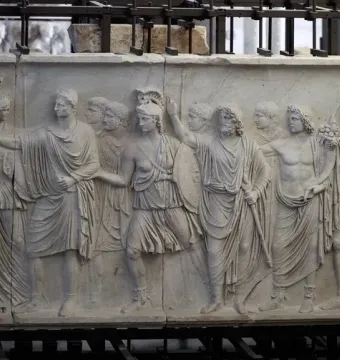
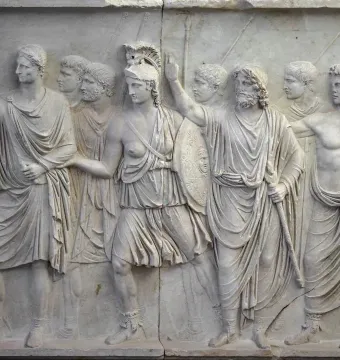
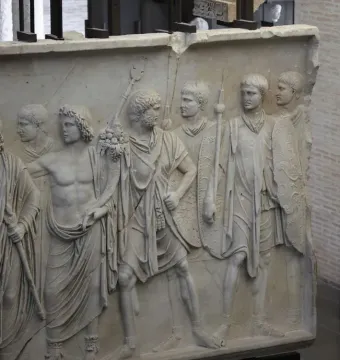
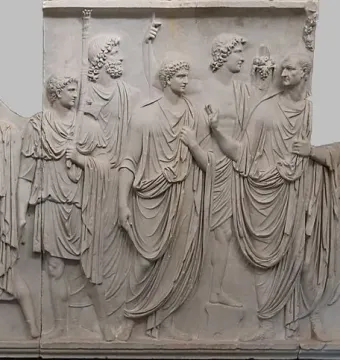
The Cancelleria Reliefs are marble relief panels from the last two decades of the 1st century. They were discovered between 1937 and 1939 during restoration work beneath the Palazzo della Cancelleria in Rome, where they had partly leaned against a wall that had once enclosed the tomb of Aulus Hirtius. The panels are divided into two separate relief ensembles, commonly called Frieze A and Frieze B. Both are 2.06 meters high; Frieze A measures 5.08 meters in length and Frieze B 6.08 meters. Their original setting, the identification of the figures, and the meaning of the scenes remain debated. The reliefs are generally linked to events from the reign of Domitian, and later alterations appear to have replaced his portrait with that of Nerva on Frieze A. They are now displayed in the Museo Gregoriano Profano in the Vatican Museums.
November 2024 © Fabrizio Garrisi · CC0
November 2024 © Fabrizio Garrisi · CC0
November 2024 © Fabrizio Garrisi · CC0
November 2018 © Rabax63 · CC BY-SA 4.0
November 2024 © Fabrizio Garrisi · CC0
Identification | |
| Title | Cancelleria Reliefs |
| Panel names | Fries A and Fries B |
| Alternative names | Fries A; Fries B |
| Number of panels | Two |
| Type | Set of two incomplete marble reliefs |
Creator | |
| Commissioned by | Believed to have been commissioned by the Roman Emperor Domitian |
| Commission date | 81–96 AD, during Domitian's reign |
| Artist | Unknown; it is believed the entire work was executed by the same sculptor |
Discovery and provenance | |
| Original provenance | Removed from an unknown building and stored away |
| Original intended building | Unknown |
| Original building location | Unknown |
| Other proposed original locations | The Templum Divorum, multiple arches erected under Domitian and later torn down after his death, the grounds of the Domus Aurea, an arch near the Temple of Fortuna Redux, or the area of the Villa publica |
| Original find condition | Some slabs were partly leaning against a wall that had enclosed the burial place of Aulus Hirtius |
| Discovery date | Between 1937 and 1939 |
| Discovery condition | Found incomplete |
| Proposed original location | Most likely one of the numerous buildings erected under Domitian |
| Discovery context | Found during restoration work |
| Discovery location | Under the Palazzo della Cancelleria in Rome |
Physical characteristics | |
| Height | 2.06 m |
| Length of Fries A | 5.08 m |
| Length of Fries B | 6.08 m |
| Fries A original length | Exact original length is difficult to assess because part of the left end is missing |
| Fries B width | Thought to have spanned nearly 597 cm |
| Fries B condition | Contains various broken panels; the upper half is partly severely damaged |
| Composition | Consists of two separate relief ensembles made of several marble slabs |
| Figural style | The figures are rendered two-dimensionally, with some parts suggested flatly in the background and others raised plastically in the foreground |
| Fries A condition | Survived relatively intact, but is missing part of the left end |
Materials | |
| Material | Marble |
Technique | |
| Technique | Relief carving; some figures and portraits were later recarved |
Historical context | |
| Founding of dynasty | Founded by Vespasian in 69 AD |
| Stylistic dating issue | The style makes precise dating difficult; it appears to have been carved in the Classical style of the Augustan period, unlike the more mannered style of securely dated reliefs from the Arch of Titus |
| Historical function | Thought to have been part of a propaganda effort to legitimize Flavian rule |
| Historical period depicted | Events relevant to the Principate of Domitian (AD 81–96) |
| Dynasty depicted | Flavian dynasty |
| Earliest probable date of creation | At least 83 AD |
| Date | Last two decades of the 1st century AD; probably reworked at the end of the 1st century AD |
| Subject | Events from the life of Domitian and the history of the Flavian dynasty |
Appearance | |
| Fries B alternative identified emperor | The emperor on Fries B may instead be Domitian rather than Vespasian |
| Movement and mood | The foreground is restless and dynamic, while the background figures are more orderly |
| Religious and civic figures | Minerva, Mars, Virtus, the Genius Senatus, the Genius Populi Romani, the Vestal Virgins, and Roma |
| Fries B composition | An emperor in a toga stands on the left, touching the shoulder of a togatus on the right; nearby are lictors, the Genii of the Senate and the Roman People, a fragmentary flying Victoria, Vestal Virgins, and Roma |
| Fries B subject | A scene of Vespasian's reconciliation with Domitian after the civil war of 69 |
| Fries A missing element | The lost left slab originally showed a flying Victoria and an advancing lictor |
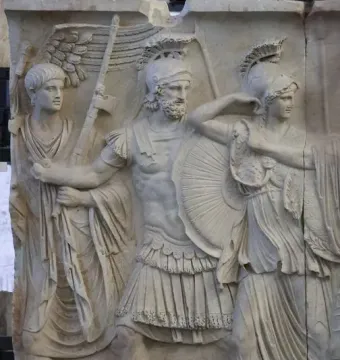
| Fries A composition | A stoic emperor stands in the foreground in travel clothes with his right arm raised; Minerva, Mars, and a lictor advance ahead of him; Virtus stands behind him, supporting his left forearm; the Genii of the Roman Senate and the Roman People follow, along with soldiers |
| Fries A subject | Domitian preparing to depart for a campaign against the Chatti |
Iconography and meaning | |
| Other reworking interpretation | According to Marianne Bergmann, the portrait of Vespasian on Fries B was also transformed from an original head of Domitian |
| Damnatio memoriae | After Domitian's assassination on 18 September 96, the Senate condemned his memory and ordered his name erased from public records and his statues and arches destroyed |
| Interpretive status | The content, identification of figures, original location, and overall interpretation remain controversial in modern research |
| Historical subject uncertainty | The exact campaign of Domitian cannot be specified because he held several triumphal processions |
| Minority hypothesis | Some scholars have proposed that both relief ensembles originally showed Nero and were later reworked again |
| Baumer's interpretation | Baumer argues that the reliefs show two temporal levels; on Fries A the foreground episode is in the past and the background column represents the actual triumphal procession inside Rome, while on Fries B the foreground shows Domitian conducting the census outside the pomerium and the background indicates the ensuing lustrum |
| Nerva portrait reworking | Domitian's imperial portrait on Fries A was reworked into Nerva's after Domitian's damnatio memoriae; Nerva's head is out of proportion to the body, suggesting it was carved from an earlier Domitian model |
| Fries B interpretation | The composition suggests that Domitian assures Vespasian that Rome has been governed well in his absence and that their relations are good |
| Emperor's depicted qualities | The princeps is shown as calm and composed, demonstrating bravery and modestia toward the gods and toward the Senate and People of Rome |
| Baumer's broader conclusion about Domitian | The reliefs are meant to present Domitian as an exemplum of virtus and modestia |
| Modern scholarly tendency | Modern research largely favors an adventus interpretation for Fries A and Baumer's census-and-lustrum interpretation for Fries B |
| Main interpretation | The reliefs are variously interpreted as a departure from Rome for war (profectio), a return from war (adventus), a census followed by a lustrum on the Campus Martius, the foundation stone laying for the new Capitoline Temple in 70, the appointment of the Sodales Flaviales Titiales, or the dedication of the Temple of Fortuna Redux in 93 |
Location and ownership | |
| Current location | Museo Gregoriano Profano, Vatican Museums, Rome |
| Name origin | Named after the place where they were found |
Other | |
| Researcher mentioned | Marianne Bergmann |
| Scholar | Brian Jones |
| Scholar | Lorenz E. Baumer |