
Terracotta Vase in the Shape of a Cockerel
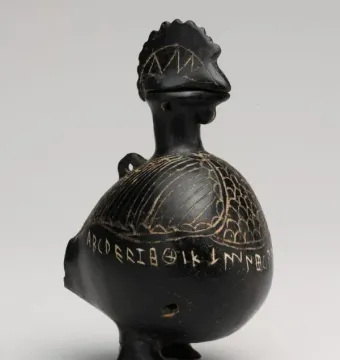
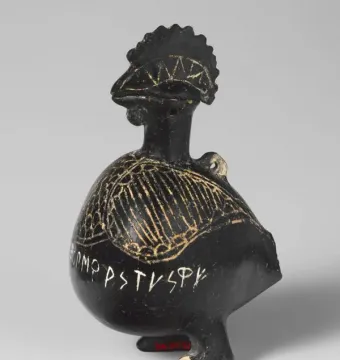
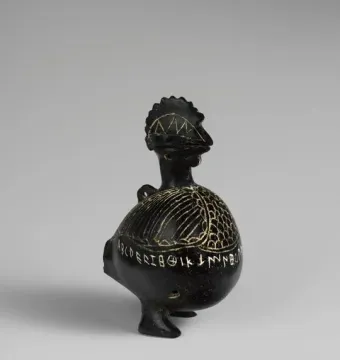
Terracotta vase in the shape of a cockerel is an Etruscan artifact from the late 7th century BCE, now in the Metropolitan Museum of Art in New York. Made of fired black clay, or bucchero, it was probably used as a container for ink. The vessel is engraved with an early Etruscan alphabet. It is an early example of Etruscan bucchero pottery and of alphabetic inscriptions on such ceramics. The object also reflects the ritual, decorative, and status-related roles of writing and bucchero wares in Etruscan culture.
© Unknown authorUnknown author Photographer: Metmuseum CC0 · CC0
© Unknown authorUnknown author · CC0
· CC0
© Unknown authorUnknown author · CC0
© Unknown authorUnknown author · Public domain
Identification | |
| Title | Terracotta vase in the shape of a cockerel |
| Alternative name | The Cockerel of Viterbo |
| Type | Etruscan bucchero vessel; abecedarium |
| Culture | Etruscan |
Historical context | |
| Date | Late 7th century BC; more specifically c. 630–620 BC |
| Bucchero production period | Mid-7th century BC to early 4th century BC |
Creator | |
| Craftsmanship | Produced through a complex, labor-intensive process requiring a high level of skill |
Discovery and provenance | |
| Probable origin | Probably from the vicinity of Viterbo in Latium |
| Discovery location | Probably found near Viterbo in Lazio |
| Acquisition date | 1924 |
Location and ownership | |
| Inventory numbers | CIE 10494; ET AT 9.1 |
| Current location | Metropolitan Museum of Art, New York |
| Inventory number | 24.97.21a, b |
| Current owner | Metropolitan Museum of Art |
Physical characteristics | |
| Height | 10.3 cm |
| Length | 5.3 cm |
| Form | Vase in the shape of a cockerel |
| Condition | The rear part of the figure is broken off and has not yet been found; the front part of the left foot is missing |
| Lid | The head is detachable at the level of the beak and probably served as a stopper |
Materials | |
| Material | Bucchero (fired black clay / terracotta) |
| Type of ceramic | Bucchero |
| Color | Black, glossy or matte sheen |
Technique | |
| Surface decoration | Feather pattern and alphabet incised after firing |
| Cause of black color | Black color was produced by limiting oxygen during firing |
| Firing technique | Reduction firing |
Appearance | |
| Graphical classification of inscription | By its graphic features, the inscription belongs to the third group distinguished among 7th-century BCE inscriptions from Caere |
| Decoration | Engraved feather pattern and alphabet inscription |
| Unused letters | B, D, and O were not used because Etruscan lacked the corresponding sounds; the window-shaped sign corresponding to Phoenician samekh and Greek xi was also not used |
| Scribal error | The letter s appears twice, at positions 21 and 24; position 24 probably should have ṡ |
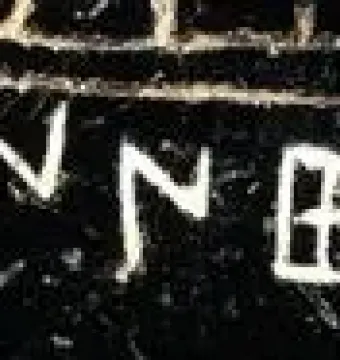
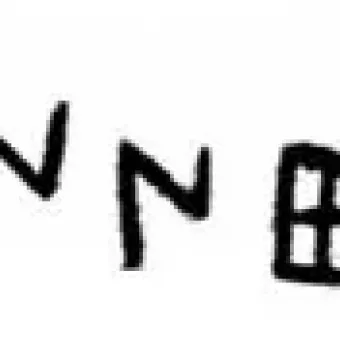
| Graphic features | Crescent-shaped c; theta with a straight crossbar; elongated downward m and n with a vertical first stroke; u and chi formed by one vertical stroke with one or two attached oblique strokes; p with a curved upper stroke instead of an oblique one |
| Inscription direction | Left to right |
| Alphabet represented | West Greek alphabet |
| Writing direction | Left to right |
| Letter height | About 0.5 cm |
| Number of letters | 26 |
| Inscription | Early Etruscan alphabet engraved on the vessel as an abecedarium |
Iconography and meaning | |
| Function | Probably used to store liquid, especially ink; possibly also a decorative drinking vessel or prestige object associated with elites |
| Interpretation of inscription | The inscription likely helped with memorization, demonstrated the owner's literacy, and may have had a sacred or magical function |
| Symbolic meaning | Writing the letters was considered a ritual |
| Cultural transmission | The alphabet was adopted by the Etruscans from Greek settlers in Campania in the 7th century BC |
Significance | |
| Historical significance | An early example of Etruscan pottery with alphabet writing and part of the tradition of abecedaries |
| Usage context | Bucchero pottery was a prestige product for wealthy elites rather than everyday ware |
| Comparative note | Many bucchero vessels imitated Greek forms and names; for example, the Etruscan culichna derives from Greek kylix |
| Related objects | Other early Etruscan abecedaries include an amphora from Formello, an alabastron from Cerveteri, and a bucchero inkpot from near Cerveteri |
Other | |
| Associated early alphabet example | One of the earliest known abecedaries was written right to left in mirrored letters and used the same letters as the cockerel vessel except for an orthographic error |
| Interpretive note | It is generally easier to memorize the beginning of an alphabet than the end |