
Trisomatos Typhon
Trisomatos Typhon is an ancient Greek sculpture in the typical style of the early Archaic period. It formed part of the west pediment of the Hecatompedon temple on the Acropolis of Athens and is now in the Acropolis Museum in Athens, Greece. The sculpture is made of limestone and is notable for the large amount of pigment that has survived on its surface. Its mythological identity is uncertain. Suggestions have included the sea god Nereus, the serpent monster Typhon, or the Tritopatores. If it represents Typhon, the red-clad figure beside it may be Zeus. The identification remains debated.
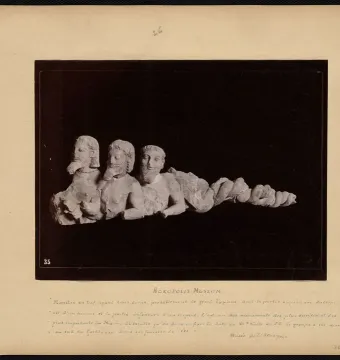
© Boston Public Library · Public domain
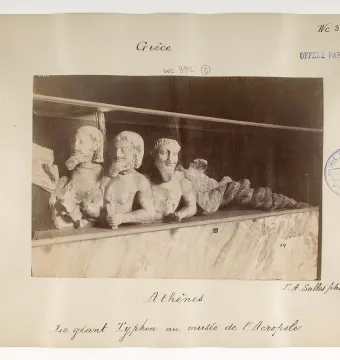
© Salles, André (1860-1929). Photographe. Donateur · Public domain
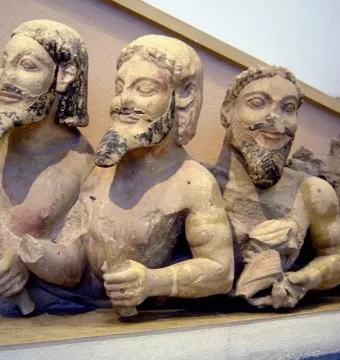
2006 · CC BY-SA 3.0
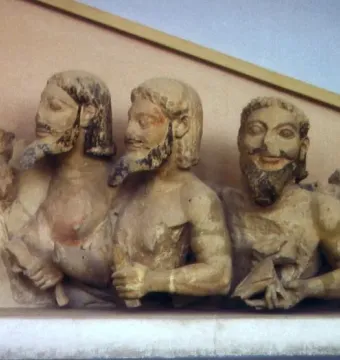
March 2019 © Zde · CC BY-SA 4.0
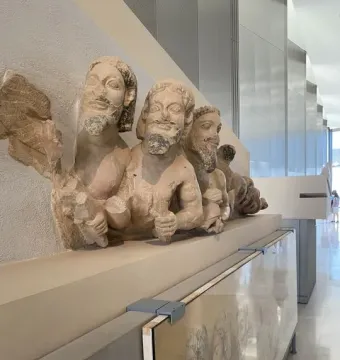
July 2022 © Melissopetra · CC BY-SA 4.0
Identification | |
| Title | Trisomatos Typhon |
| Alternative names | Demonio de tres cuerpos; Monstruo de tres cuerpos; The Three-Bodied Daemon; The Three-Bodied Monster |
| Type | Ancient Greek sculpture; part of a sculptural group |
Historical context | |
| Date | Around 570 BC |
| Period | Early Archaic period |
Creator | |
| Style | Typical early Archaic period style |
Discovery and provenance | |
| Discovery date of most fragments | 1888 |
| Discovery location of most fragments | East and southeast of the Parthenon |
| Associated groups in the same pediment | A group of Heracles fighting the sea-god Triton and a group of lions devouring a bull |
| Associated monument | The Hekatompedon pediments |
| Original placement | West pediment of the Hekatompedon temple on the Acropolis of Athens |
Location and ownership | |
| Current location | Acropolis Museum, Athens, Greece |
| Paint preservation | A large amount of colored pigment has survived on the limestone, with bright decoration still visible |
Materials | |
| Material | Limestone; porous limestone (porolithus) |
| Additional materials | Plaster; lead |
Physical characteristics | |
| Condition of added parts | The first two human heads were made in separate limestone pieces; the third head was similarly inserted, though it is uncertain whether it belongs to this body or another similar one |
| Preserved joins | Two holes on the right forearm of the middle body are certainly part of this group; the forearm of the Zeus figure was attached similarly but now has a smooth cross-sectional surface without lead-filled holes |
| Construction | Separate parts were inserted or attached to the main body rather than carved from a single block |
| Attachment details | Holes 6–7 millimeters wide were made to fix parts in place and preserve the lead; three holes in a line fastened the right wing |
| Preservation state | The upper part of the body was destroyed and filled with plaster |
| Dimensions | 3.35 m long; 79 cm high |
History and restoration | |
| Restoration | Most fragments were welded together and restored with plaster |
Appearance | |
| Depicted figure | Typhon is uncertainly identified; possible identifications include Nereus or the Tritopatores |
| Figure description | A large male figure with three naked bodies |
| Anatomical features | The three bodies are bearded and seem to share a single large tail |
| Associated figure | A red-clad figure to the right survives; if the subject is Typhon, it would be Zeus |
| Held objects | A lightning bolt, waves, and a bird |
| Body coloration | First body: red flesh, especially on the chest; brown areola; red-black hair and beard; black eyelids and eyebrows; red eyes with light green irises. Second body: reddish skin with color remaining on the chest and left half of the face; reddish-black beard; no trace of color on the hair; black eyelids and eyebrows; paint faded from the irises. Third body: no distinguishable color survives. Wing: dark blue on the upper part with incised lines below; the wings may originally have been alternately colored and uncolored, possibly with one row red and another black-green. Tail: a red band between two black-blue bands, with one section in the natural color of the stone |
Iconography and meaning | |
| Proposed symbolism of objects | Lightning bolt = fire; waves = water; bird = air |
| Tail symbolism | The long swirling tail symbolizes the earth, though no further conclusion can be reached |
| Interpretive notes | Furtwängler suggested the figure may represent the Tritopatores, based on the tri- prefix in their name; there is no evidence they were depicted as three bodies with a single tail and they were more likely shown as three separate beings |
| Identification dispute | The sculpture’s mythological character is unclear; Typhon identification is suggested by analogy with a red-figure vase, but this is disputed |
| Literary reference | Euripides’ Heracles describes Typhon as having three bodies |
Significance | |
| Stylistic note | The Hekatompedon pediments are considered excellent examples of colored ancient Greek sculpture that retained some or most of their painting over the centuries |